





This article was first published on The Bit Journal.
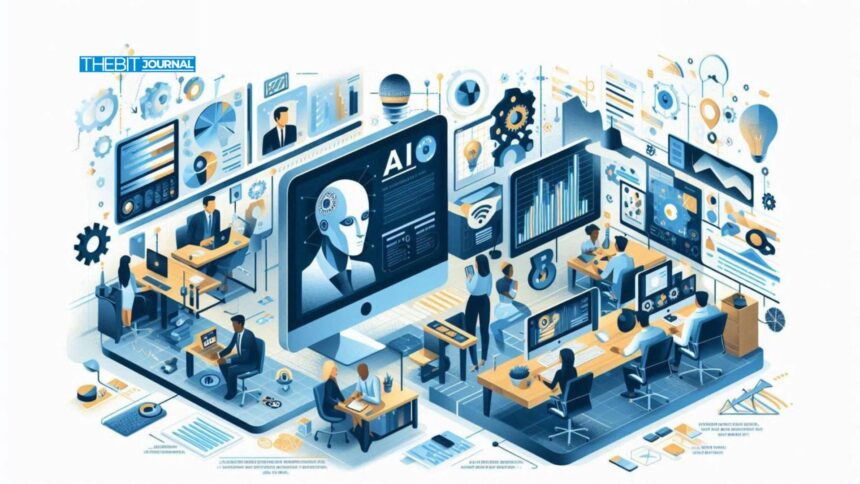
In the past few years, a surprising thing has happened in US workplaces: employees are deploying AI tools like ChatGPT and other generative models on the job in secret.
Surveys show nearly half of American workers are using AI at work without telling their managers. This underground AI-driven productivity has been called the “shadow productivity economy.”
According to experts, this is a big deal, happening in offices from California to New York and changes how work gets done. In short, AI has become an invisible coworker, churning out emails, summaries and code behind the scenes and fundamentally altering job workflows.
Widespread Covert AI Use: The Rise of the Shadow Productivity Economy
The shadow productivity economy is when employees use AI tools to get work done faster, often without official approval. Sources say many employees secretly use artificial intelligence tools to ease their workloads, meet deadlines and improve work quality.
For example, employees may ask ChatGPT to write emails, summarize reports or even code, all behind the scenes. This is more common than is thought of.
A Times of India report says 50% of US employees use AI at work without telling their managers. A Gusto HR survey found 45% of workers had used AI on the job without informing their boss. A global KPMG study (48,000 participants) found 58% of employees intentionally use AI at work and 57% admit to hiding their usage from employers.
In short, about half of workers are using AI in secret, creating a “shadow economy of productivity gains” that their employers may not even know they’re benefiting from.
| Study / Report (2025) | Scope | Key Findings on Secret AI Use |
| WalkMe AI Survey | 1,000 U.S. workers | 78% use unapproved AI tools; only 7.5% had formal training |
| Gusto Workplace Study | U.S. employees | 45% used AI at work without telling managers |
| KPMG (Business Insider) | Global (47 countries) | 58% use AI for work; 57% admit hiding their AI use |
| ProofHub Report | U.S. & global trends | Nearly 50% of U.S. employees use AI covertly, sparking a “shadow productivity economy” |
| WalkMe AI Survey | 1,000 U.S. workers | 49% hide AI use to avoid judgment; 45% pretend to know AI tools |
These surveys show AI is being used in secret. In one IBM survey (Nov 2025), 80% of US office workers said they use AI at work, but only 22% use company-approved tools.
In other words, 58% are going outside official channels. IBM also reports 97% of office workers feel AI increases productivity, which is why usage is so high.
A silent revolution seems to be happening as employees are using AI on their own terms, creating huge productivity gains but also new blind spots for employers.
Why Workers Hide Their AI Use
Several factors drive this shadow economy. Many employees don’t trust their bosses will approve of AI shortcuts. They worry using AI will be seen as “cheating,” lazy or even get them in trouble.
In industries like finance or tech, companies initially banned ChatGPT (e.g. JPMorgan, Apple), so workers using it risk backlash.
Others simply have no clear guidance, companies often have no AI policy so workers use AI quietly the only way they know how. Tight deadlines and heavy workloads also push employees to grab any efficiency tool.
In one survey, 80% of employees think AI increases productivity and 75% of IBM’s respondents saw AI as moderate-to-highly productive. But without permission, workers go “incognito” with AI.
In fact, a Google pilot program shows this tension.
Researchers found many employees felt they needed permission to use AI. Google’s Debbie Weinstein said workers wanted “permission to prompt” AI at work, only after managers gave explicit approval did employees fully adopt AI.
Before permission, employees often hid AI use out of uncertainty or fear. A WalkMe survey confirms this: 49% of workers admitted to hiding their AI use to avoid judgment and 45% pretended to know how to use AI tools rather than get judged.
Additionally, 51% of those surveyed said they got conflicting guidance on AI from their employer.
KPMG researchers point out another human factor: some employees are just plain excited by AI. As one researcher said, beyond fear of bans there is “a seductive element” to using AI that makes workers reluctant to give it up.
In essence, unclear rules, workplace pressure and the ease of work all combine to drive AI underground.
The result is a stealthy productivity surge, a shadow productivity economy that leaders are only just starting to recognize.
Unofficial Gains in Efficiency and Output
Although it’s not official, the shadow productivity economy delivers real results. Employees report big-time and output savings from AI. WalkMe’s data show 80% of workers think AI makes them more productive.
IBM’s survey found one-third of users estimate AI takes up to 6 hours a week off their workload.
Google’s pilot program found trained workers saved 122 hours a year on administrative tasks by using AI for scheduling, drafts and analysis.
Studies also show the upside. A McKinsey study cited by ProofHub found that agents using AI solved 15% more support tickets per hour. And Morgan Stanley estimates that widespread AI adoption could save US companies up to $920 billion annually in labor and efficiency gains.
In other words, when left unchecked, hidden AI is quietly driving huge productivity gains, gains companies are probably reaping without realizing it.
One analyst had earlier predicted, “89% of companies will use AI to boost productivity” by 2025.
Employees see the upside too. Gusto’s HR survey found 36% of workers already consider AI “essential” to their job.
And by building AI habits under the table, workers feel more capable. WalkMe’s CEO warns that if nearly 80% of staff are using shadow AI, companies are missing a massive opportunity to “strategically empower their people”.
The shadow economy shows a clear demand: today’s employees want AI as a collaborator. The challenge is to capture those gains officially, before data leaks or errors outweigh the benefits.
Risks, Compliance, and Governance Gaps
The shadow AI boom also creates big risks. When employees use unsanctioned AI apps, sensitive data can leak or be misused.
For example, many workers reportedly admit uploading confidential information to public AI services, a serious compliance risk in regulated industries.
KPMG’s Sam Gloede says such opaque AI use is really concerning because it leaves organizations exposed to significant risk, from data breaches to errors.
In one KPMG report, 66% of workers said they never checked AI outputs for accuracy, and 48% uploaded proprietary data, exactly the kind of unsafe behaviour hidden AI enables.
Executives worry about compliance and ethics. The Cogent Infotech blog summarizes the paradox:
“Employees see AI as essential for productivity, while leaders worry about risks such as compliance issues, data leaks and reputational harm”.
Some companies have resorted to bans or surveillance to catch shadow AI, but experts say this can backfire by eroding trust.
Indeed, experts believe that if AI was banned, employees would just hide their usage more deeply.
Instead, leaders are told to address governance openly.
Beyond data leaks, there’s a cultural risk. Hidden AI use can undermine transparency and collaboration.
If teams can’t share how they work openly, managers lose visibility of what’s going on. Worst case, the secretive environment can create mistrust.
WalkMe calls it a “governance crisis”, saying without clear frameworks, companies will waste innovation and amplify security gaps. In regulated industries like finance or healthcare, unsupervised AI use could even be illegal (e.g. HIPAA or SEC rules).
In summary, the shadow productivity economy highlights big governance and compliance issues to manage.
Expert Insight: Bridging the Shadow AI Gap
Industry leaders and analysts say companies should accept not ban this trend. The goal is to bring the shadow economy into the light.
Dan Adika, CEO of WalkMe, puts it bluntly:
“When 80% of employees are using shadow AI tools, organizations are not just losing money; they’re losing control.”
He says companies should empower their people by integrating AI into official workflows and policies.
Gina Smith of IDC says
“without training and guardrails, shadow AI creates risk and undermines ROI.”
Both say training and clear rules are the fix.
Google’s pilot results support this view. By simply telling workers it was okay to use AI, giving them “permission to prompt”, adoption skyrocketed with no harm. Debbie Weinstein of Google notes that after just a few hours of AI training, usage doubled and gains held over time.
IBM says companies need to find the balance between productivity and governance; provide easy-to-use, enterprise-grade AI tools and training and workers will move away from shadow solutions.
One way to do that is to make official AI platforms more attractive. IBM suggests investing in data infrastructure so in-house AI works as well as public tools.
Experts also point to policy clarity. Nearly 75% of employees say clear policies would help them use AI safely.
Companies are starting to act. For example, Microsoft and PwC (U.S.) have reportedly launched formal AI training and certification programs to demystify proper use.
A practical step is to audit AI usage patterns and then grant allowances for safe tools. As one expert says, helping employees understand why some data shouldn’t go into ChatGPT is key to preventing accidents.
In short, the shadow productivity economy can be a force for good if managed well. Experts recommend companies own this change; acknowledge employees want AI, set use guidelines, train and provide secure AI platforms. That way, companies can capture hidden productivity gains and minimize risk.
Conclusion
The shadow productivity economy seems to be here to stay. Multiple 2025 surveys show that nearly half of U.S. employees are already using AI tools at work without permission, and getting significant productivity boosts.
This silent AI revolution with apps on mobile phones, browsers and laptops is changing job roles and it’s exposing gaps in governance.
Experts agree that companies should respond by integrating AI into official policies. By giving workers approved AI tools, clear guidelines and training, not punishing them, companies can capture the productivity gains of the shadow economy and protect sensitive data.
In the end, it’s not whether AI is used as workers will always do so, but how companies manage this hidden energy.
The companies that recognize and manage the shadow productivity economy will get ahead, turning a stealth revolution into a structured innovation strategy.
Glossary
Shadow Productivity Economy: When employees use AI tools without approval or oversight to boost productivity.
Generative AI: Advanced AI models (e.g. ChatGPT, Claude) that can create text, code, images or content. Used for drafting emails, reports or code automatically.
Shadow AI: Unapproved AI applications within a company’s network. Like shadow IT, it’s when employees use AI without formal sanction.
Governance/Governance Crisis: Company policies and processes to ensure technology is safe and compliant. A governance crisis occurs when secret tech usage (like shadow AI) outpaces the company’s ability to monitor or control it.
Compliance: Adherence to laws and regulations (e.g. data privacy rules like HIPAA or GDPR).
FAQs About AI Shadow Productivity Economy
What is the “shadow productivity economy”?
The term describes the hidden world of AI use by employees to improve productivity. It arises when workers use AI tools (e.g. ChatGPT) unofficially without manager approval or official IT support; to get tasks done faster. It’s “shadow” because it operates behind the scenes, outside formal channels.
How common is secret AI use at work?
Very common. Recent surveys suggest roughly half of U.S. employees use AI secretly on the job. A 2025 Gusto survey found 45% of American workers had used AI at work without informing their boss. Another large study reported 57% of employees globally hide their AI use. Even an IBM survey found 80% of U.S. office workers use AI in their roles, often resorting to unsanctioned tools.
Why do employees hide their AI use?
The main reasons are unclear rules and fear of punishment. Many companies still have no clear AI policy, so employees don’t know if it’s allowed. Some worry managers will see AI use as cheating or replaceable. In short, without clear guidance, workers use AI covertly to avoid trouble.
What benefits does the shadow productivity economy bring?
Hidden AI use can significantly boost efficiency. Workers report substantial time savings. IBM found one-third save up to 6 hours per week using AI, and Google’s pilot saw 122 hours saved per year in admin work. Studies also show output increases: for example, AI-assisted agents can resolve 15% more tasks per hour .Overall, the shadow AI trend suggests employees are using AI to do routine tasks faster, potentially unlocking billions in productivity gains.
What risks does secret AI use pose?
Major risks involve data security and compliance. When employees use public AI tools unsupervised, proprietary or personal data can leak. KPMG reports many workers upload company secrets into AI without checks. This violates privacy laws and corporate policies. Hidden AI use also means companies may miss errors as most workers don’t verify AI outputs, leading to mistakes.
What should companies do about the shadow productivity economy?
Embrace and manage it. That means set clear AI policies (approved tools and uses) and train employees. Instead of banning AI, companies should provide secure, user-friendly AI platforms and explain safe usage (e.g. what data is off-limits). Companies like Microsoft and PwC have launched AI training programs for employees. By giving workers “permission to prompt” in a controlled way, employers can get the productivity gains without the risk.