





Institutional investors are gearing up for a seismic shift toward tokenized assets, expecting them to play a much larger role in global portfolios by the end of the decade, according to a new study by financial giant State Street.
The report released on Thursday predicts that 10 to 24 percent of institutional investments will be done on tokenized assets by 2030, a significant transformation in the process of capital allocations and management. It is anticipated that this transition will be led by the private equity and the private fixed income, which have long issues of illiquidity and high operating expenses.
Tokenized Assets Redefining the Financial Landscape

Joerg Ambrosius, President of Investment Services at State Street said that institutional investors are not experimenting anymore. Digital assets and tokenized assets have become growth, efficiency, and innovation drivers. The cross-section of tokenization, artificial intelligence and quantum computing is redefining the future of finance.
The paper identifies the initial significant adoption of tokenized assets by private markets, which is driven by the need to seek efficiency and liquidity. Digitization of ownership structures can enable the settling of these assets, decrease administrative overheads, and provide access to investment opportunities that were previously exclusive.
Our 2025 global research on #digitalassets and emerging technologies reveals a decisive shift in adoption and strategic commitment among institutional investors toward #tokenization and blockchain-enabled transformation. Read more: https://t.co/hzk1f3dZ1O pic.twitter.com/tULwI2Ke88
— State Street (@StateStreet) October 9, 2025
Emerging Technologies Outpace Blockchain in Impact
Although tokenization is on the rise, the study suggests that most investors consider other emerging technologies especially generative AI and quantum computing even more disruptive.
More than half of the respondents claimed these tools would cause more long-term impacts on operations than blockchain, but the majority anticipate that the technologies will integrate to modernize financial systems and improve the management of tokenized assets.
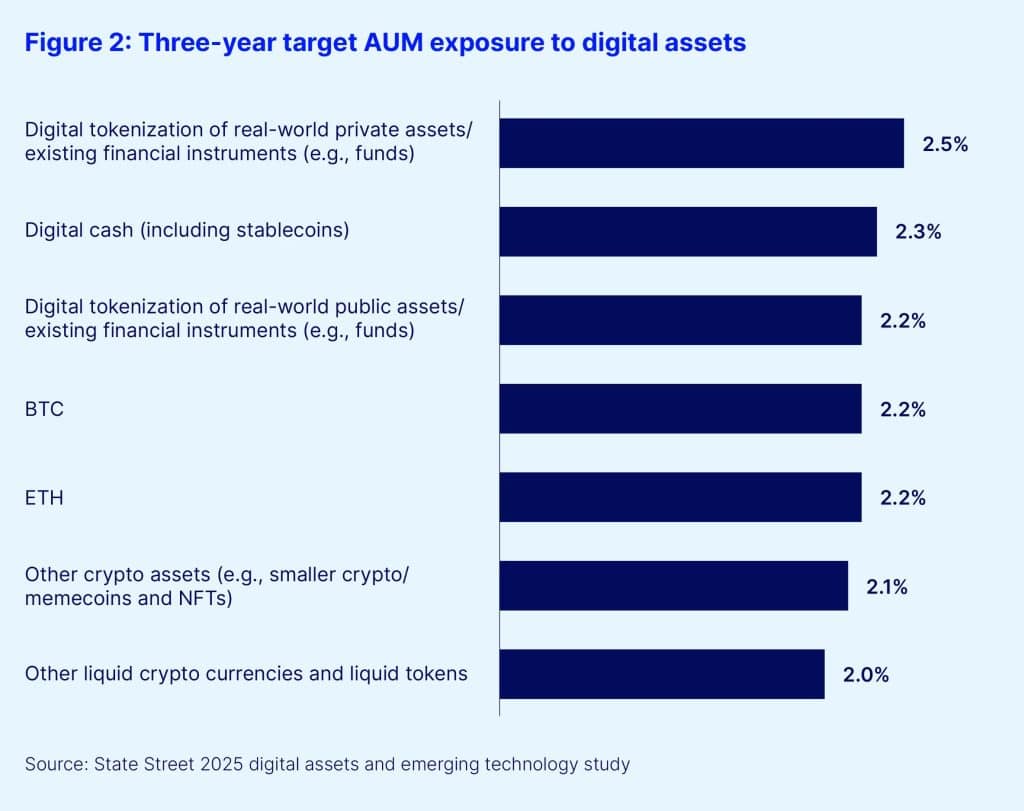
As of today, institutional portfolios have approximately 7 percent in digital and tokenized assets that are projected to increase to 16 percent in 3 years. A typical portfolio will consist of digital cash and tokenization of equities and fixed income instruments, with each holding about 1 percent of the portfolio.
Bitcoin, Ethereum Dominate Digital Asset Portfolios
Asset owners are engaging less than the asset managers, especially in crypto exposure. Approximately 14% of managers had portfolios of between 2 to 5% portfolios in Bitcoin, as opposed to 7% of asset holders.
A minor group also admitted as many as 5 percent of assets in Ethereum, meme coins or NFTs, which points to a more general risk tolerance among managers considering tokenized assets and digital instruments. Even though there is a rise in interest in tokenized assets, cryptocurrencies are the most popular returns generators among institutional investors.
The research determined that 27 percent of the respondents rated Bitcoin as their most successful investment, and 25 percent believed that it would remain their top investment in the next three years. Ether is close behind, followed by 21% that cited that ethereum is the reigning leader and 22% that it would continue to gain.
Also read: Bitcoin and Ethereum ETFs Record $4.5 Billion Inflows as Institutional Demand Surges
Institutional Investors Embrace Tokenization Momentum
In comparison, tokenized public and private assets are not yet major drivers of performance, at 13% and 10% of returns respectively a trend unlikely to transform in the near future. Nevertheless, the tokenized assets are generally regarded as possessing more potential in the long term as infrastructure and regulation evolve.
The results of the State Street support the opinion that tokenized assets are shifting to the center of institutional strategy. With the maturity of the blockchain infrastructure and increased trust in the investor, tokenized assets might open up trillions of dollars worth of illiquid assets in real estate and private credit that would reduce settlement time and cost.
Also read: Institutional Investment in Crypto: Wall Street’s Next Move
Conclusion
Based on the latest research, tokenized assets are rapidly moving from experimentation to mainstream adoption, signaling a structural transformation in global finance. The tokenization of illiquid assets would become accessible due to the maturity of blockchain infrastructure and the increased confidence of investors, defining the decade-to-come approach to institutional investment.
For more expert reviews and crypto insights, visit our dedicated platform for the latest news and predictions.
Follow us on Twitter and LinkedIn, and join our Telegram channel to be instantly informed about breaking news!
Summary
A new State Street study reveals that institutional investors expect tokenized assets to play a major role in global portfolios by 2030, with private markets leading the shift. Investments in the range of 10 percent to 24 percent may be tokenized, which is motivated by the expectation of more liquidity and efficiency. The report identifies an increased use of blockchain, AI, and quantum computing as some of the forces that are transforming institutional finance globally.
Glossary of Key Terms
Tokenized Assets: Digital versions of real-world assets on blockchain for faster, cheaper, and more liquid trading.
Institutional Investors: Large organizations like banks or funds managing major investments.
Private Markets: Non-public investments such as private equity or debt.
Private Equity: Direct investments in private companies or buyouts of public firms.
Digital Cash: Blockchain-based money used for fast and secure transactions.
Artificial Intelligence (AI): Technology simulating human intelligence to automate financial tasks.
Quantum Computing: Advanced computing technology that performs complex calculations rapidly.
NFTs: Unique digital assets representing ownership of items or art.
RWA Tokenization: Turning real-world assets like real estate into digital tokens.
Capital Markets: Markets connecting investors and capital seekers.
Frequently Asked Questions about tokenized assets
1. What are tokenized assets?
Digital versions of real assets on blockchain for easier, faster, and cheaper trading.
2. Why are investors using them?
They boost efficiency, transparency, and liquidity in private markets.
3. How big will tokenization get by 2030?
Up to 24% of institutional investments could be tokenized.
4. What tech powers tokenization?
Blockchain, AI, and quantum computing drive its growth.