





This article was first published on The Bit Journal.
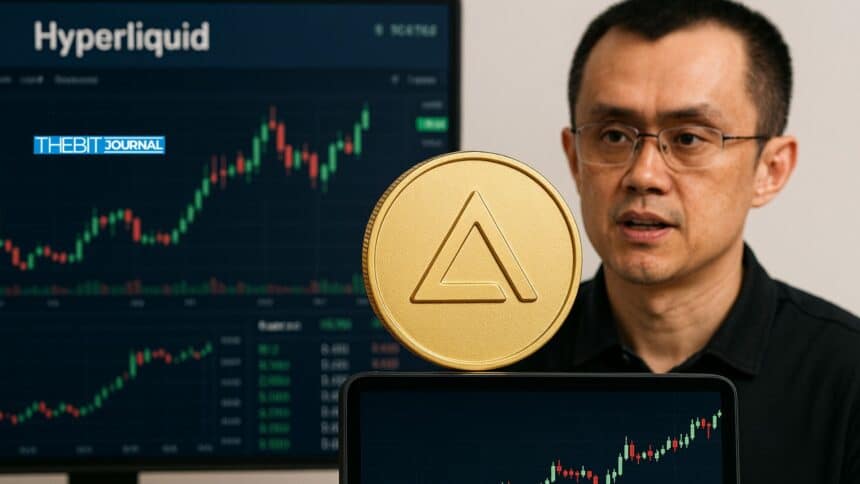
In an interview with Galaxy Digital’s Head of Research Alex Thorn, Zhao came out and said that Hyperliquid’s model is “actually awesome”, which was a big endorsement considering that the platform has carved out a niche for itself that Binance can’t easily compete with. However, he also issued a warning that regulatory scrutiny remains a serious risk for any platform that operates without traditional ID verification requirements.
Hyperliquid token has continued trading near record highs as a result of renewed demand from institutional investors and fresh inflows into its HYPE exchange-traded products on the spot market.
CZ’s Praise Comes With a Compliance Warning
Zhao’s comments are mixed with praise and a dose of caution.
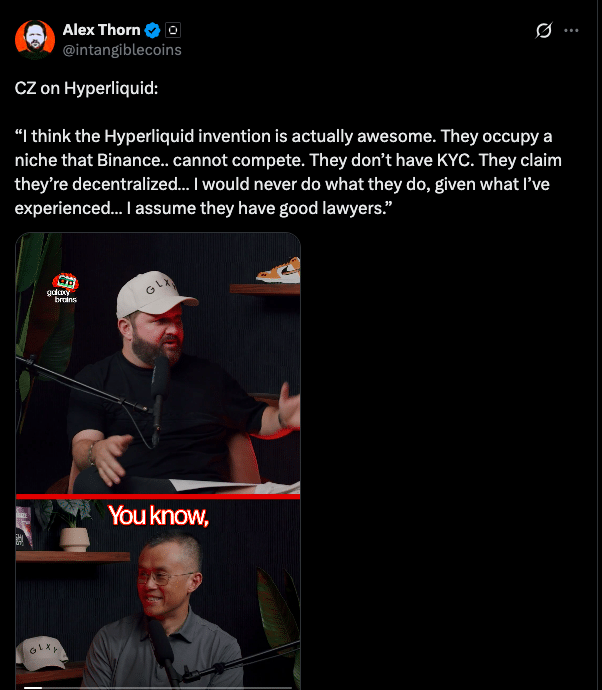
Speaking on the Galaxy Brains podcast, Binance’s former CEO said that Hyperliquid’s operating model, which doesn’t follow traditional Know Your Customer (KYC) requirements, occupies “a niche that Binance can’t compete with.”
He then added that he personally wouldn’t run a business that way after seeing the regulatory headaches he himself had to deal with at Binance, and seems to assume that Hyperliquid’s team has some top-notch lawyers looking after them.
That warning came with extra significance given Binance’s past. The company had agreed to a multi-billion dollar settlement with US authorities over anti-money laundering compliance failures, making Zhao one of the few industry leaders speaking from direct experience on regulatory exposure.
Industry’s Dispute Reveals Hyperliquid’s Growing Influence
The comments quickly drew some reactions from Zhao’s competitors.
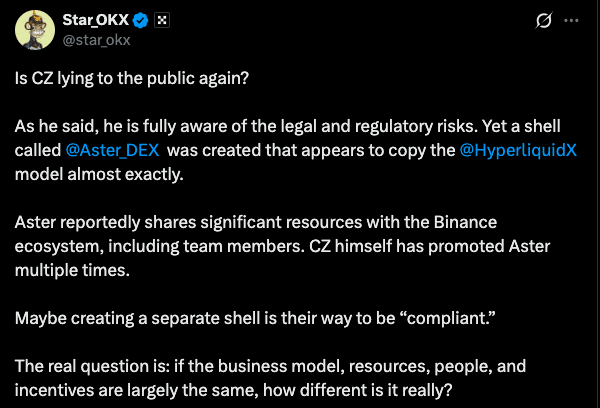
OKX founder Star Xu shot back at him, saying that supporting other decentralized platforms while criticizing Hyperliquid’s regulatory risks just sends mixed signals to the market. He pointed out that Binance has some reported connections to Aster, another decentralized exchange that follows a similar trading model, which Xu claims is hypocritical.
Hyperliquid’s rise has forced some of the industry’s biggest exchanges to respond. The network has turned into one of the most widely-discussed trading ecosystems, especially among traders looking for alternatives to centralized exchanges.
That growing influence helps explain why comments from executives such as Zhao and Xu generate immediate attention.
ETF Demand Continues Supporting Hyperliquid Token Price Rally
Beyond the headlines, one of the factors really driving Hyperliquid token’s recent performance is institutional demand.
According to available data, U.S spot HYPE products saw big inflows of approximately $26 million in just two days which helped push Hyperliquid token to a fresh all-time high near $76.9.
Bitwise, meanwhile, also disclosed that it currently stakes 1 million HYPE tokens for its BHYP exchange-traded product, which is part of roughly 7.8 million HYPE that the firm’s validator operations are staking.
The overall trend towards ETFs has been a big driver of HYPE’s price movements. New HYPE-based investment products have attracted more than $100 million in initial inflows, which has helped Hyperliquid establish itself as one of the strongest-performing digital assets in 2026.
This institutional backing has even provided a lifeline when general crypto markets have faltered under pressure from Federal Reserves decision making and economic downturn uncertainty.
The Biggest Risk Remains Uncertainty Around Regulations
While investor appetite is showing signs of strengthening, that doesn’t change the fact that regulatory uncertainty is something that can’t just be ignored.
Hyperliquid recently established the Hyperliquid Policy Center, which is all about working with policymakers and pushing for clearer rules that govern the way Decentralized finance is run. The group has already participated in discussions surrounding proposed U.S. anti-money laundering requirements affecting digital assets.
Also, regulators have been paying a lot more attention. In May, the UK’s Financial Conduct Authority added Hyperliquid onto its warning list saying that the platform might be operating in the UK without the right permissions to do so.
These developments don’t necessarily pose an immediate threat to Hyperliquid’s day to day, but they do stress the fact that rapid growth usually brings regulatory attention to the table.
As Decentralized exchanges keep pushing further into areas where traditionally you’d find regulated financial institutions, compliance issues are only going to become more important.
Conclusion
Hyperliquid is still strongly building its position as one of the fastest growing trading platforms in the Crypto space. Zhao’s endorsement of the project validated its innovation and pointed to the legal and compliance challenges that come with operating outside the boundaries of traditional finance.
Mixed with strong ETF inflows, institutional backing, and a record breaking price, Hyperliquid is one of the most watched projects in digital assets right now. If Hyperliquid token (HYPE) can extend its rally and push towards $80 or more really depends on how regulatory developments play out.
Glossary
Hyperliquid (HYPE): A decentralized trading platform and its native token.
KYC: Know Your Customer checks used to verify customers identity.
AML: Anti-money laundering regulations that help lrevent illicit financial activity
ETF: A type of Exchange traded fund that allows investors to gain exposure to assets without having to go through traditional markets.
Decentralized Exchange (DEX): A trading platform that lets users trade directly from their wallets without having to go through a central intermediary.
Frequently Asked Questions About Hyperliquid Token and Ecosystem
Why did CZ praise Hyperliquid?
Changpeng Zhao said that Hyperliquid occupies a space in the market that Binance finds hard to compete with due to its decentralized structure and lack of KYC requirements.
What was the latest price for Hyperliquid token (HYPE)?
According to recent market data, HYPE recently hit a new all-time high of $76.9
What is driving the demand for Hyperliquid token (HYPE)?
Institutional support, ETF inflows in the spot market, staking demand and growing adoption of Hyperliquid’s trading platform have all been contributing to the rally.
Is Hyperliquid facing any regulatory heat?
Yes. Regulators in some places have raised concerns and Hyperliquid has also started up a few policy initiatives of its own to try and get more involved with lawmakers.
References