






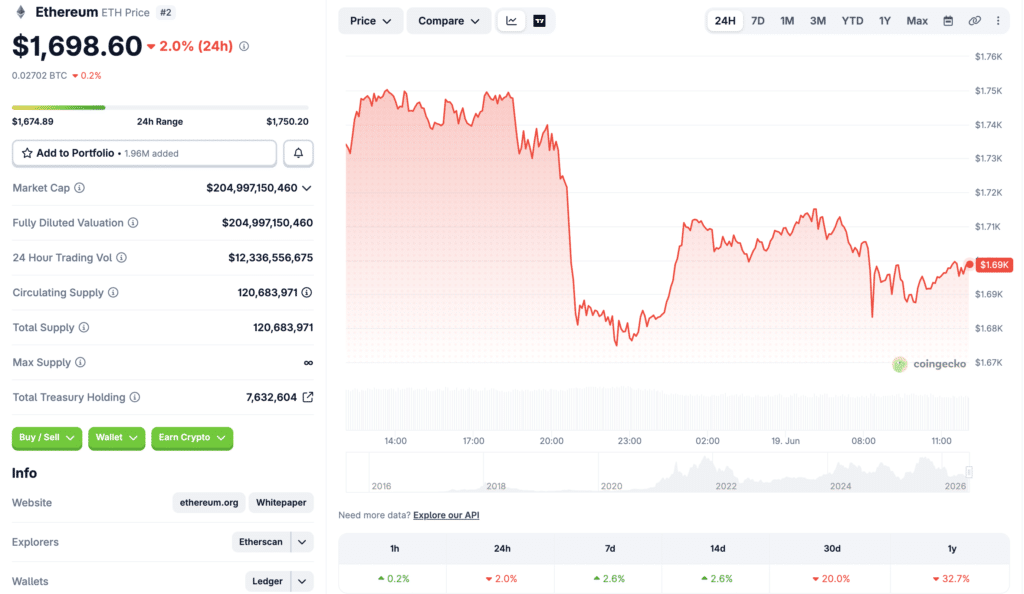
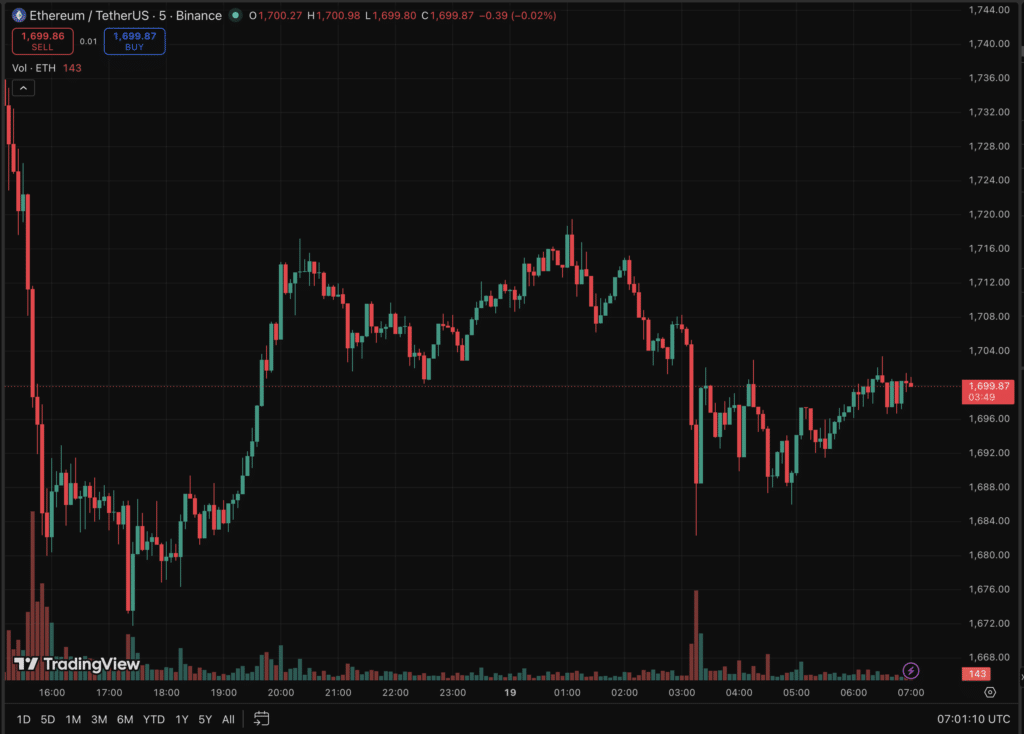
The Ethereum price is still pressured following its failure to secure an upward trend above the crucial resistance point of $1,700. Ethereum is currently trading at $1,698.94, recording a loss of 1.83% in the past 24 hours while the daily traded volume is currently $12.62 billion. The latest on-chain and derivative analytics indicate that bearish sentiment prevails in the market.
Increasing concerns have been raised about the potential selling wave triggered by falling demand, inflows into exchanges, and weak futures activity. Therefore, ETH traders await whether the cryptocurrency will maintain its important support levels or witness a new drop.
Increased Pressure on the Ethereum Price Due to Exchange Inflows
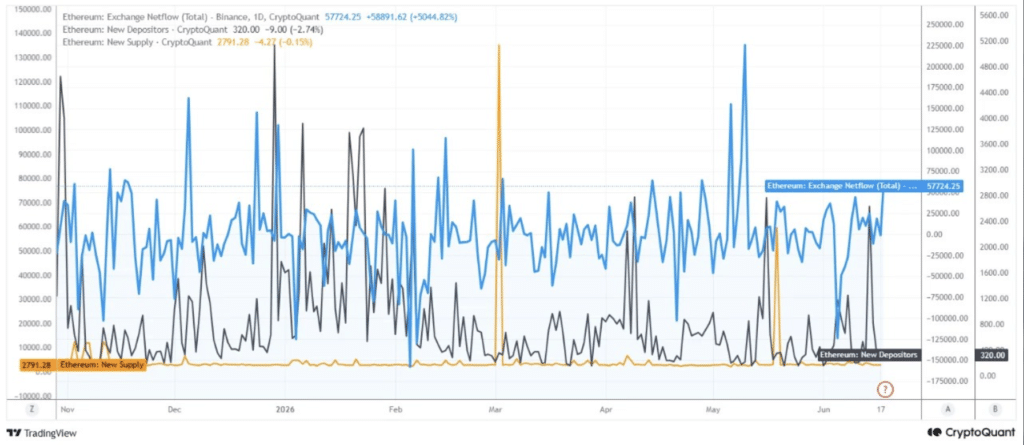
The first point that affects the Ethereum price is related to the inflows into exchanges. Based on the information of CryptoQuant, almost 57,700 ETH have been flowing into Binance during the last several days. The high flows into exchanges are traditionally considered as bearish indicators since people usually send their assets to exchanges ahead of selling.
On the other hand, the amount of new ETH depositors is currently quite small in comparison with the periods of high market interest. This situation has caused concerns among the news about Ethereum and increased the probability of Ethereum sell-off in case if resistance will remain.
Low Demand Puts Market Health into Question
Although there is still continuous supply to the market, demand is still very much low. As per the recent analysis on Ethereum, it has been noticed that there have been only 320 new deposits of Ethereum into the market. This number is very much lower when compared to those seen during previous bullish waves.
Since there is no active participation by the new investors in the market, it can be quite hard for the Ethereum price to maintain its current levels. It is mainly the existing holders who keep the market going.
Ether Futures Show Sliding Confidence Levels
The derivative market is also sending signals of trouble ahead. The Ether futures OI has dropped from $15 billion to $10.3 billion in just one month. It is a fall of 31%. It is the lowest figure in April 2025. The lower the OI means lower levels of speculation and lower trader confidence levels.
Ethereum usually needs high levels of derivatives participation when there is a rise in prices. But now it seems that traders have stepped back. It has become an important part of technical analysis of ETH prices.
Leverage Unwinds Point to a More Defensive Market
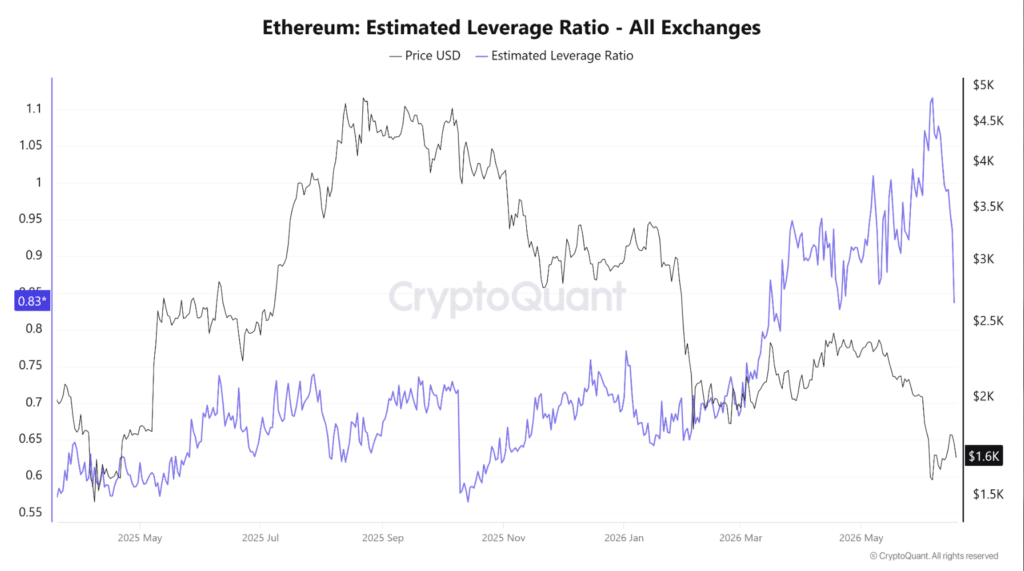
Another important metric is the estimated leverage ratio, which recently dropped to 0.83 from a record high of 1.10 earlier this month. Such a decline signals a significant reduction in leveraged positions across exchanges. While lower leverage can reduce market volatility, it also indicates that traders are becoming more defensive.
The Ethereum price has historically benefited from increased risk appetite during bullish cycles. In contrast, the current leverage unwind reflects caution and uncertainty. For investors seeking an Ethereum price prediction, this trend suggests market participants remain hesitant to aggressively accumulate ETH.
Key Support Levels Could Determine Ethereum’s Next Move
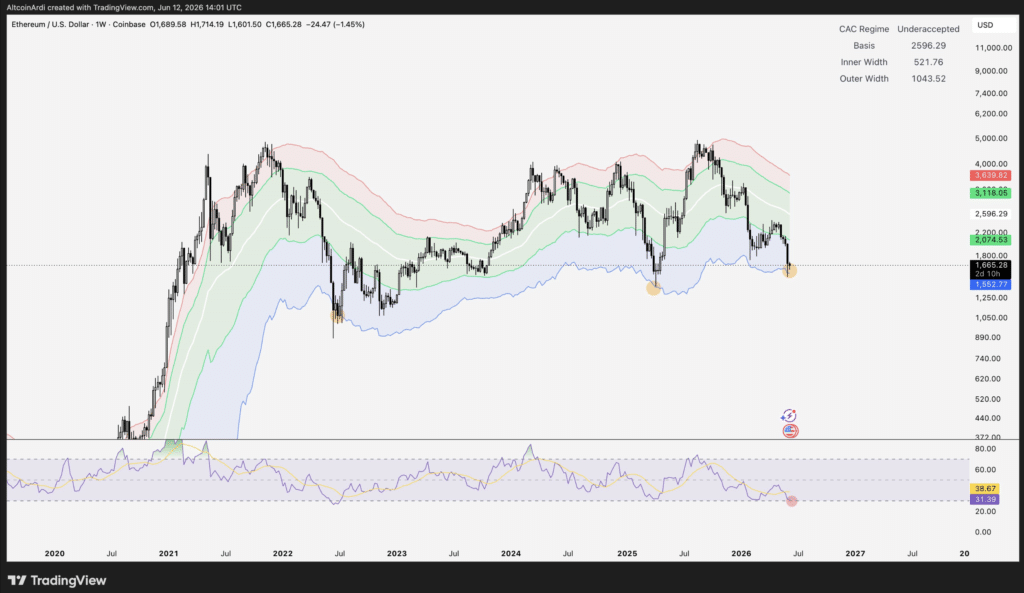
Technical traders continue focusing on critical support zones. The Ethereum price has fallen approximately 30% during the past 42 days and remains near the demand area between $1,700 and $1,400. If bearish momentum accelerates, the April 2025 low near $1,384 could become the next major target.
Below that level, analysts are monitoring the historical demand zone between $1,289 and $1,071. Understanding these Ethereum support and resistance levels to watch is essential because a breakdown below support could trigger additional liquidation events and strengthen bearish market sentiment.
Technical Indicators Suggest a Potential Bottom May Be Forming
Despite ongoing weakness, some analysts believe the market may be approaching a bottoming phase. The weekly Relative Strength Index currently sits near 31 after reaching extremely oversold conditions during the recent correction. Historically, such readings have often coincided with significant turning points.
This development has sparked discussion regarding Ethereum price prediction after falling below $1,700. While technical indicators alone do not guarantee a recovery, they suggest selling pressure may be becoming exhausted. As a result, some investors are beginning to evaluate whether current levels offer a favorable risk-reward opportunity.
ETH/BTC Performance Remains a Critical Market Signal
Another factor shaping the ETH market outlook is Ethereum’s performance against Bitcoin. The ETH/BTC trading pair continues trending lower, indicating that Ethereum remains weaker relative to the broader cryptocurrency market leader. This weakness has limited investor confidence and reduced capital inflows into ETH. Many professional traders consider ETH/BTC one of the most important indicators for assessing long-term strength. Until this ratio stabilizes, Ethereum trading activity may remain subdued. Consequently, questions such as “Will Ethereum recover after falling below $1,700?” continue dominating discussions throughout the crypto community.
Comparing Bullish and Bearish Scenarios for Ethereum
The current market presents two competing narratives. Bears point to exchange inflows, declining open interest, and weak participation as evidence that additional downside remains likely. Bulls, meanwhile, highlight oversold technical conditions, historically low RSI readings, and long-term support zones as reasons for optimism. This divergence makes Ethereum market analysis and price prediction particularly challenging.
If buyers successfully defend the $1,400-$1,700 range, a recovery could emerge. However, failure to hold support may validate concerns surrounding another Ethereum sell-off and open the door to significantly lower price levels.
Ethereum Price Forecast for the Next 30 Days
Looking ahead, the Ethereum price forecast for the next 30 days largely depends on whether buyers can regain control near current levels. A successful move above $1,700 could improve sentiment and attract fresh capital into the market. Conversely, continued weakness may push ETH toward the $1,400 region.
Investors searching for answers to “Why Ethereum dropped below $1,700 today” should focus on weakening derivatives activity, rising exchange inflows, and declining demand. These factors currently dominate market dynamics and will likely shape Ethereum’s short-term direction.
Conclusion
The Ethereum price remains at a critical crossroads. On-chain metrics, exchange inflows, futures data, and technical indicators collectively suggest that risks remain elevated. While oversold conditions provide some support for a potential rebound, analysts continue warning that another selling wave could emerge if key resistance levels remain intact.
The $1,400 to $1,700 range is likely to determine Ethereum’s next major move. Investors should closely monitor market developments, evaluate risk carefully, and remain disciplined as volatility continues shaping the cryptocurrency landscape.
Frequently Asked Questions About Ethereum Price
Why is the Ethereum price struggling below $1,700?
The Ethereum price faces pressure from rising exchange inflows, weak new demand, and declining futures open interest, all of which indicate reduced market confidence.
What are the key Ethereum support levels?
Current support levels are located between $1,700 and $1,400, with additional historical demand zones near $1,289 and $1,071.
Will Ethereum recover after falling below $1,700?
Recovery remains possible if buyers defend key support zones and market sentiment improves. However, analysts continue monitoring risks of additional selling pressure.
Is Ethereum a buy below $1,700 in 2026?
Investment decisions depend on individual risk tolerance and market outlook. Some analysts view current levels as attractive, while others expect further downside.
Appendix: Glossary of Key Terms
Ethereum Price: The current market value of one ETH token.
Open Interest: The total value of active futures contracts in the market.
RSI: Relative Strength Index, a technical indicator used to measure momentum.
Exchange Inflows: Cryptocurrency transferred onto exchanges, often indicating potential selling activity.
Leverage Ratio: A metric showing the amount of borrowed capital being used in trading positions.
Support Level: A price area where buying demand may prevent further declines.
Resistance Level: A price area where selling pressure may limit upward movement.
References