




DeFi Tokens sit at the center of on-chain finance. They power trading, lending, staking, and yield. They also rise and fall with demand, fees, and trust. This guide explains how they work and what drives price. It also shows how to think about DeFi token valuation in simple terms.
DeFi Tokens can be viewed like small online businesses. Each one has a product, income, costs, and risks. Basic numbers tell the story. Fees, users, and supply shape price. Simple checks go a long way. A quick look at cash flow, emissions, and unlocks sets the base for DeFi token valuation.
Why DeFi Tokens Matter Right Now
Capital keeps flowing back into on-chain markets. Total value locked in DeFi hit a three-year high near $153 billion in late July 2025. That shows stronger liquidity and renewed interest. Ethereum still leads. Activity on Solana and other chains is growing fast.
Decentralized exchanges also keep their share. Uniswap held about 35.9% of DEX volume in August 2025 with $111.8 billion monthly trade. That scale helps set pricing power for many assets.
What are DeFi Tokens
DeFi Tokens are digital assets that power decentralized apps. Each token has a job. Utility tokens pay for swaps, gas rebates, or features. Governance tokens give holders a vote on fees, listings, and budgets. Revenue or buyback tokens use fees to buy and burn tokens or to pay holders. Collateral and staking tokens secure networks or loans and earn yield. One token can play more than one role. Clear design and real demand drive value.
Where Value Comes From
Value grows when fees turn into cash flow or buybacks. Utility demand also matters. Users need the token to trade, borrow, or farm. Strong treasuries and reserves support growth and buybacks. Network effects lift value as users and liquidity rise. More use makes it harder to switch away.
DeFi Token Valuation: The Basics
DeFi token valuation starts with a simple idea. Treat a protocol like a small business on-chain. It has revenue, costs, and users. Then pick metrics that fit the token’s rights. Price to fees shows token price against annualized protocol fees. A lower ratio signals cheaper value. Price to revenue applies when the token captures real revenue and helps compare earnings power.
Market cap to TVL compares market value with deposits; a high ratio can suggest strong margins or simple hype. Fully diluted value is price times max supply and highlights future unlock risk. Real yield tracks returns that come from fees rather than inflationary emissions. User unit economics measure fees per active user or per dollar of TVL; rising fees per user point to better use and stronger demand. Together these checks give a fast, clear read on value and risk.
A Simple Flow to Analyze any DeFi Token
An analyst starts by mapping the token’s rights. That means checking votes, cash flow, discounts, boosts, or none of these. Next comes supply. Note emissions, vesting, and all unlock dates. Then track demand with users, volumes, and on-chain revenue trends. After that, benchmark against close peers on the same chain. Finish with a stress test. Cut volume by 30 percent and recalc the key ratios. If value still holds, the case looks stronger.
On-Chain Metrics That Matter
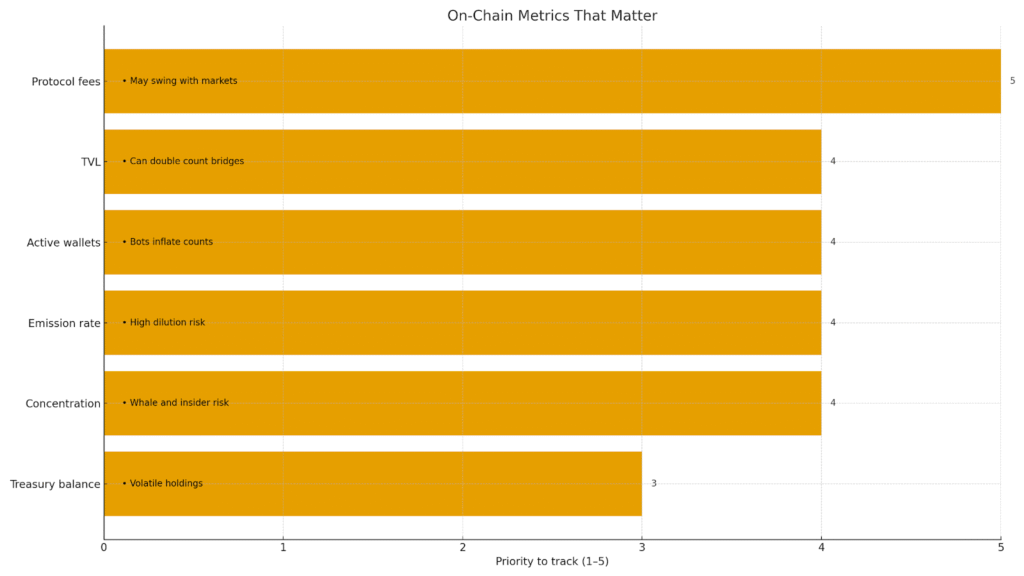
Most DeFi data is public. Use it.
- TVL. Measures deposits and trust. It can overcount bridged assets.
- Active wallets. Shows use, but can include bots.
- Protocol fees. Best signal for durable value.
- Treasury balance. Fuels growth and runway.
- Emission rate. High emissions can crush price.
- Concentration. Whale and insider holdings add risk.
DeFi Token Valuation Signals
| Metric | Purpose | Inputs to pull | Good signal | Red flag |
| Price/Fees (P/F) | Link price to fee capture | Market cap, 30–365 day fee share to token | P/F falls as fees rise | Fees rise, price flat, but no buybacks or payouts |
| Price/Revenue (P/R) | Value cash flows to token | Market cap, net revenue to token | Stable or falling P/R with steady growth | P/R climbs while revenue stalls |
| M/TVL | Compare price to deposits | Circulating MC, protocol TVL | Lower than peers with similar risk | High M/TVL with weak usage |
| FDV/Revenue | Check long term dilution vs earnings | FDV, annualized revenue to token | FDV near peers and revenue rising | FDV huge vs float and revenue small |
| Users/Fees | Monetization quality | Active wallets, total fees | Fees per user rise over time | Users rise, fees per user fall |
| Treasury/MC | Runway and safety | Liquid treasury value, market cap | 12 to 24 months runway | Illiquid or high beta treasury |
| Emission rate | Dilution pressure | Monthly token emissions | Clear drop or hard cap | Emissions steady or rising |
| Unlock pressure | Float growth risk | Next 6 to 12 month unlocks | Small, staggered unlocks | Large cliff to insiders |
| Retention (30d) | Stickiness of demand | Cohort wallets, repeat use | Repeat use holds or grows | One and done activity spikes |
| Liquidity depth | Exit and entry quality | Top pool depth, 1 percent move depth | Deep books on majors | Thin depth across chains |
How Tokens Can Create Value
Lending protocols. They earn interest spreads and liquidation fees. Token value can rise when deposits grow and bad debt stays low.
DEX tokens. They benefit when volumes and fee tiers match trader demand. Features like limit orders, routing, and L3 support can lift shares.
Liquid staking. Value links to staked assets and network yield. Smart de-peg risk control matters as much as growth.
Security and Regulatory Context
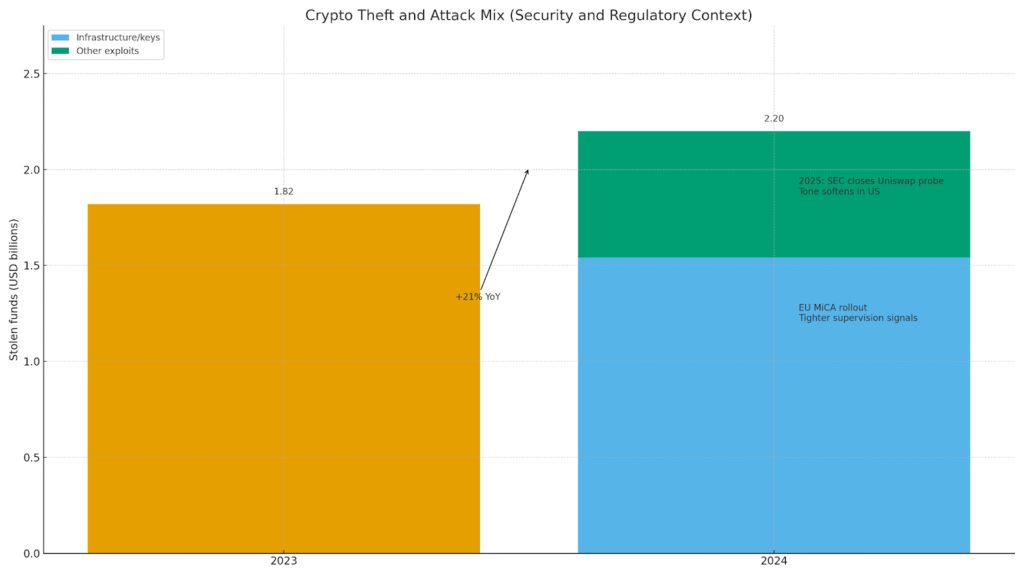
Security risks remain real. Hackers stole about $2.2 billion in 2024. That number rose about 21% from 2023. Most losses came from compromised keys and central points, but DeFi exploits stayed common.
Infrastructure attacks did most of the damage in 2024. TRM Labs estimates nearly 70% of stolen funds came from key or infrastructure compromises. That dwarfs pure smart contract bugs. Good op-sec now matters as much as audits.
Policy shifts also matter. The SEC closed its Uniswap probe in February 2025 and took no action. That removed a major overhang for DEX tokens and set a softer tone in the U.S. for now.
Europe keeps moving with MiCA. Regulators continue to iron out the rollout and supervision. France even warned it could challenge passporting if oversight stays uneven. That signals tighter checks for large players under EU law.
What this means for investors. Security events can erase months of gains. Laws can change routes for token economics, fee sharing, or KYC. Token value lives on both code and policy.
Red Flags and Risk Controls
Smart contract risk. Look for multiple audits, bug bounties, and paused functions. Ask if the team can upgrade contracts. That power can help fix bugs but adds trust risk.
Key and governance risk. Multisig signers should be public and diverse. Unlock schedules should be clear. A short cliff plus high unlocks can crush prices.
Oracle and market risk. Thin books cause price gaps. Protocols need robust oracles and circuit breakers.
Liquidity risk. Small pools can trap exits. Check depth across chains.
Regulatory risk. Tokens with fee shares may face securities claims in some places. Track legal notes and disclosures.
A Practical Framework for DeFi Token Valuation
Use this checklist to build a quick view.
1) Business model
- What product drives usage: swaps, lending, leverage, staking, payments
- How the protocol earns: fees, spreads, liquidations, MEV capture
2) Traction
- TVL trend over 90 days
- 30-day fees and volumes
3) Supply
- Emissions and unlocks over the next 12 months
Insider and market maker share
4) Risk
- Audit history and bounty size
- Multisig details and emergency powers
5) Price sanity
- P/F and P/R vs peers
- M/TVL vs peers on the same chain
Scenario: minus 30% volume, can value still hold
Token Design Choices That Move Price
Clear cash flow helps value. Buybacks add demand, but only when fees exceed emissions. Some tokens boost yields for lockers. That creates deep lock-in but can mask weak real demand. Points can drive use. They often fade. If points turn into real cash flow later, the token may re-rate. Until then, treat points as short-term. Bridges grow reach but add attack surface. Native deployments on L2s cut costs and grow users with less risk.
How to Research DeFi Tokens in One Afternoon
- Start with data. Pull TVL, fees, and volumes from a trusted dashboard.
- Read docs. Focus on token rights and cash-flow paths.
- Scan code and audits. Look for recent commits and audit scope.
- Map supply. Note the next six unlocks.
- Check governance. Who holds power and keys.
- Compare peers. Pick three rivals and chart P/F and M/TVL.
- Write a one-page brief. End with risks that would change the view.
DeFi Token Types at a Glance
| Token type | What it does | How value can grow | What to watch |
| Utility | Powers swaps, loans, features | More users and activity | Fees per user, daily active wallets |
| Governance | Enables votes on fees, listings, budgets | Better policy and upgrades | Voter turnout, holder concentration |
| Revenue or buyback | Sends fees to holders or burns supply | Rising protocol revenue | Payout ratio, buyback cadence |
| Collateral or staking | Secures networks and loans | More staking and lower churn | Staked share, de-peg risk |
| Liquidity incentive | Rewards market makers and LPs | Deeper books, tighter spreads | Emission rate, real volume |
| Hybrid | Mix of the above | Balanced rights and demand | Clarity of rights, overlap risk |
Common Valuation Pitfalls
High APY from new emissions often dilutes holders. Focus on fee-backed yield. A low market cap with huge FDV can mislead. Unlocks can double float fast. TVL can rise with token price. It can also double count across bridges. Pair TVL with revenue. A protocol can fragment use over many chains. That can lower depth and raise cost.
Sample Research Table: Questions to Answer before Buying
| Topic | Key question | What good looks like |
| Fees | Do fees grow with users and volume | A rising 90-day trend |
| Emissions | Do emissions shrink over time | Clear halvening or cap |
| Unlocks | Who unlocks and when | Staggered, with public plans |
| Treasury | Is the runway strong | 18+ months in liquid assets |
| Security | Are audits recent and broad | Top firms, live bounty |
| Governance | Who can pause or upgrade | Diverse multisig, timelock |
The Bigger Picture in 2025
DeFi keeps moving toward real cash flow. DEXs, money markets, and liquid staking set the pace. TVL and volumes show a healthy base. Security is still the hard part. Policy remains fluid, with softer signs in the U.S. and tighter rules in the EU. Expect more KYC, clearer fee rules, and better on-chain risk tools.
Conclusion
DeFi Tokens live and die by real use, clear rights, and strong security. The best projects turn user demand into steady fees. They keep emissions in check. They show clear audits and sound governance. A simple mix of P/F, M/TVL, and supply data gives a fast read. Add a policy lens and a risk plan. That is how to make sense of DeFi token valuation in 2025.
Set a short checklist before any move. Read the token rights. Chart fees and users. Map supply and the next unlocks. Compare with two close peers. If the picture still looks strong, size a small entry. These steps keep DeFi token valuation simple and repeatable while DeFi Tokens reward careful work.
FAQs About DeFi Tokens
What are DeFi Tokens in simple terms?
They are digital chips that power apps like DEXs and lenders. They can grant votes, fee share, or better yields.
How does DeFi token valuation work?
Analysts compare price with on-chain cash flows, fees, and deposits. They also check supply, unlocks, and risk.
Is TVL a good signal?
TVL helps gauge trust and liquidity. Pair it with revenue and user growth. Never use it alone.
What makes DeFi tokens risky?
Bugs, key leaks, thin liquidity, and legal changes. Strong audits and diverse multisigs reduce risk.
What laws affect DeFi today?
EU MiCA sets broad rules. The U.S. eased pressure in early 2025 by closing several probes, including Uniswap. Local rules still vary.
Glossary
- DeFi Tokens: Assets that power decentralized finance apps.
- DeFi token valuation: A method to value tokens using fees, revenue, and on-chain data.
- TVL: Total value locked in a protocol or chain.
- FDV: Fully diluted value. Price times max supply.
- Real yield: Yield paid from real fees or cash flow, not emissions.
- Emission: New tokens released to the market.
- Buyback and burn: Using fees to buy tokens and remove them from supply.
- Oracle: A data feed that brings prices on-chain.
- Multisig: A wallet that needs several approvals to move funds.
- Governance: The rules and voting that guide a protocol.
- Disclaimer: This article is for informational purposes only and does not constitute financial advice.
Summary
DeFi Tokens power trading, lending, and staking on public blockchains. Their value depends on clear token rights, strong demand, and sound security. A simple approach to DeFi token valuation uses price-to-fees, price-to-revenue, market cap-to-TVL, and FDV, while checking emissions, unlocks, and treasury strength. TVL and DEX volumes improved in 2025, signaling deeper liquidity, but security risk remains high. Hackers stole about $2.2 billion in 2024, with most losses tied to key or infrastructure compromises. Policy is mixed. The SEC closed its Uniswap probe in February 2025, while the EU’s MiCA framework is moving into practice, with France pushing for stricter supervision. Combine cash-flow metrics, on-chain data, and risk checks to form a clear view.