







This article was first published on The Bit Journal.
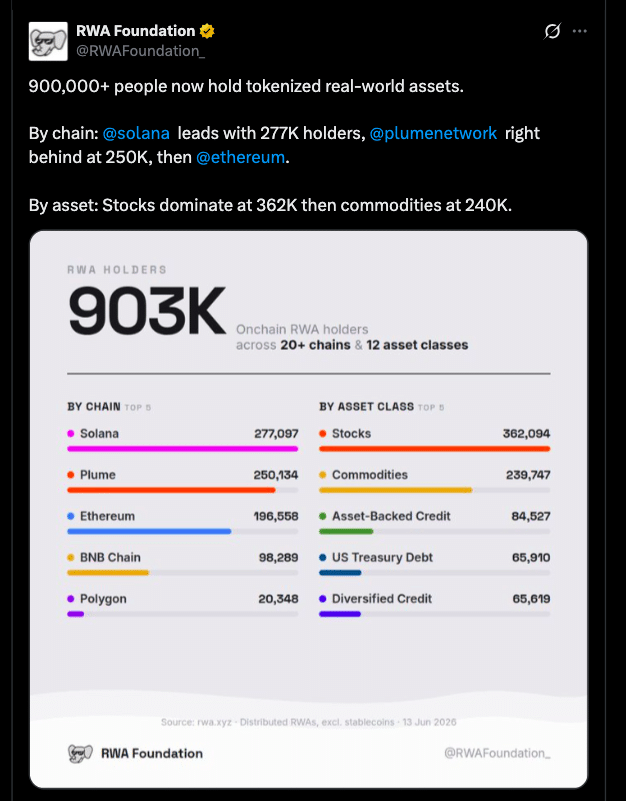
The market for tokenized Real World Assets is attracting users at a pace that is hard to match anywhere else in crypto. Over 900,000 holders now own tokenized real-world assets. However, hidden beneath all those impressive growth figures is a simple question that might make or break the sector’s future: can the yields driving all this adoption actually keep going?
While tokenized RWAs are taking up capital across different blockchain networks, trouble is starting to emerge in one of the market’s most important areas, which is private credit.
Tokenized RWAs Are Spreading Fast Across Major Blockchains
The tokenized RWA sector has turned into one of the fastest-growing areas of the digital asset space.
According to the latest numbers, the sector now has more than 900,000 holders, with Solana leading the user participation with around 277,000 holders. Plume Network is second with roughly 250,000 holders, and Ethereum is still a player as well.
Interest is spreading across different asset categories. Tokenized stocks currently lead with around 362,000 holders, but tokenized commodities aren’t far behind with roughly 240,000 holders.
The overall market has also just kept expanding. Industry research shows that tokenized real-world assets has exceeded $31 billion in on-chain value in 2026.
XRP Ledger Leads Recent Capital Inflows
Investors aren’t concentrating on a single ecosystem, either.
In the last 90 days, the biggest net inflows have been on the XRP Ledger, which has pulled in around $1.9 billion worth of tokenized asset inflows. Ethereum was close behind with $1.6 billion, and Stellar had roughly $1.4 billion.
Other networks like BNB Chain, Solana, Avalanche, Sei, and Mantle have had some pretty decent inflows, too.
CoinGecko’s latest RWA report found that tokenized assets have tripled since early 2025, due to growing interest from traditional financial institutions and expanding regulatory clarity.
Private Credit Is The Main Driver Of DeFi Adoption
Not all tokenized RWAs are being used in the same way.
Private credit has become one of the most active areas in Decentralized Finance. Previous market analysis showed that 64.3% of the value of tokenized private credit is getting used across DeFi apps, which is way higher than a lot of other RWA categories.
The appeal is easy to understand. Tokenized private credit often offers yields ranging from 8% to 15%, far above what investors can earn from many traditional fixed-income products.
This combination of yield just how easy it is to get on the blockchain has made private credit one of the strongest growth forces for tokenized RWAs.
However, that same dependence on yield is becoming a source of concern.
The Risk That Investors Shouldn’t Ignore
A lot of the excitement around tokenized RWAs has been based on the promise of stable income.
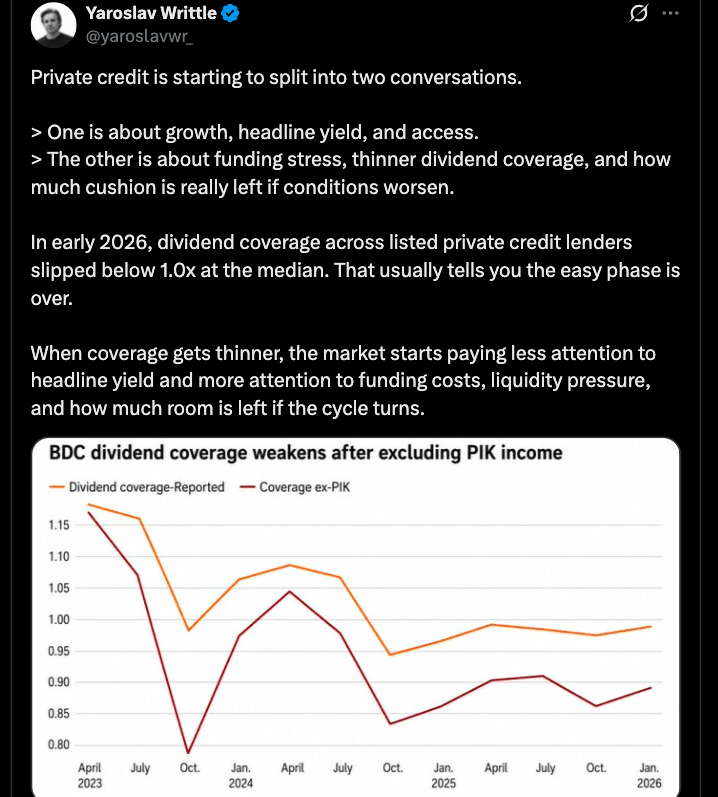
But that promise is now facing scrutiny. Data from the private credit sector shows that dividend coverage ratios have been steadily weakening since 2023. Coverage stood above 1.15x in April 2023 but had fallen to just below 1.0x by early 2026.
It gets even more concerning when Payment-in-Kind (PIK) income is left out. PIK income is the earnings that get recorded on paper but have yet to be collected in cash. Using that measure, dividend coverage dropped to approximately 0.89x in January 2026.
What this means is that some lenders are no longer generating enough actual cash earnings to fully cover their distributions.
All of this is a warning sign that investors might start focusing more on the quality of the yields they’re getting and less on just chasing after the big headline returns.
Growth Alone Doesn’t Eliminate Risk
The fast expansion of tokenized RWAs has created serious talks about what the future holds for on-chain finance.
But recent academic research suggests that large asset values and growing holder counts do not automatically translate into healthy markets.
Multiple sectors of tokenized assets are actually struggling with issues like liquidity, concentration risk, and trading activity.
That doesn’t necessarily mean the long-term case for tokenization is a bad one. What it does mean is that the sector’s next big move is going to depend on proving that the assets can continue to deliver on their promises through various market ups and downs.
Conclusion
Tokenized RWAs have now passed the 900,000 holder mark and continue to attract billions of in fresh capital. Solana, Ethereum, XRP Ledger and other platforms are all doing well because there’s m strong demand for tokenized stocks, commodities, and private credit products.
However, the sector’s strongest growth driver which is private credit also might be its greatest test. With dividend coverage ratios slipping below 1.0x and cash earnings coming under pressure, investors are on the verge of finding out if the yields driving tokenized RWAs are going to be able to weather a tougher financial environment.
Glossary
Tokenized RWAs: Real-world assets represented as blockchain tokens.
Private Credit: Loans that get issued outside of the traditional banking system, often offering a high yield.
PIK Income: Payment-in-Kind income that accrues on paper rather than being paid in cash.
Dividend Coverage Ratio: A measure of whether earnings are sufficient to support distributions.
DeFi: Decentralized finance applications that operate through blockchain-based smart contracts.
Frequently Asked Questions About Tokenized RWAs
What are tokenized RWAs?
Tokenized RWAs are blockchain versions of real assets like stocks, bonds, commodities, private credit, and real estate.
How many holders do these tokenized RWAs have?
They’ve now surpassed the 900,000 holder mark across multiple different blockchain networks.
Which blockchain has the most RWAs?
Solana’s in the lead right now with around 277,000 holders, followed closely by Plume Network with roughly 250,000 holders.
What makes private credit so important for these tokenized RWAs?
Private credit offers attractive yields and it is a big part of the RWAs activity in decentralized finance.
References