






The tokenized RWAs market has entered a new phase of growth, surpassing $30 billion as traditional financial assets continue to migrate on-chain. The market is now witnessing a rapid evolution into more infrastructure transformation touching on treasuries, bonds, commodities, private credit, equities and tokenized funds.
That kind of growth is hard to ignore and now investors and institutions are having to pay closer attention to how exactly tokenized RWAs sit in the financial system.
Despite the impressive growth as a result of the expansion of the market, industry analysts are starting to think that bringing more assets on-chain will not be enough. The bigger question now is if those assets can actually be used in true crypto markets instead of simply existing as passive blockchain wrappers.
Market data of late show that adoption is growing more quickly than many analysts had anticipated.
Tokenized RWAs Expand Beyond Stablecoins
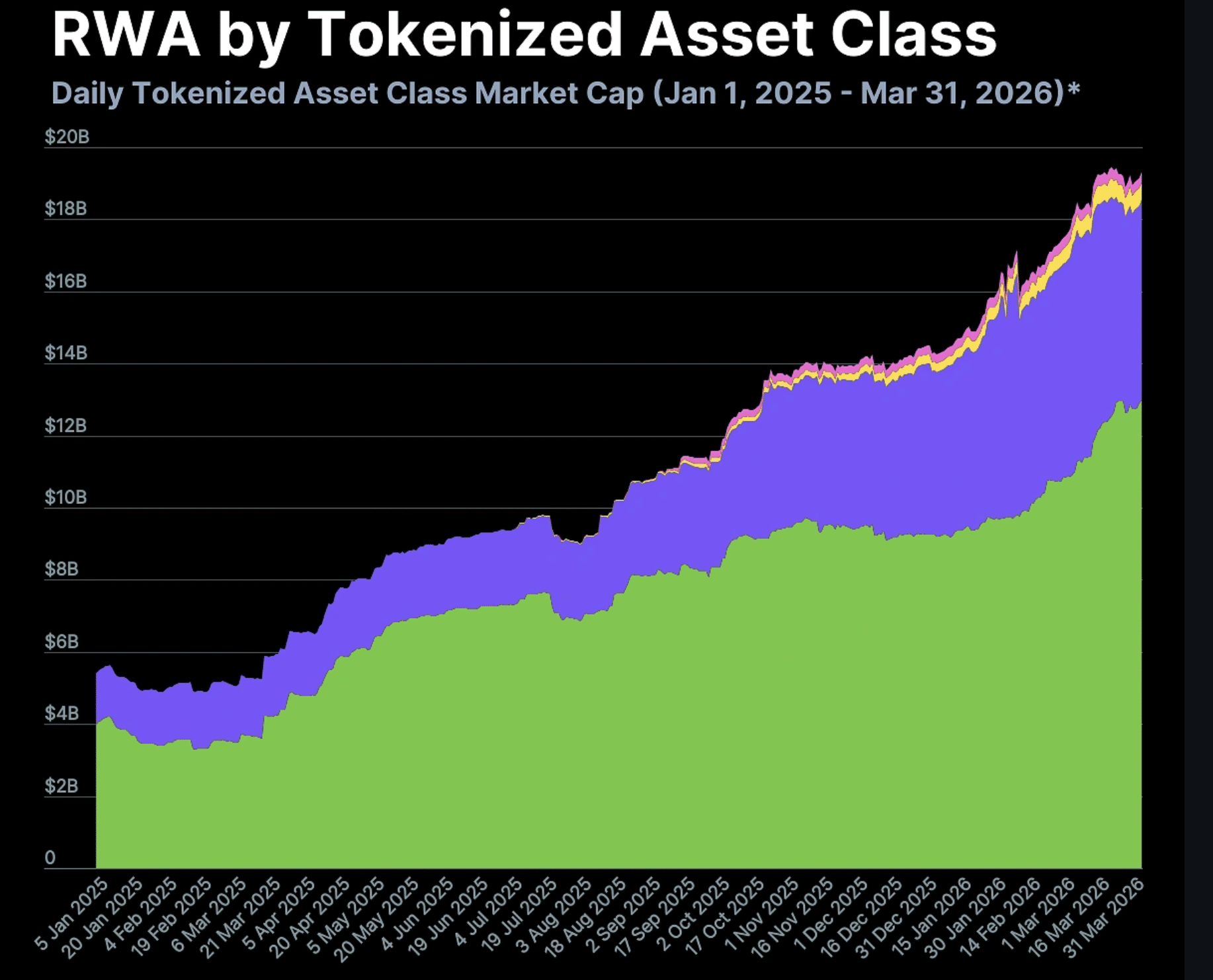
Since the beginning of 2025, the tokenized RWAs sector has increased substantially. In a newly released CoinGecko research paper; the market cap for tokenized real-world assets has grown from about $5.4 billion in early 2025 to over $19.3 billion by late Q1 2026.
More recent market tracking from RWA.xyz and industry reports now place the tokenized RWA ecosystem above $30 billion, with some datasets estimating values above $31 billion depending on whether stablecoin-linked infrastructure is included.
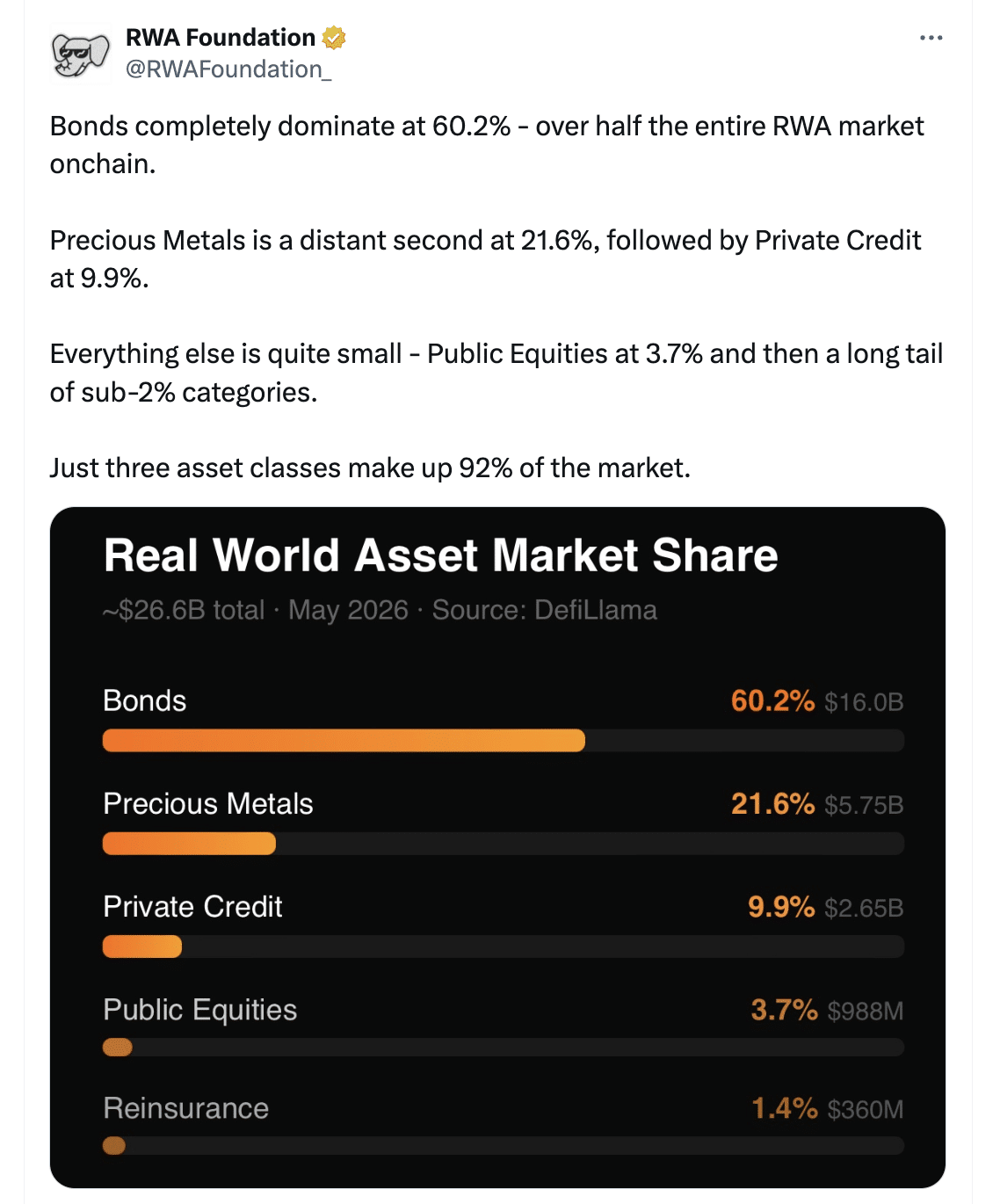
Bonds currently make up a sizable part of the industry, comprising close to 60% of the sector. Tokenized treasuries alone represent a massive share of overall growth, while precious metals and private credit continue gaining traction as investors seek yield-bearing blockchain assets.
Major traditional finance institutions like J.P. Morgan, BlackRock, Franklin Templeton and BNY have all expanded their tokenization initiatives over the past year.
Recent trials with tokenized U.S. Treasury transfers over blockchain rails reveal how major financial institutions have started to view tokenization more as a component of the next-generation settlement infrastructure, not just another crypto test case.
Growing tokenized RWAs in 2026 is being driven by various factors.
Regulatory clarity has improved in key regions, particularly across Europe under MiCA-related frameworks. That clarity has encouraged institutions to move cautiously into blockchain-based financial products.
Meanwhile, investors are seeking yield generating assets after many years of wild crypto-only returns. Tokenized treasuries, bonds, and private credit products offer exposure to real-world cash flows while still benefiting from blockchain settlement efficiency.
Tokenized commodities also saw a rapid growth of their own. The most recent study from CoinGecko revealed that tokenized commodities increased to approximately $5.5 billion, with growth being driven by issuances of gold-backed products like PAXG and XAUT.
Market capitalization has grown, as have trading activity. In Q1 2026 alone, trading volumes for tokenized gold have purportedly exceeded $90 billion exceeding total full-year 2025 totals.
The tokenized stocks and the ETFs have been another big catalyst for this. Since launching in mid-2025, tokenized equities have scaled rapidly, allowing investors to gain blockchain-based exposure to major public companies with around-the-clock settlement access.
The Real Challenge Is No Longer Tokenization
Despite the sector’s rapid expansion, many analysts believe tokenized RWAs still face a major problem. In the crypto world, once an asset goes on chain, it typically stays static.
Bonds, metals and credit products require deeper incorporation within the crypto ecosystems. Without deeper utility, many tokenized RWAs risk functioning as passive holdings rather than productive financial tools.
As the DeFi sector matures, that concern has become more mature. Earlier phases of crypto adoption focused heavily on bringing assets onto blockchains. The next phase may depend on whether those assets can actively participate in lending markets, collateral systems, derivatives, automated market makers, and yield strategies.
Many analysts now insist that the future champions in RWA will most likely be platforms capable of integrating tokenized assets seamlessly into trading and liquidity infrastructure rather than simply issuing blockchain representations of traditional products.
This is especially true for tokenized treasuries and bonds. Investors are unlikely to be satisfied simply holding blockchain equivalents of low-risk assets. Instead, they want those products to be built on top of lending systems, margin trading platforms and institutional liquidity rails.
Without that functionality, tokenized RWAs could struggle to move beyond institutional pilot programs and niche investment products.
Institutions Are Changing the Competitive Space
Competition for tokenized RWAs is heating up among institutions.
The biggest names in finance are not just launching tokenized products but constructing the infrastructural layers that surround custody, compliance, settlement and liquidity.
Recent reporting showed that the Depository Trust & Clearing Corporation plans to roll out expanded tokenization services later this year, including tokenized Treasury-related infrastructure.
At the same time, blockchain-native companies such as Ondo Finance and Securitize continue pushing deeper into institutional-grade tokenization markets. The competition is no longer just about asset issuance.
Forecasts for the RWA market remain aggressive. Some industry projections estimate that tokenized assets could eventually grow into a multi-trillion-dollar sector if institutional adoption continues accelerating.
However, market observers warn that fast expansion also brings new risks of liquidity fragmentation, regulatory arbitrage and reliance on centralized infrastructure providers.
Conclusion
In 2026, tokenized RWAs no longer exist on the experiment line. With the market surpassing $30 billion, blockchain-based versions of bonds, treasuries, commodities, private credit, and equities are becoming a meaningful part of digital finance infrastructure.
However, the industry’s next challenge is becoming increasingly clear.
Growth alone will not guarantee long-term success. The sector now faces pressure to make tokenized assets genuinely useful inside crypto markets rather than simply accessible on-chain.
That means improving collateral utility; integrating with DeFi protocols, expanding liquidity access, and creating systems where tokenized RWAs can actively participate in trading and financial activity.
Glossary
Tokenized RWAs: Blockchain-based representations of real-world assets such as bonds; commodities, stocks, or private credit.
Treasuries: Debt securities issued by the government that are often the lowest risk investment.
DeFi: These are decentralized finance applications that run on blockchain networks without the involvement of traditional intermediaries.
Collateral: Assets pledged to obtain loans or enter into financial positions.
MiCA: EU regulatory framework for Markets in Crypto-Assets.
Frequently Asked Questions About Tokenized RWAs
What are tokenized RWAs?
Tokenized RWAs (Real World Assets) are digital representations of real world financial assets stored on blockchain networks.
What is driving the rapid growth of tokenized RWAs?
The rising need for yield products on the blockchain; regulatory clarity and increased institutional adoption have all acted as accelerators for market growth.
Which assets dominate the tokenized RWA market?
Bonds and treasuries currently make up the largest share of the sector; followed by commodities and private credit.
Why is utility important for RWAs?
Without integration into lending, collateral, and trading systems; tokenized assets risk becoming passive holdings with limited practical use.
References