






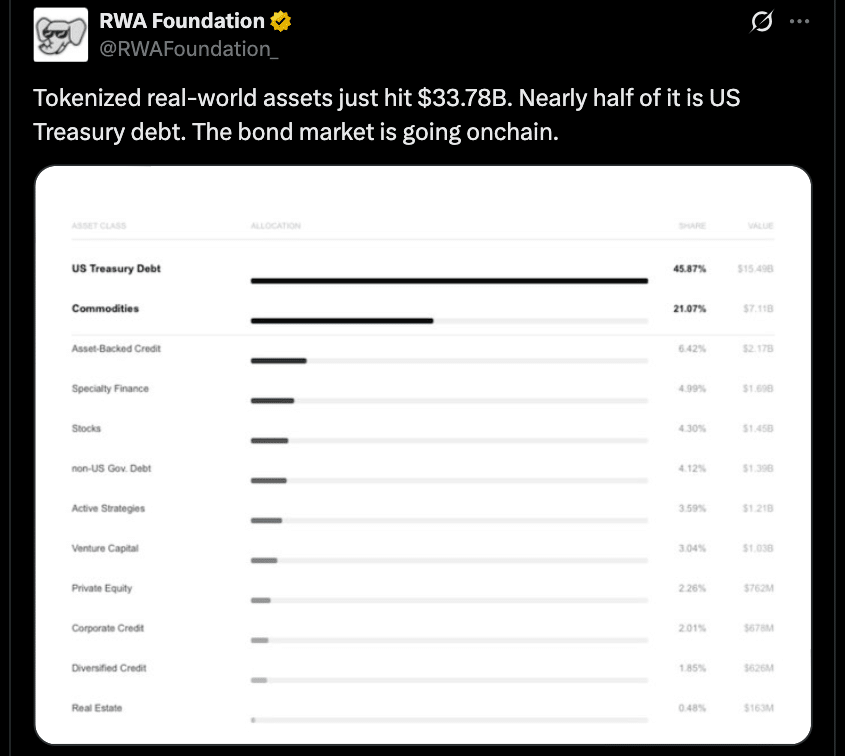
The tokenized RWAs market reached a new all-time high of $33.78 billion this May 2026, its continued growth showing how much institutional investors are getting into blockchain-based financial infrastructure.
Despite the volatile swings in the crypto market, investors are still pouring capital into tokenized assets tied to government bonds, commodities, and credit markets.
Institutions are using blockchain systems for settlement efficiency, liquidity access, and yield-generating products, not speculative trading alone.
Tokenized Treasuries Still Remain Dominant
Tokenized US Treasuries remain the biggest segment of the tokenized RWAs market.
Government bond products make up $15.49 billion of the market, which is roughly 45.87% of the whole market. Commodities followed with about $7.11 billion, and asset-backed credit at just over $2.17 billion.
The concentration around Treasuries shows institutions still prefer lower-risk and yield-bearing assets while also slowly getting more comfortable with blockchain.
Blackrock’s BUIDL and Franklin Templeton’s BENJI continued to lead the growth in tokenized Treasury products, as institutions increased usage across settlement and liquidity management systems.
Industry data also showed tokenized Treasury products approaching the $13 billion mark earlier this year, before climbing further during Q2 2026.
Ondo Finance and Institutional Platforms Drive Expansion
Ondo Finance is one of the fastest-growing platforms in the tokenized RWAs market.
In just one month, the company expanded the value of its tokenized market capitalization to over $2 billion and has seen growth of over 236% in the last 8 months.
Institutional demand for tokenized Treasury exposure and programmable financial products has helped accelerate Ondo’s growth.
The tokenization market is also starting to expand beyond just Treasury products.
CoinGecko’s recent research found that tokenized commodities, ETFs and private credit products are all seeing steady growth in 2026. Commodities alone have gone from about $1.4 billion to over $5.5 billion over the past year.
Still, institutional allocation remains concentrated in safer asset classes rather than high-risk blockchain products.
Blockchain Infrastructure is Helping Institutional Adoption
The growth of tokenized RWAs is increasing reliance on blockchain infrastructure providers.
As more and more institutions start using blockchain for financial products, there’s need for pricing oracles, compliance systems, and real-time settlement coordination.
Chainlink has continued expanding its role in the sector through pricing feeds, reserve verification, NAV calculations, and cross-chain communication services supporting tokenized products.
The reason institutions are moving into blockchain is that they can get faster settlements and less operational hassle compared to traditional finance.
However, long-term adoption will depend on getting more liquidity, better interoperability standards, and clearer regulation across different countries.

What the $33.78 Billion Milestone Means for Crypto Markets
The rise of tokenized RWAs shows blockchain adoption is being driven more by practical financial use cases, than retail speculation alone.
Instead of just focusing on cryptos, these institutions are bringing traditional financial products onto blockchain networks through tokenization.
This could be one of the most important long-term growth areas for the crypto industry, because it connects blockchain technology directly to the global capital markets.
The sector may be small compared to traditional finance, but continued growth suggests institutions are steadily integrating blockchain settlement systems into financial operations.
Conclusion
The fact that the tokenized RWAs market has now reached $33.78 billion is another huge step in the right direction for institutional blockchain adoption.
Treasury products are still dominant across the sector as firms prioritize lower-risk and yield-generating assets.
At the same time, the likes of Ondo Finance and infrastructure providers like Chainlink are expanding tokenized finance across different asset classes.
The next phase of growth will depend on getting more liquidity in, improving interoperability and getting clearer compliance rules in place.
Glossary
RWA: A real-world asset, represented on a blockchain.
Tokenization : The process of converting ownership rights into digital blockchain tokens.
NAV: Net asset value used to determine the value of investment products.
Interoperability: The ability of blockchain systems to communicate across different networks
Frequently Asked Questions About Tokenized RWAs
What are tokenized RWAs ?
Tokenized RWAs are blockchain based versions of traditional financial assets like Treasuries, commodities, bonds and credit products.
Why are institutions adopting tokenized RWAs ?
Institutions are using tokenized RWAs for faster settlement times, better operational efficiency, access to extra liquidity and the potential for higher yields.
Which sector is the biggest in the tokenized RWA market?
Tokenized U.S. Treasuries currently account for 46% of the total market.
What makes the $33.78B milestone so important?
It shows how much institutions are now relying on blockchain infrastructure within traditional finance.
References