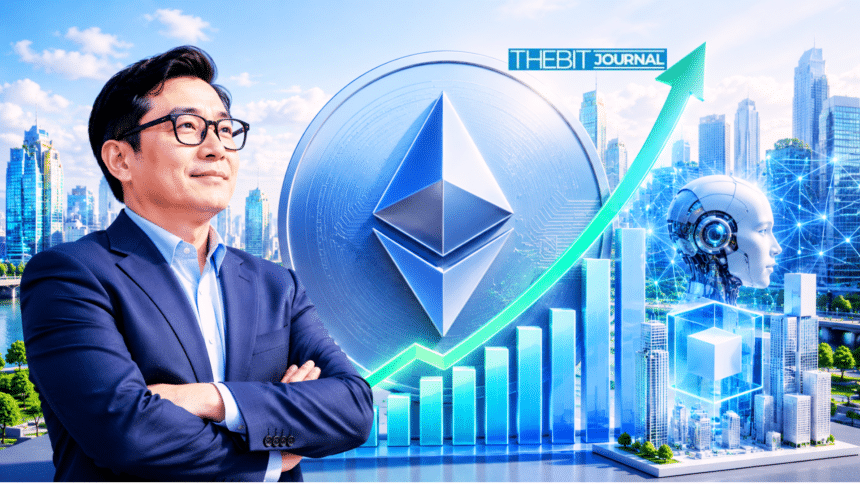

Tom Lee ETH prediction is drawing renewed market attention, though the outlook remains part of a broader debate over Ethereum’s recent underperformance and the impact of geopolitical tensions on crypto markets. Fundstrat Global Advisors Head of Research Tom Lee stated that Ether’s recent weakness reflects temporary macro-driven pressure tied to rising oil prices rather than a structural deterioration in Ethereum’s long-term outlook.
While Bitcoin has declined nearly 12% year-to-date, Ether has fallen close to 28% during the same period as volatility in energy markets and investor caution weighed on risk assets. Lee linked part of Ethereum’s weakness to the sharp rise in crude oil prices during the latest U.S.-Iran tensions. He described the market environment as “short-term tactical noise” while maintaining that tokenization and AI-related blockchain adoption remain long-term structural drivers for Ethereum heading into 2026.
Why Is Tom Lee ETH Prediction Closely Linked to Oil Prices?
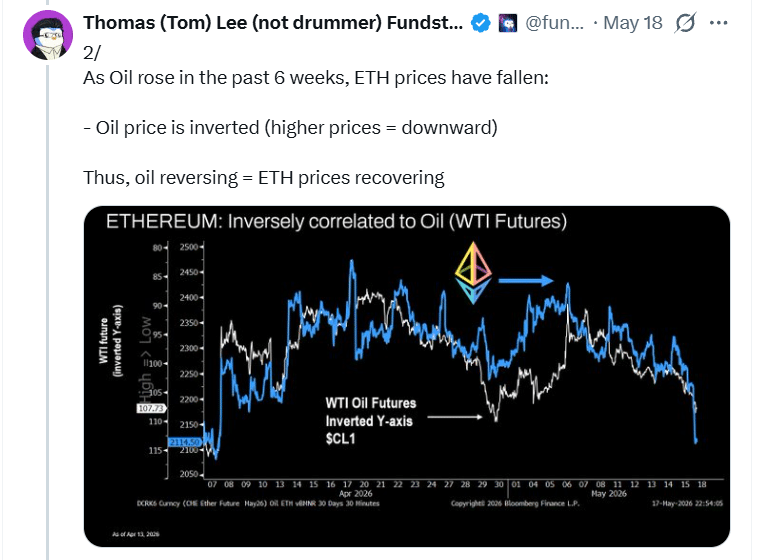
Tom Lee ETH prediction focuses heavily on the relationship between rising crude oil prices and Ethereum’s recent decline. Lee stated on X that higher oil prices had become “the biggest headwind” for ETH during the past several months. He also shared charts on X highlighting the unusually strong inverse correlation between WTI crude and Ethereum over the previous six weeks. As oil prices moved higher, ETH prices weakened sharply.

The relationship intensified after geopolitical tensions involving the U.S., Israel, and Iran triggered renewed volatility across global energy markets. During that period, WTI crude reportedly climbed to $108 while Brent crude briefly touched $111. Lee argued that higher energy prices reinforce inflation concerns and strengthen expectations for tighter monetary policy. That environment typically reduces investor appetite for high-risk assets including cryptocurrencies.
Ether experienced steeper declines than Bitcoin during this phase. ETH is currently trading around $2,137.49, up 0.75% over the past 24 hours but down 7.08% over the past week amid the broader market downturn. The asset also remains roughly 57% below its all-time high. Still, Lee maintained that the current weakness reflects temporary macroeconomic conditions rather than a long-term breakdown in Ethereum’s fundamentals.
What Long-Term Factors Continue Supporting Ethereum?
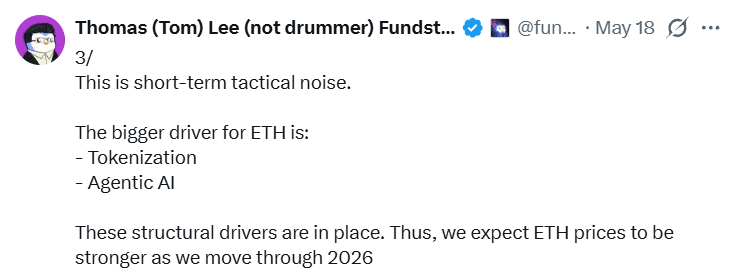
Fundstrat’s view on Ethereum continues to center around tokenization and AI-driven blockchain adoption despite the current market pressure. The first theme involves tokenized financial assets. Ethereum remains one of the leading blockchain ecosystems supporting tokenization and institutional settlement infrastructure. Boston Consulting Group forecasts that tokenized assets may surpass $16 trillion in value by 2030 and contribute close to one-tenth of global GDP.
Institutional activity tied to blockchain-based financial products has continued expanding even during broader crypto market weakness. That trend has strengthened Ethereum’s position within on-chain finance and tokenized asset infrastructure. Lee’s 2026 ETH thesis argues that these institutional adoption trends remain in the early stages and could become more significant over the next several years.
How Does Artificial Intelligence Connect to Ethereum’s Growth Narrative?
Another major component behind Tom Lee ETH prediction involves agentic AI systems and decentralized digital payments. The concept refers to autonomous AI software capable of completing economic interactions independently. Supporters of this thesis believe AI agents may increasingly rely on decentralized blockchain infrastructure because traditional banking systems are not designed for autonomous software transactions.
Ethereum co-founder Vitalik Buterin has described Ethereum as an “economic layer for AI-related interactions,” enabling AIs to interact economically in decentralized environments rather than operating entirely through centralized corporate systems. Some developers believe decentralized AI ecosystems may eventually require programmable blockchain infrastructure capable of handling automated microtransactions and machine-driven settlements at scale.
However, both tokenization and AI-related blockchain activity remain early-stage sectors. Analysts note that adoption could progress more slowly than optimistic projections assume, particularly if regulatory hurdles or technical scalability issues delay broader implementation.
Are Analysts Fully Aligned With Lee’s Outlook?
While Tom Lee ETH prediction has attracted attention across crypto markets, not all analysts agree that oil prices alone explain Ethereum’s recent weakness. Andri Fauzan Adziima, research lead at Bitrue Research Institute, described Ethereum’s recent decline as the result of “multi-factor pressure.” He pointed to ETF outflows, whale selling activity, rising exchange reserves, and Ethereum’s weaker performance relative to Bitcoin. Ethereum ETFs reportedly recorded outflows during all five trading sessions last week.
Weekly redemptions reached $254 million while total net assets in Ether ETF products declined to $12.93 billion. The ETH/BTC ratio also recently touched a ten-month low, reflecting stronger institutional preference toward Bitcoin-focused investment products during uncertain macroeconomic conditions. At the same time, rising ETH exchange reserves suggested more holders were moving assets onto trading platforms, a trend commonly associated with potential selling activity rather than accumulation.
Could Competition Limit Ethereum’s Market Position?
Tom Lee ETH prediction assumes Ethereum will remain central to tokenization and AI-related payment infrastructure. However, analysts continue monitoring competition across the broader blockchain sector. Specialized layer-2 networks and rival smart-contract platforms are also competing for institutional adoption, tokenized finance activity, and AI-related payment infrastructure.
Some market observers believe Ethereum’s transaction costs and scalability challenges could encourage developers and institutions to explore alternative ecosystems. Regulatory scrutiny surrounding tokenized financial assets may also shape adoption rates over the coming years. At the same time, persistent inflation pressures or prolonged geopolitical tensions could continue weighing on risk assets even if blockchain adoption trends remain positive over the longer term.
What Market Indicators Are Investors Watching Now?
Several indicators may influence Ethereum’s next major market move. Oil futures remain closely watched because of the inverse correlation highlighted in Tom Lee ETH prediction.

Investors are also monitoring ETF flows, exchange reserve activity, and the ETH/BTC ratio to gauge institutional positioning toward Ethereum relative to Bitcoin. On-chain tokenization growth and AI-related blockchain payment activity may become increasingly important metrics over time as those sectors continue developing.
Conclusion
Tom Lee’s ETH prediction reflects one of the more closely followed views on Ethereum as investors assess whether the recent downturn is tied primarily to macroeconomic conditions or deeper market-specific pressures. Lee believes rising oil prices and geopolitical instability created temporary selling pressure that accelerated ETH weakness across global markets. At the same time, other analysts continue pointing to ETF outflows, institutional caution, and broader market headwinds as additional factors behind Ethereum’s underperformance.
While tokenization and decentralized AI remain important long-term narratives for Ethereum, the pace of adoption, regulatory developments, and ongoing competition across blockchain infrastructure are likely to shape how the market evolves through 2026. Both slower adoption and faster institutional uptake remain plausible depending on how macroeconomic, regulatory, and technical conditions develop.
Glossary
Tokenization: Turning real-world assets into digital blockchain tokens.
Agentic AI: AI systems that can act and transact independently.
WTI Crude: A key global benchmark for U.S. oil prices.
Blockchain Infrastructure: Core technology powering crypto networks and transactions.
Decentralized Finance: Financial services operating without traditional banks.
Frequently Asked Questions About Tom Lee ETH Prediction
Why has Ethereum fallen recently?
Ethereum has fallen due to rising oil prices and weaker market sentiment.
Why are oil prices affecting Ethereum?
Higher oil prices often reduce investor interest in risky assets like crypto.
How could AI help Ethereum grow?
AI could use Ethereum for automated blockchain payments and transactions.
What did Vitalik Buterin say about AI and Ethereum?
Vitalik Buterin said Ethereum can support economic interactions between AI systems.
Could Ethereum recover in 2026?
Some analysts believe Ethereum could recover as AI and tokenization grow.
Sources: