
This article was first published on The Bit Journal.
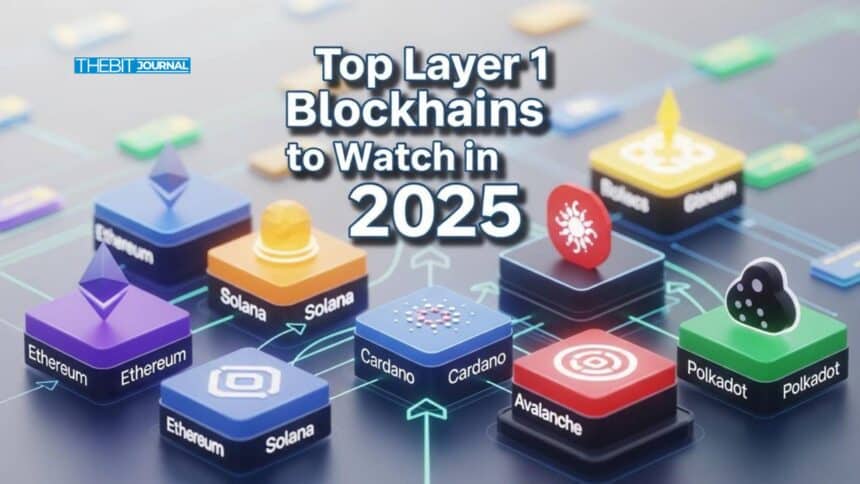
In 2025, layer 1 blockchains are still the base layer of cryptocurrency and decentralized applications. As adoption of the technology grows globally, networks with a strong history like Bitcoin and Ethereum continue their progression alongside high-performance newcomers including Solana and Avalanche breaking records for transactions.
At the same time, the industry is witnessing big fintech and tech giants building their own L1 solutions (e.g., Stripe’s Tempo, Google’s GCUL, Circle’s Arc) indicating they have deep interest in blockchain infrastructure.
What are Layer-1-Blockchains?
Layer 1 blockchains are the main blockchains on top of which everything else is built. They establish fundamental rules for the network, record those transactions while remaining secure without relying on another blockchain.
Notable examples include Bitcoin, Ethereum, Solana. They process transactions directly on their own network, which is why they are referred to as “Layer 1.”
Apps, tokens and other tools can then be created on top of them. Simply put, a Layer 1 blockchain is like the main road, everything begins there and users might later add other systems to help it run faster, or with bigger capacity for more people.
Industry Trends: Scaling, Stablecoins and Interoperability
Blockchain infrastructure has matured rapidly. Major L1 network throughput in aggregate surged more than 100x to 3,450 from fewer than 25 tx/s after just five years; the same order of magnitude reached by legacy systems.
That surge comes from network upgrades and innovations. For instance, Solana ’s high-throughput design is already seeing thousands of TPS and sub-cent fees, resulting in approximately $3billion decentralized app revenue over the last year.
Ethereum’s transition to Proof of Stake (PoS) and rollups has also cut fees. On its L2s (Arbitrum, Optimism, Base), average fees dropped from $24 to mere cents.
Even in L1, stablecoins are helping to boost activity. USDT and USDC transactions have exploded, growing to more than 60% of volume on Ethereum and Tron networks, and now totaling to $46 trillion worth of annual transfers.
In short, 2025’s layer 1 blockchains are enjoying real user growth on the back of DeFi, NFTs and institutional flows, not just speculation.
Simultaneously, the multichain ecosystem is growing with new L1 chains and bridging protocols.
The U.S. government even reportedly considered publishing GDP reports on public blockchains (including Bitcoin, Ethereum, Avalanche and Solana) to enhance data integrity.
Interoperability layers, such as LayerZero and Circle’s Cross-Chain Transfer Protocol have already pushed tens of billions in volume.
These are all valuable signs layer 1 blockchains are no longer isolated silos but a piece of a more connected whole.
Which Top Layer 1 Blockchains Is Worth Investing In for 2025
Below are the L1 chains with the most impact and adoption trends for 2025. All of these have good security and other feature or use-case decisions.
Bitcoin (BTC)
This is the first layer 1 chain and still remains a store of value. With a market cap over $2trillion, Bitcoin draws the focus of huge institutional demand (spot ETFs and corporate treasury buys).
Its PoW model is unparalleled in terms of decentralization. Innovations continue to make Bitcoin more usable. the Lightning Network is bringing instant, low cost payments to the network while new standards, like Ordinals, bring tokenization on BTC.
Though they have power consumption equivalent to small country cities, Bitcoin’s inept layer 1 leads in market cap and on-chain TVL.
Ethereum (ETH)
Ethereum is the original programmable blockchain and is thus the cornerstone of any smart-contract ecosystem.
Its move to PoS (“Merge”) reduced energy consumption 99%, and upcoming sharding is designed to dramatically increase its throughput whilst maintaining decentralization.
But Ethereum’s base-layer throughput (20 TPS) is capped, so most activity has shifted to Layer-2 rollups for the Ethereum blockchain.
In 2025, Ethereum L2 networks (Arbitrum, Optimism, Base etc) have millions of cheap transactions running through them.
Ethereum is only as strong as its large ecosystem and most of the DeFi protocols and NFTs run on Ethereum and institutional staking and ETF inflows.
A recent report also shows that tens of billions are pouring into Ethereum-based E.T.F.s. In other words, Ethereum and its L2 extensions are the beating heart of Web3, blending chain security with new ways to scale.
Solana (SOL)
It is a network meant for super fast transactions. Its proof-of-history model also supports thousands of transactions per second, and sub-cent fees.
This raw speed has drawn NFT marketplaces, meme coin traders and DeFi apps to the chain, giving Solana a fast-rising user base.
Cointelegraph reports Solana at 57million active monthly addresses in 2025 which are the most for any blockchain.
The Solana developer community continues to grow rapidly, despite previous outages under very heavy load. The platform service is even available on mobile, that is the Saga phone, signifying a clear vision for its adaption by the masses.
Scheduled network updates including emerging speed boosts such as “Turbo” are projected to double throughput by the end of 2025.
In summary, L1 Solana is prioritizing speed and low-cost: its high-performance, low fee architecture now supports NFT marketplaces with native usage revenue of 3 billion dollars in the past year.
Avalanche (AVAX)
Avalanche is modular. Its foundational L1 network facilitates custom “subnets” (application-specific L1s) with shared security.
Utilizing DAG-style consensus with sub-second finality, Avalanche is well-suited for high-speed finance. Avalanche, in 2025 has seen dramatic growth. A report published recently offered the proof by concluding its transaction count jumped to outperform all competing chains.
This surge was likely prompted partly by new government use (US Commerce posting economic data) along with a lot of stablecoin and DeFi activity.
Luigi D’Onorio DeMeo, CSO at Ava Labs credits stablecoins and DeFi for the recent Avalanche boom says;
“growth of additional Avalanche L1s… new growth in terms of transactions on the Avalanche C-Chain related to … stablecoins and DeFi.”
Avalanche’s enterprise narrative is also potent. Big firms are using its L1 subnets to tokenize the real world. Should the Avalanche ecosystem maintain this momentum, then it is certainly one layer 1 to keep an eye on even as 2025 bows out.
BNB Chain (BNB)
A Binance-supported EVM-compatible chain (formerly known as BSC), this is a juggernaut for DeFi and trading.
BNB Chain leverages Binance’s gigantic userbase, offering unparalleled liquidity and onramps. Its extremely low fees has enabled it to become a house for popular DApps like PancakeSwap.
In 2025, BNB Chain stands shoulder to shoulder with top chains with its $127 billion market cap and it has millions of active users by on-chain metrics.
The primary issue is centralization, that is validator control by Binance, but from an ecosystem viewpoint, BNB Chain is one of the top L1 blockchains to keep an eye on
TRON (TRX)
TRON focuses on high throughput and low-cost transactions, and most notably where stablecoins are concerned.
It is capable of processing huge volumes of USDT (Tether) daily, with its low fees and quick finality.
TRON introduces the concept of DPOS to pursue extremely high TPS. With a PoS mechanism, TRON can still function efficiently while consuming much less power.
As of 2025, it is still one of the highest L1 networks by DAAs (14.4M as of mid-2025), and market cap of $27B.
It’s weathered some regulatory troubles, but TRON’s user base (especially in Asia and Latin America) keeps growing, largely because it has extremely low costs for on-chain payments and stablecoin transfers.
Cardano (ADA)
Cardano takes more of an academic approach. Its PoS “Ouroboros” consensus and phased rollouts (Byron, Shelley, Goguen, Basho, Voltaire) focus on security and peer review.
Cardano is fully smart contract-enabled by 2025 and rolling out Hydra L2, Set to scale throughput significantly while remaining a decentralized protocol.
The Cardano Summit 2025 shed light on business and DeFi aspirations. The Cardano Foundation pointed to a roadmap concentrating on DeFi liquidity, Web3 integration and tokenization of real-world assets (RWA).
In reality, Cardano has been slower to be adopted than certain rivals, but it still has a strong brand in some areas.
Its focus on “trust and identity” in blockchain has won partnerships (such as those for government ID, and education projects).
For the 2025 viewers, Cardano is looking good for the enterprise-focused developer research. The Hydra v2 upgrade is anticipated to light rocket fuel under DeFi and enterprise adoption on Cardano.
Polkadot and Cosmos (Interoperability)
A bit less hype on these chains than the ones listed above, these two are still worth noting.
Polkadot’s relay-chain architecture and parachains allow multiple specialized L1s to run in parallel with shared security.
Cosmos uses a hub and spoke model (with IBC protocol) to connect separate chains. Both ecosystems are focused on cross-chain interoperability and app-specific blockchains.
Though they’re counts are quite small today, they are crucial projects aimed at the multichain future. Marketcap of Polkadot is around $4B; and for Cosmos, market cap plus usage are greater.
They serve as an alternative L1 strategy, not monoliths but interconnected blockchains.
Emerging Chains (Aptos, Sui etc)
A new set of L1s designed by ex-Meta (Facebook) are starting to take off. Aptos, Sui use the ‘Move’ language and emphasize safety first, parallel execution and throughput (20K TPS).
These chains are VC-backed and are integrating other stablecoins (e.g. USDt on Aptos) and DeFi.
Though these projects remain small compared with Ethereum, they have lively communities of builders.
They are be fascinating to watch as speculative “Layer 1 2.0” on the platforms of 2025, whether they break out or not depends on network effects, new developer tools and marketing.
Metrics for Top Layer 1 Blockchains (2025)
| Blockchain | Estimated Throughput / TPS | 2025 Q2 DeFi TVL Share | Use Cases / Strengths |
|---|---|---|---|
| Ethereum | 20-30 TPS native (much more via L2 rollups) | 60.8% of all tracked TVL for major L1s in Q2 2025 | Smart contracts, DeFi, NFTs, tokenization of assets |
| Solana | Very high (designed for thousands of TPS) | 10.8% of TVL in Q2 2025 | High-speed trading, NFTs, DeFi, mobile, DePIN |
| Avalanche | 4,500 TPS (via subnet architecture) | Smaller but growing subset of DeFi activity as per ecosystem reports | Custom subnets, DeFi, real-world asset tokenization |
| BNB Chain | 60 TPS (Proof-of-Stake-Authority) | Significant DEX and active user share | Trading, smart contracts, bridge to Binance ecosystem |
| TRON | 2,000 TPS (Delegated PoS) | Not always top DeFi by TVL but very high stablecoin volume | Content apps, stablecoin transfers, gaming |
| Bitcoin | 7 TPS (Proof-of-Work) | Not typically used for DeFi TVL (primarily store-of-value) | Digital gold, settlement, Lightning payments |

Expert Take: Behind the Layer 1 Hype With Industry Insiders
Blockchain old-timers had told it that 2025 is when the L1 chains get serious.
Just recently, the CEO of Stripe Patrick Collison explained that a new L1 chain “Tempo” developed with Paradigm will make global payments, remittance, micro transactions and even on-chain tokenized deposits super smooth.
His remark highlights a trend that payments and stablecoins are one of the most popular use cases.
Tempo will further highlight decentralization and stablecoin neutrality, according to Matt Huang of Paradigm, an investor in the project.
Similarly, Google Web3 lead Rich Widmann describes GCUL as a “performance, credibly neutral” blockchain for banks, created so that “any financial institution can build” on it (one bank wouldn’t be locked into a rival’s chain).
In other words, big fintechs see an opportunity to mold the next-gen settlement layers.
At the same time, crypto-native analysis highlights three principles about the trilemma of speed, security and decentralization.
Solana and Avalanche each demonstrate different trade-offs (very high speed, but more centralized nodes) compared to Ethereum’s slower but relatively more decentralized approach.
L1 blockchains are currently competing with L2 networks , experts say.
Luigi DeMeo, co-founder of Ava Labs, attributes Avalanche’s recent surge to fast stablecoin flows and DeFi demand, a tangible sign that what really matters for L1 success are real usage metrics not just token price.
The onboarding of hundreds of thousands of users brings scrutiny, regulators around the world are monitoring stablecoin usage and identity, as evidenced by the recent AML/KYC push across bigger chains.
Conclusion
Analysts believe Layer-1 blockchains that will succeed will provide either unparalleled security (Bitcoin, Ethereum), extraordinary performance (Solana, Avalanche), niche features (Cosmos, Polkadot) or build on large user bases (BNB Chain, TRON).
The institutional push (Stripe, Google, Circle launches) adds another dimension. L1s may also need to serve legacy finance needs and compliance.
For investors and builders, this means closely following which L1s get real traction or partnerships.
In summary, the continued growth of these top layer 1 blockchain projects will be required to determine the future of blockchain technology in 2025 and beyond.
Glossary
Blockchain: A distributed ledger of transactions, kept by a network of computers.
Layer 1 (L1): basic level in the blockchain architecture, with an independent consensus mechanism (e.g., PoW, PoS). L1’s security and validation of transactions is offered by L1s itself.
Proof-of-Work (PoW): A consensus mechanism in which miners provide a proof of resource by solving cryptographic puzzles (or problems, as the case is with Bitcoin).
Proof-of-Stake (PoS): A consensus mechanism where validators put up tokens to protect the network (employed by Ethereum, Cardano etc.).
Throughput (TPS): Transactions per second. How many transactions a blockchain can handle per second.
DeFi: Financial services (loans, trading and insurance) created using blockchain technology.
NFT (non-fungible token): A unique digital asset or collectible token on a blockchain that represents items like art, music and other virtual cutlery.
Subnets/Parachains: Standalone blockchains, running parallel to a main chain (e.g., Avalanche subnets, Polkadot parachains), which share security.
Frequently Asked Questions About Top Layer 1 Blockchains
What is a layer 1 blockchain?
Base blockchain networks with their own native consensus mechanism (eg., Proof-of-Work, PoW; Proof-of-Stake, PoS, etc.) that process and secure transactions endogenously are called layer 1 blockchains. Examples include Bitcoin and Ethereum. Layer 1 blockchains bring the trust and decentralization to decentralized apps (DApps) and digital assets
Why are layer 1 blockchains relevant in 2025?
Layer 1 chains are important because they are secure and decentralized at the heart of crypto. In 2025, they are powering new financial infrastructure such as stablecoins and tokenized assets and scaling solutions. The best leading L1 blockchains continue to experience real user growth as they serve DeFi, NFTs and enterprise projects.
How do stablecoins fit into the layer 1 blockchain protocols?
USDT, USDC etc. are powering enormous transactional volumes on these L1 networks. Trillions of on-chain payments are facilitated by stablecoins, bringing actual usage to these chains. Tron, for example, is home to vast amounts of USDT activity because it has low fees.
What is the differentiation between layer 1 and layer 2 chains?
Layer 1: The base blockchain with its own consensus (Bitcoin, Ethereum). Layer 2 refers to scaling networks that are built on top of a layer 1 (such as Bitcoin’s Lightning Network or Ethereum’s Arbitrum). L2s maintain the security of their parent L1 but handle transactions off-chain (or in rollups) for added speed and reduced fees. By 2025, L1s and L2s cooperate: for example, Ethereum’s L2 ecosystem dominates most low-cost transactions, while Ethereum L1 settles as the ultimate layer.
References