






This article was first published on The Bit Journal.
Vitalik Buterin, co-founder of Ethereum, has ignited the crypto markets by proposing a new way to look at Ethereum’s second-layer (L2) systems. The long-held notion that L2s primarily exist to simply scale the base chain is now old news, Vitalik says, as Ethereum’s Layer 1 (L1) is now scaling even better than a Layer 2.
Instead, he believes Ethereum Layer 2 development should be about delivering a more distinctive proposition and stronger interoperability as opposed to being mere “extensions” of the mainnet.
Re-Assessing the Original Layer 2 Vision
Layer 2 solutions were originally pitched as the scaling solution for Ethereum. The vision was that most transactions would be processed by L2s, including popular rollups like Arbitrum and Optimism at lower costs while taking advantage of Ethereum’s strong security guarantees.
This model, sometimes called branded shards saw L2s as composable extensions of the Ethereum mainnet which added capacity without sacrificing decentralization.
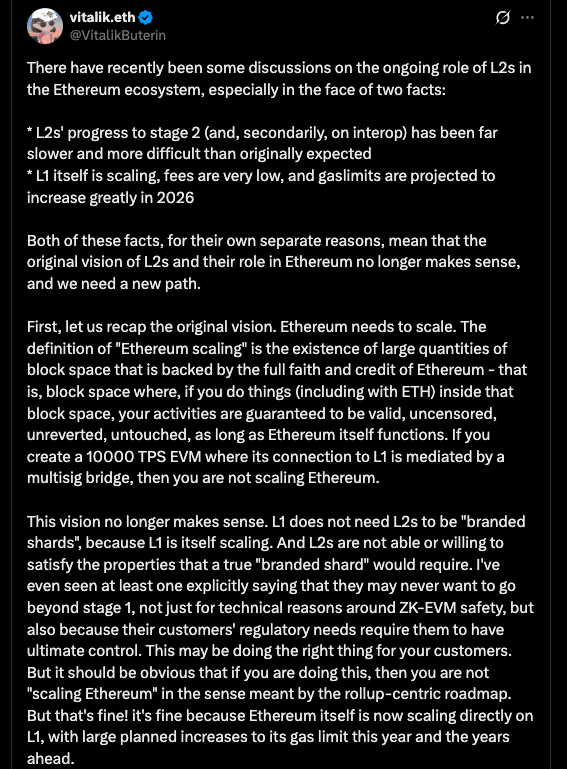
Vitalik now puts it out that this original vision is no longer relevant in today’s world. Many L2s never even reached Stage 2 decentralization that was the initial dream and some of them may likely never be at Stage 2 due to technical complexity, or for commercial and regulatory reasons.
While the base layer of Ethereum scales, transaction fees come down and gas limits are set to rise through 2026, relieving the original pressure to move activity off-chain.
In Vitalik’s words “the original vision of L2s and their role in Ethereum no longer makes sense, and we need a new path.”
What Ethereum Layer 1’s Scaling for L2s
Ethereum has made some technical advancements recently that have improved the scalability of the base layer. One of the upgrades, EIP-4844 (Proto-Danksharding) which is meant to lower data costs for Layer 2 rollups in existing shard chains has further increased Ethereum’s capacity to process transactions on its own.
This progress has lessened the pressure of off-chain scaling a bit and refocused the ecosystem towards more architectural objectives.
Vitalik and other developers now consider Ethereum L1 as the strong, scalable foundation that supports a network of specialized execution environments.
As such, the reasons for Layer 2’s which just replicate base-chain utility is not as sound as it used to be. Ethereum L2s need to bring something to the table that is different from that which a scaled L1 already delivers.
New Direction: From Scaling Specialized Value
Vitalik has laid out a mission for Layer 2 networks beyond simply throughput. He argues that developers should work on L2s that provide a unique value proposition beyond the low-cost of Ethereum transactions. These are privacy improvements, application-specific execution environments (ASEs), ultra-low latency networks, and non-financial or niche use cases.
Alongside specialization, he stresses the importance of maximizing compatibility with Ethereum and between L2s. This would include stronger cross-chain communication and security standards that allow value and data to seamlessly move back and forth between various execution layers, with trust assumptions still maintained at the Ethereum core protocol level.
He has also pointed at the importance of native rollup precompiles, protocol-level capabilities that enhance interoperability and security without depending on external bridges.
By following this approach, he says complexity and risk involved in cross-layer communication can be minimized.
Community and Market Response
The response among Ethereum’s technical community was part support, part strategic re-evaluation.
Many developers agree that scaling progress on L1 lowers barriers to transaction throughput, though some also cite challenges associated with attaining decentralized Stage 2 rollups and fully trustless Layer 2 deployments.
Analysts tracking network usage also note changes in user behavior. As the fees for interacting on base chain remain relatively low, some of the activity that would have otherwise moved to the L2 has chosen to stay on the L1 and is further validating the notion that direct execution on Ethereum can be very practical and cost competitive in a wide set of use cases.
This change in network dynamics adds weight to calls for L2s that offer capabilities beyond simple scalability.
Conclusion
For Ethereum, the long road to scaling has become an inflection point.
Vitalik Buterin’s call to rethink the Ethereum Layer 2 space is not a rejection of L2s, but rather a recommitment to them serving their purpose.
As the base layer is assuming increasingly sophisticated and decentrally enriched roles, Layer 2 networks must mature into value-adding functions that improve the wider utility of the ecosystem.
The future of Ethereum is modular, interconnected, and innovation-based. Layer 2s are no longer just for handling overflow traffic.
They are about unlocking something new, whether it be around privacy, custom execution environments, or specific apps being crafted and designed to secure composable cross-layer experiences.
Glossary
Ethereum Layer 2 evolution: has to do with the changing role and architecture of L2 networks, being more than just mere scaling solutions and becoming dedicated environments with intrinsic modularity.
Layer 2 solutions (L2s): second layer networks from a base blockchain (Ethereum) designed to increase speed, scalability or security.
EIP-4844 (Proto-Danksharding): an Ethereum upgrade that lowers the cost of data for rollups, i.e making it cheaper to post transaction data to the mainnet.
Native rollup precompiles: protocol upgrades that enable a tighter verification of proofs, we get interoperability at a more secure layer.
Frequently asked Questions About Ethereum Layer 2s
What is the purpose of integration of Layer 2s with Ethereum?
Before 2026, L2s were mostly to scale Ethereum by moving transactions off of the base chain but still maintaining the same level of security.
Why is Vitalik advocating for a change now?
That’s because Ethereum Layer 1 is scaling better, and most Ethereum Layer 2s have not achieved full decentralization, lessening the importance of their initial function.
How can Ethereum Layer 2s have new functions?
L2s could be tailored for privacy, application-specific chains, low-latency environments or enable support of non-financial use cases.
Does this mean that L2s are going to be eliminated?
No. The advice is for the L2s to innovate and do something unique, not die off.
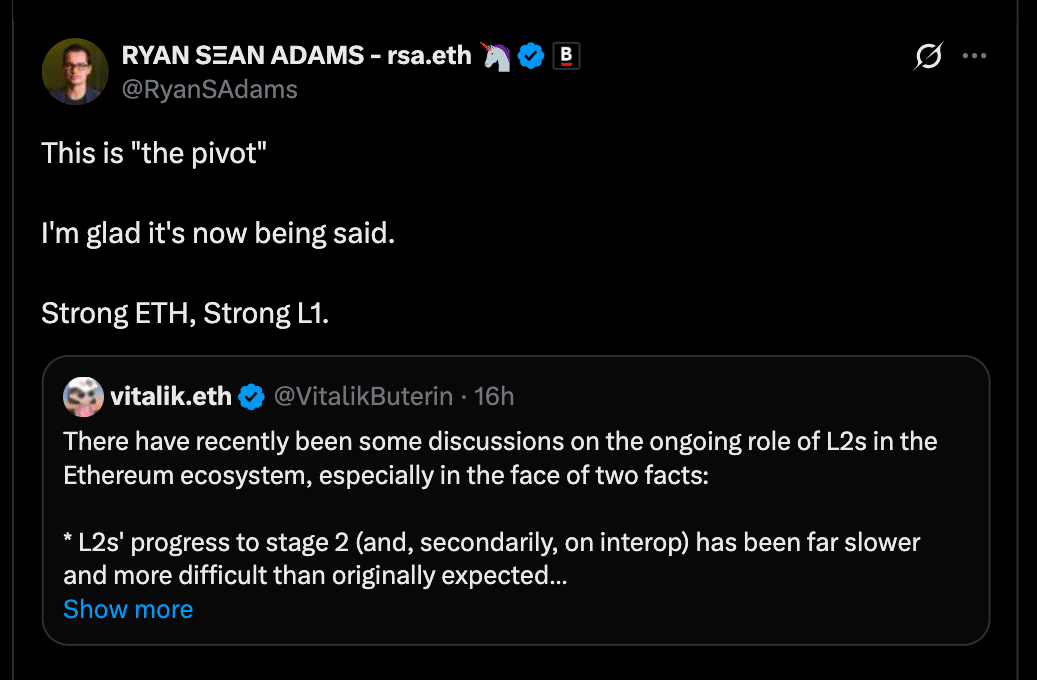
https://x.com/RyanSAdams/status/2018727620624384059
References