






Copy trading is a method that lets one trader automatically mirror another trader’s positions, with the follower choosing an allocation and keeping control over when to pause or stop. It can feel like a shortcut, but the risk still sits with the follower because the positions, leverage, and liquidation rules apply to their account.
Why mirroring has become popular in crypto
Crypto markets can swing hard on a headline, a liquidation wave, or a sudden shift in liquidity. Newcomers often learn the basics, then hit the same wall: entries look obvious in hindsight, while real-time decisions feel messy. Copy trading offers a structured way to observe a repeatable process, then study results like a live workbook instead of a theory lesson.
That social layer can help and hurt. Leaderboards make performance easy to compare, but they also encourage chasing the latest hot streak, which is where many accounts go off the rails.
What is shifting in 2025: more tools, more noise
More venues now display deeper statistics, public trade histories, and risk labels for leaders, which can help followers compare styles. At the same time, social feeds have made hype travel faster than facts, so a calm review process matters even more. A follower who checks drawdown, leverage habits, and market conditions will usually outlast a follower who chases the loudest profile.
How the system works under the hood
Most platforms connect a “leader” account and a “follower” account through rules that replicate positions at a scaled size. Copy trading commonly uses proportional sizing, so a leader risking 2% of their account can be mirrored with 2% of the follower’s allocated funds, if that setting is enabled.
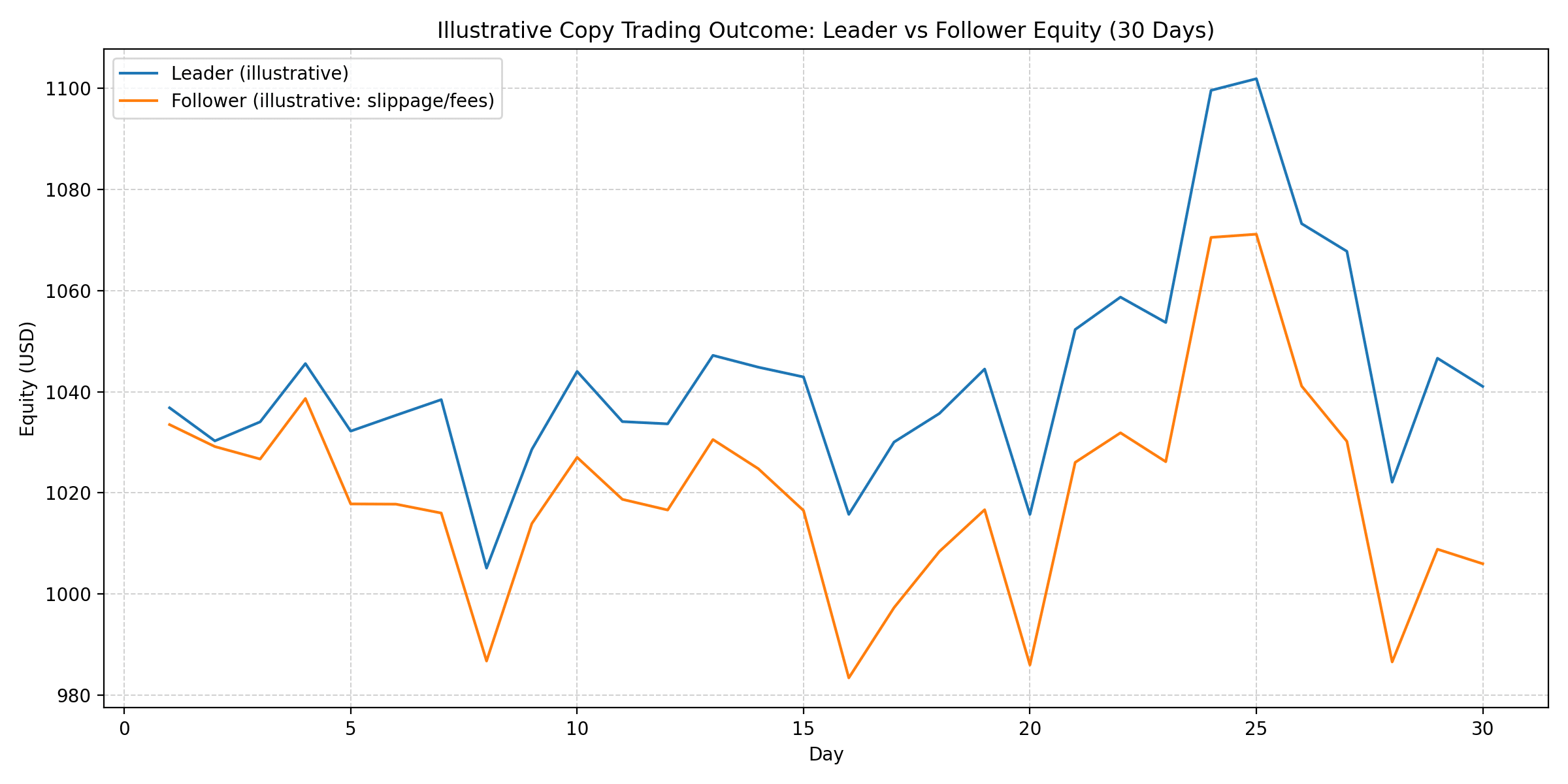
Execution is not identical. A follower may get filled seconds later, at a worse price, especially during fast moves. That gap becomes slippage, and slippage is often the hidden tax that turns a solid strategy into a mediocre one.
What gets copied, and what does not
A follower typically copies trade direction, entry and exit actions, leverage level, and sometimes stop loss and take profit orders. Copy trading does not copy the leader’s research, stress tolerance, or any private hedges they might hold elsewhere. A leader can endure a deep drawdown with a large bankroll, while a smaller follower may panic much earlier.
This is why allocation matters more than excitement. Outsourcing 100% of a trading balance to one leader is not learning, it is dependence.
How beginners can mirror professional strategies without copying professional mistakes
The first goal is consistency, not the biggest return. Copy trading tends to work better when a leader uses modest leverage, keeps position sizes disciplined, and stays calm in sideways markets.
A practical approach is a “learning allocation,” such as 10% to 25% of a trading balance, while the rest stays in longer-term holdings or cash. That separation reduces emotional pressure and makes it easier to evaluate decisions objectively.
A screening checklist for picking a leader
A follower can keep the evaluation simple and still be smart:
Track record length: Several months across different conditions is more meaningful than a two-week sprint.
Max drawdown: Big returns paired with brutal drawdowns often mean the strategy hides risk until it breaks.
Risk per trade: Leaders who risk small slices of capital usually last longer.
Trade frequency: Too many trades can mean overtrading, while too few trades can make results hard to judge.
Style clarity: A leader should match the follower’s tolerance, whether trend-following, range trading, or news-driven momentum.
If copy trading is used as education, it also helps to compare the leader’s notes to their actual positions. Consistency between words and actions is a quiet sign of professionalism.
Key crypto indicators that followers should understand before mirroring anyone
Copy trading is not a substitute for basic market literacy. A follower should understand the signals that change trade quality:
Liquidity and order book depth: Thin books increase slippage and make stops less reliable.
Bid-ask spread: Wider spreads raise the cost of every entry and exit.
Volume: Healthy volume can support breakouts; weak volume can signal traps.
Volatility: Higher volatility increases liquidation risk, especially with leverage.
Open interest and funding rates: Rising open interest can show crowding; extreme funding can hint at one-sided positioning.
Funding and liquidation zones: Crowded trades often unwind fast when a key level breaks.
These indicators explain why a leader’s chart can look clean while a follower’s fills feel chaotic.

Costs that followers should calculate upfront
Copy trading can include revenue sharing, subscriptions, or higher trading fees for certain leader programs. The bigger cost is often market friction: spreads, funding payments in derivatives, and slippage. A follower who mirrors high-frequency scalping is especially exposed because small price differences compound quickly.
Tax reporting can also become more complex when many short-term trades are mirrored. Lower frequency and tighter allocation can reduce that burden.
Pros and cons that actually matter
Copy trading has real advantages when guardrails are in place.
Pros
Faster learning through real examples, not abstract rules.
Reduced decision fatigue for newcomers who freeze during volatility.
A track record that can be reviewed, paused, or replaced.
Cons
Overconfidence from short-term gains that do not reflect true risk.
Execution gaps during fast moves and thin liquidity.
Strategy drift when a leader changes behavior after gaining followers.
Risk controls that should be non-negotiable
Copy trading becomes safer when the follower sets limits before the first trade fires. Useful controls include a max daily loss, a max drawdown, and a cap on leverage. It also helps to avoid adding funds after a winning streak, because that is when followers tend to overestimate skill.
Some followers split capital across two leaders with different styles, but that only makes sense after the first leader has been monitored through losses.
Common mistakes that turn a helpful tool into a hazard
Copy trading often fails for predictable reasons: chasing leaderboard returns, scaling allocation too quickly, and copying strategies that depend on perfect execution. High leverage and rapid scalping are the classic traps because delays and slippage punish followers more than leaders.
Another failure pattern is interference. When a follower starts closing trades early or adding extra side trades, the account becomes a confused mix of strategies with no tested edge.
Conclusion
Frequently Asked Questions
Is mirroring the same as letting someone manage funds?
In most setups, the follower keeps custody and can stop mirroring at any time, so it is different from giving a manager direct control.
Can losses exceed the amount allocated to a leader?
With leverage and liquidation, losses can expand quickly, so allocation limits and leverage caps matter.
What is a reasonable starting allocation?
Many beginners start below 25% of the trading balance until the leader’s risk behavior is clear.
How long should a leader be tested before scaling?
A multi-month window that includes both trending and choppy periods is more informative than a short streak.
Glossary of key terms
Allocation: The portion of capital set aside to mirror a leader’s trades.
Drawdown: The peak-to-trough decline in account value, a key measure of risk.
Funding rate: A periodic payment in perpetual futures that signals crowded positioning.
Liquidity: How easily a trade can be executed without moving the price.
Slippage: The difference between expected price and the actual fill price.
References