






This article was first published on The Bit Journal.
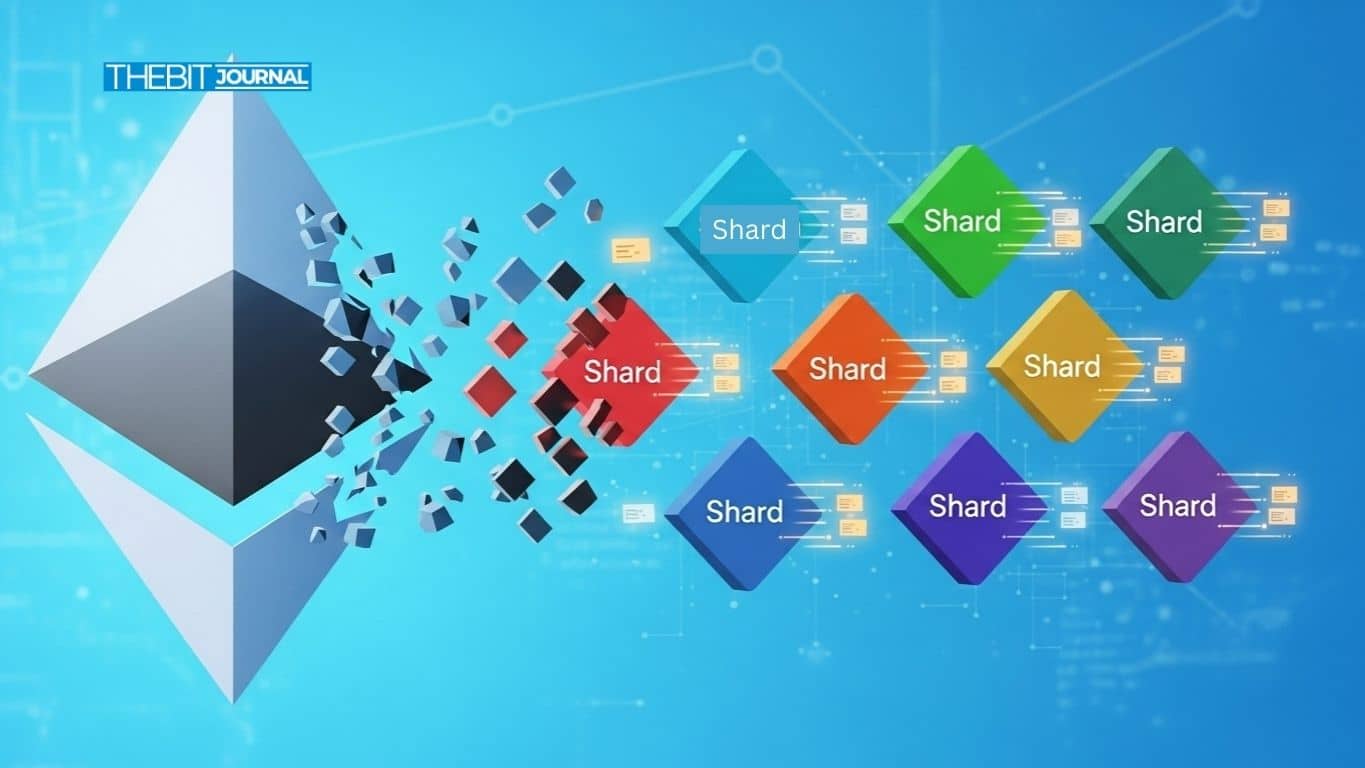
Blockchain sharding can be likened to adding parallel highways for transactions. Take Ethereum’s network, for example, each shard handles its own distinct subnetwork of data and transactions, allowing multiple transactions to be processed concurrently (in parallel).
This really increases throughput while offloading the pressure on each node. In traditional blockchains, every node has to execute all these transactions (which makes it slow), but sharding allows the network to scale out by dividing the work across shards. As usage grows, sharding helps to keep transaction speeds fast and fees low.
Blockchain Sharding Explained: Solving Scalability Challenges
Ethereum and other blockchains have struggled with congestion and high fees as usage increased. Blockchain sharding solves this by partitioning the network. In essence, sharding is “the process of splitting up a database”; in blockchains, it means dividing the ledger and validators into smaller groups (“shards”), so they can process transactions in parallel.
This idea goes back to database systems, and it’s among the most important innovations for blockchain scalability. By splitting transactions across shards, scalability challenges are solved via the following:
Increased throughput: Many transactions can be confirmed at once in network with parallel shards. Shards enable blockchains to process more transactions at the same time while maintaining security and decentralization.
Minimized Node Requirements: Each node processes only its shard’s data, not the whole chain. This means there’s less computing and storage requirement per node, making it easier to run a full node. The more nodes, the better decentralization.
Cost effectiveness: More capacity tends to mean less congestion. Sharded blockchain can scale to increased number of transactions, sometimes reducing average fees as compared to a fully saturated single-chain system. For instance, Ethereum’s EIP-4844 upgrade (a type of sharding) reduced the fees on layer 2 by 10-100×
Fault Isolation: As each shard is semi-independent, failures or attacks can be limited to a single shard. The damage is not disabling to the entire network.
However, blockchain sharding comes with its own set of challenges; transactions that span across shards are hard to coordinate on, and if the shard is small enough, it is also more vulnerable if not properly secured.
How Blockchain Sharding Works
These are the processes in a sharded blockchain:
Partition the Chain: The blockchain is divided into various shards (or partitions), each with its own set of accounts, contracts and history. In essence, each shard is a mini blockchain.
Parallel Processing: Each shard’s validators (or miners) process transactions for that particular shard only. This means shards can run in parallel, increasing the network’s overall processing power. For instance, while Shard A validates one group of transactions, Shard B can validate another at the same time.
Cross-Shard Communication: This is supported using a customized protocol. If a transaction involves accounts on different shards, the shards send messages to each other in order to guarantee that the transaction only gets executed if it is valid on both. This is the way to keep it on a shared ledger even when there is a divergence.
Commit to Main Chain: Every once in a while, the new block or state of each shard is summarized and posted into a main Beacon chain (Singleton root chain). This is what grounds the shards’ work in a global state. The way Ethereum is designed, every shard deposits a batch of transactions (in block format) to the Beacon chain in order to keep the whole network in sync.
In essence, blockchain sharding turns one slow-moving lane into many parallel lanes. Overall throughput skyrockets as transactions fan out across shards.
Benefits and Drawbacks
| Feature | Traditional Blockchain | Sharded Blockchain |
| Throughput | All nodes process all transactions sequentially, so TPS is low. | Shards process transactions in parallel, dramatically increasing TPS |
| Node Requirements | Nodes store full history and validate every transaction (high hardware needs). | Each node handles one shard’s data, greatly reducing storage/CPU demands |
| Gas / Fees | Can spike under heavy load (e.g. congested Ethereum). | Higher capacity per block often means lower average fees, especially as rollup costs drop. |
| Security | Very high, as all nodes verify everything. | Secure but requires careful design; each shard has fewer validators, so protocols must guard against shard-specific attacks. |
| Complexity | Simpler (no shards to coordinate). | More complex: must handle inter-shard consensus and data availability. Coordination overhead is needed. |
| Scalability | Limited by block size/time (e.g. 10-15 TPS for Ethereum) | Scales horizontally: new shards can be added to meet demand, enabling thousands of TPS. |
What Does Sharding Mean for Ethereum 2.0 (Proto- and Danksharding)
Before the Merge, Ethereum’s original “Ethereum 2.0” plan envisioned 64 shard chains to scale up throughput. In that vision, a Beacon chain would coordinate validator committees for each shard.
However, by 2022, Ethereum moved to a rollup-centric approach. So instead of full execution shards, Ethereum adopted upgrades that focus on data availability for layer-2 solutions; a variant known as danksharding.
This process began with EIP-4844 (Proto-Danksharding), implemented in the Dencun upgrade. This added a new transaction type dealing with “blob” data (of size up to 125 kB) using KZG commitments. Blobs are temporary data stored by Ethereum nodes.
To put it in a simple way, Ethereum now has a different “data lane” for bulk rollup data. This modification itself doesn’t really create separate shards, but it prepares the way for a proper sharding in the future.
Importantly, EIP-4844 made posting data for rollups 10-100× cheaper and reduces layer-2 transaction fees significantly.
Blobs enable rollups to access data cost-effectively without inflating storage across every node.
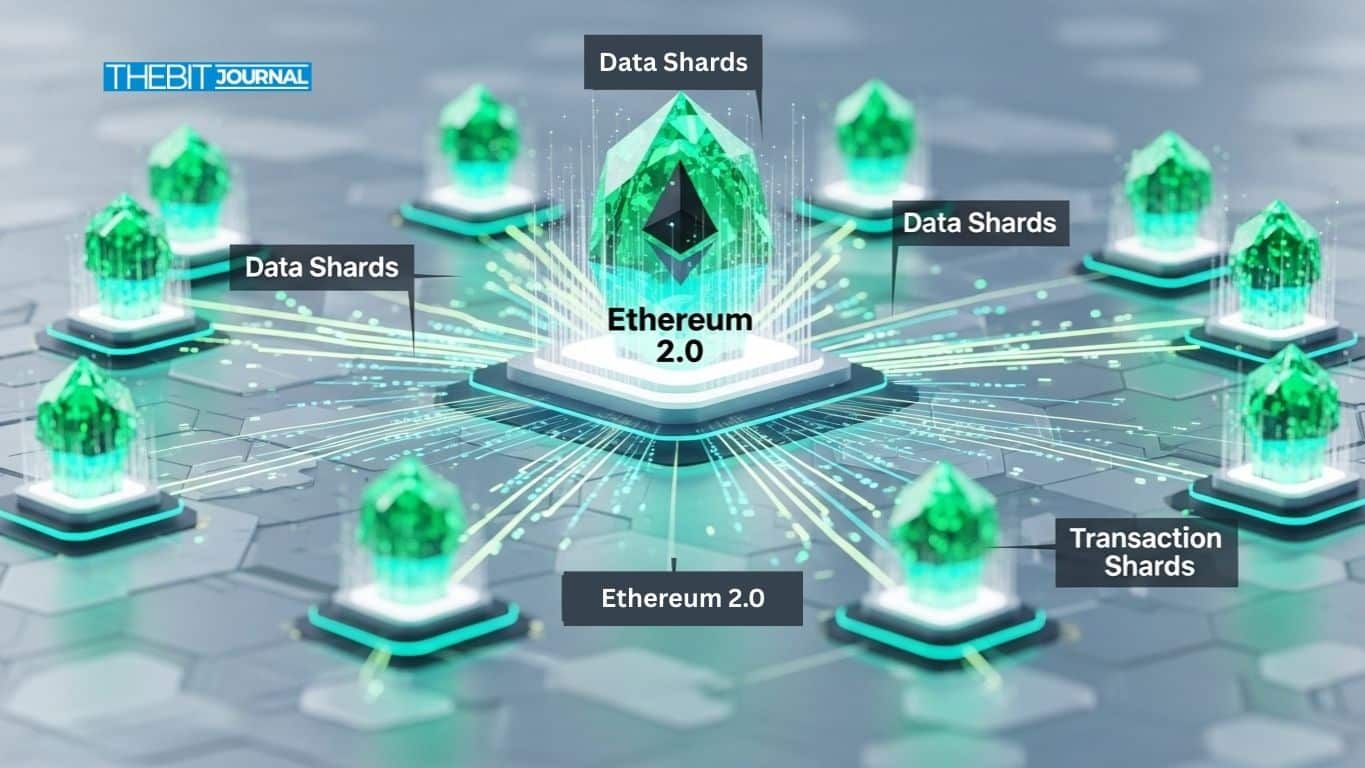
And now, Ethereum is gradually building out this data layer. Pectra upgrade in May 2025 doubled the amount of blobs per block from 3 to 6, halving cost further.
Then came Fusaka in Dec 3, 2025, with PeerDAS(Peer-to-Peer Data Availability Sampling). PeerDAS lets nodes verify that massive quantities of data are posted without needing to download it.
Fusaka greatly increases the network’s data “bandwidth” and allows for more transactions to be squeezed through at low cost.
Ethereum founder Vitalik Buterin notes that PeerDAS is “the first working implementation of data sharding.”
Though he warns this isn’t “full sharding” yet. So, as of now, Ethereum’s base layer still processes blocks serially, with all transactions sharing the same global pool.
In other words, today, Ethereum 2.0 spreads data (scaling rollups) but doesn’t yet split execution among shards. Buterin emphasizes where the road map is headed: as rollup and zkEVM technology matures, Ethereum will gradually turn these scaling tools inwards to scale its mainnet gas capacity.
Looking ahead, Danksharding is listed as one of Ethereum’s big goals. The upcoming Glamsterdam upgrade (2026) is expected to include block-level access lists and proposer-builder separation which opens the door to even faster data-handling.
Basically, the current focus for Ethereum is to use sharding ideas in supporting layer-2 scaling, rather than immediately attempting to partition their execution into many independent chains.
The goal of Ethereum is described by experts as “splitting verification work across the network rather than asking every node to replicate everything”.
For users, these Ethereum sharding-related upgrades mean transactions that are many times cheaper and faster on rollups. EIP-4844 on its own has dropped rollup fees by an order of magnitude.
The additional bandwidth increases that are in the works will further decrease congestion and also gas prices. These improvements should eventually contribute to the network’s ability to serve a million more users without compromising security.
Overall, Ethereum 2.0’s progress is changing how data moves through the chain, an important piece of the puzzle for scaling up to thousands of transactions per second.
Conclusion
Blockchain Sharding remains a basic concept for scaling decentralized networks. By breaking a blockchain into parallel shards, transaction throughput can be multiplied without having every node do all the work.
For Ethereum 2.0 specifically, the legacy of sharding can be seen in recent updates: Proto-danksharding (EIP-4844) and related upgrades add a high-capacity data layer that makes layer-2 rollups much cheaper.
These developments address much of Ethereum’s scalability problem by “splitting up verification work” between nodes.
Glossary
Shard: A partition of data and validators in a blockchain. Think of each shard as a mini-blockchain that processes part of the network’s transactions on its own.
Shard Chain (Ethereum): In Ethereum’s design, a shard chain would handle a portion of transactions. Each shard chain periodically commits its state to the Beacon (main) chain
Beacon Chain: The Proof of Stake (PoS) consensus layer of Ethereum 2.0. It coordinates validators and finalizes block production.
Danksharding: A term for Ethereum’s style of sharding, centered around data availability. Danksharding bundles “blobs” of information into blocks to facilitate layer-2 rollups.
Blob (Ethereum): A large (125KB) data payload in a new transaction type introduced by EIP-4844.
Layer-2 Rollup: A second-layer network overlayed on top of Ethereum that stores raw transactions off-chain and sends compressed data to Ethereum.
PeerDAS: (Peer-to-Peer Data Availability Sampling) A feature in the Fusaka upgrade (2025) that enables Ethereum nodes to check data availability without downloading everything
Frequently Asked Questions About Blockchain Sharding
What is blockchain sharding?
Sharding is a scaling solution that divides the network into smaller parts (shards). Each shard processes its own transactions.
How does sharding make blockchain more efficient?
Sharding boosts performance by parallelizing work. With sharding, multiple groups of validators process different transactions simultaneously, boosting the network’s overall throughput
What is Ethereum 2.0 sharding (danksharding)?
The Ethereum 2.0 roadmap introduced the idea of danksharding, which is that layer-2 chains will need data availability rather than independent execution shards. Major features are EIP-4844 (the “proto-danksharding” upgrade) which adds special data blobs to blocks, and PeerDAS which enables data verification without being downloaded by all nodes.
What are the challenges of sharding?
Sharding increases complexity and introduces some security risk. In order to coordinate transactions across shards, there’s need for new protocols for consensus and communication. Smaller shards (with few validators) can be more exposed to attacks if not well secured. Developers must develop cross-shard verification to keep the network consistent.
References
Ethereum
Quicknode
Coinbase
Colony
Coinmarketcap
Nervos