






BitMine Immersion Technologies is now being valued less like a niche operator and more like a balance sheet built around Ether. In mid-December 2025, the company disclosed 3,967,210 ETH as of Dec. 14, 2025, alongside 193 BTC, about $1.0B in cash, and an equity stake described as a “moonshot,” putting the combined value around $13.2B to $13.3B at the time. A later update pushed the Ether figure above 4 million, citing 4,066,062 ETH as of Dec. 21, 2025.
With holdings at that scale, the market tends to treat the ticker as an ETH proxy with corporate features layered on top, which is why valuation conversations shift away from classic operating metrics.
What the disclosures really tell the market
A treasury measured in millions of ETH changes quickly, and the company’s own updates highlight that speed. That matters because the stock’s implied asset value becomes tightly linked to ETH price moves. When ETH rises, the treasury looks richer. When ETH falls, the margin for error narrows, and equity markets often price that risk more harshly than spot markets do.
NAV thinking: why “per share” beats “total ETH”
Treasury-style valuation starts with net asset value, or NAV, which is assets minus liabilities. With ETH as the dominant asset, investors tend to compare the market cap to the estimated treasury value, rather than relying on a pure earnings multiple.
Share count is the hinge. In late December 2025, the stock was described as trading in the low-to-mid $30s with an estimated 425.8 million shares outstanding, putting the equity value around $13B. When market cap sits close to estimated NAV, small moves in ETH price or shares outstanding can swing the implied premium or discount, sometimes summarized as mNAV.
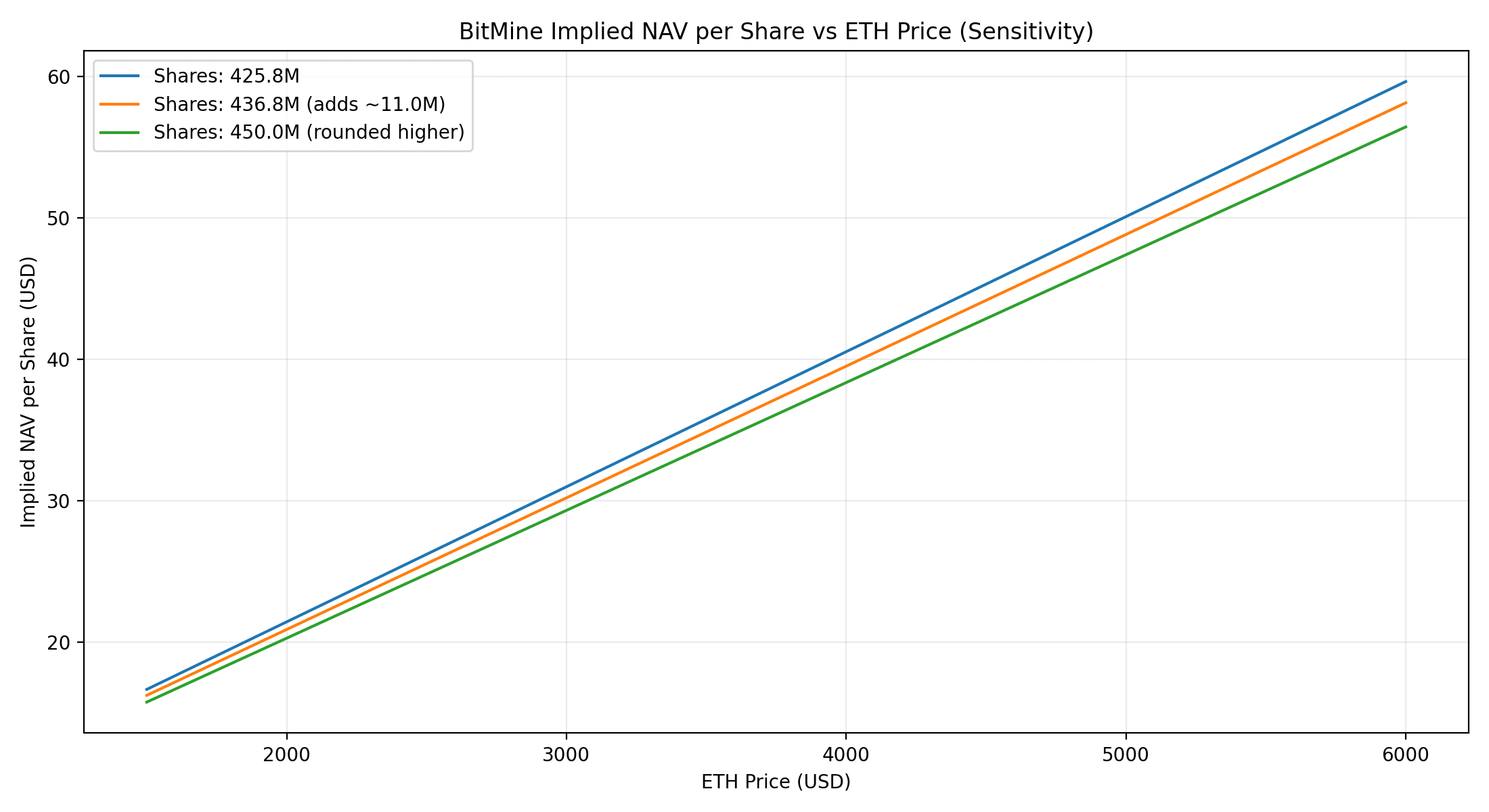
This is why “ETH per share” becomes the core indicator. A growing treasury only compounds for shareholders if the per-share claim on that treasury holds steady or grows.
Dilution and structure: the quiet variable that rewrites the math
BitMine’s 2025 financing included a private investment in public equity, with filings describing 36,309,592 shares issued at $4.50, plus pre-funded warrants for up to 11,006,444 additional shares, alongside other warrant packages tied to the same deal.
Those instruments matter because they expand the fully diluted share count, which can reduce the amount of ETH backing each share even while the headline treasury number climbs. If ETH rises 10% but the diluted share count rises at a similar pace, per-share exposure can stay flat, and the stock can lag the token. That is the hidden tax of the proxy trade.
The market indicators that can move the proxy
Because the treasury is mostly ETH, the stock tends to react to the same indicators traders watch on the token itself. Spot price is the obvious driver, but volatility often matters more for day-to-day moves, since equity flows and margin positioning can magnify swings. Staking yield and network activity matter in a slower way, because they shape whether ETH is viewed as a productive asset or simply a risk asset. Liquidity in the stock matters too, because a liquid proxy can attract fast money on the way up and fast exits on the way down.
The accounting twist that can make earnings look like a price chart
A newer US accounting standard for many in-scope crypto assets moves companies toward fair value measurement, with changes flowing through net income for fiscal years beginning after Dec. 15, 2024. For a company holding billions in ETH, that can make quarterly results swing with market prices, even if management does not sell, which pushes investors back toward NAV math and per-share exposure as the cleaner compass.
Conclusion
With disclosures showing 3,967,210 ETH on Dec. 14, 2025 and 4,066,062 ETH on Dec. 21, 2025, BitMine is increasingly priced like a publicly traded wrapper around Ether, shaped as much by dilution and structure as by the token itself. The headline is the size of the treasury, but the valuation debate lives in the denominator: fully diluted shares and ETH per share. This analysis is educational and does not constitute investment advice.
Frequently Asked Questions
What did the company report for ETH holdings?
It reported 3,967,210 ETH as of Dec. 14, 2025, and later cited 4,066,062 ETH as of Dec. 21, 2025.
Why can the stock diverge from ETH even if the treasury grows?
Share issuance and warrants can reduce ETH per share, so the per-share claim can lag the growth in total holdings.
Why can quarterly results swing without selling any ETH?
Fair value accounting can push unrealized gains and losses through net income, which can make results move with market prices.
What is the simplest way to frame valuation?
Investors often compare market cap to estimated NAV and track fully diluted ETH per share as the core indicator.
Glossary of key terms
Net Asset Value (NAV): Estimated assets minus liabilities, used to frame treasury-style valuation.
Fully diluted share count: Shares outstanding plus shares that could be created from warrants or similar instruments.
ETH per share: A rough measure of how much Ether backs each share once dilution is considered.
mNAV: Market cap divided by estimated NAV, showing premium or discount pricing.
Pre-funded warrant: A warrant where most of the purchase price is paid upfront, leaving a minimal exercise price.
Fair value: A method that updates assets to current market prices at reporting dates.
References