



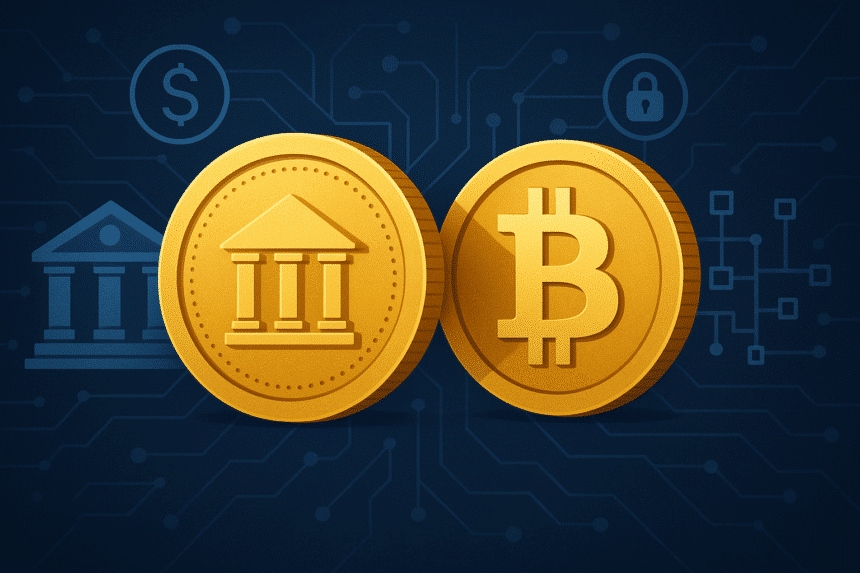

Digital money is becoming a big topic now. You hear about Bitcoin all the time, but now there’s something new people are talking about, Central Bank Digital Currencies, or CBDCs for short. On the surface, both of these are just money you can’t hold in your hand, but in reality, they work in very different ways. And the reasons they exist are also pretty different.
CBDCs are created by a central bank of a country, such as the Federal Reserve in the US or the Bank of England in the UK. Such cryptocurrencies, such as Bitcoin or Ethereum, are developed and operated by individuals through a network that is accessible to everyone. One is government-sponsored, and the other is community-based.
More and more countries are testing CBDCs because they think it can make payments faster, cheaper, and easier to control. At the same time, public cryptos are growing because people want more freedom and privacy with their money. This has created a kind of “digital money showdown” where both systems are trying to win people’s trust.
What Is a Central Bank Digital Currency (CBDC)?
A Central Bank Digital Currency is basically money in digital form, made and controlled by a country’s central bank. It’s not the same as just using your online bank account or a payment app. CBDCs are a brand new type of money that exists only in a digital version, no paper notes or coins.
The main idea behind CBDCs is that instead of holding cash or putting your money in a bank, you could keep it in a digital wallet from the central bank itself. This could make payments faster, easier, and in some cases cheaper. Governments also say it could help stop illegal money use and make the financial system safer.
Why Governments Are Exploring CBDCs
There is a lot of interest in CBDCs by many governments since they desire to have better control over the movement of money. It may assist them to trace money to combat tax evasion, accelerate the delivery of benefits to individuals, or facilitate cross-border payments. In certain nations, there is also the aspect of ensuring that they keep up with the emerging technology and do not lag behind.
Examples of Countries Testing or Launching CBDCs
Some countries are already testing CBDCs. China has been running trials for the digital yuan, The Bahamas has the Sand Dollar, and Nigeria has launched the eNaira. In Europe, the European Central Bank is exploring the digital euro, while the US is still studying the idea.
| Country | CBDC Name | Status | Year Introduced or Tested |
| China | Digital Yuan (e-CNY) | Pilot phase | 2020 |
| Bahamas | Sand Dollar | Fully launched | 2020 |
| Nigeria | eNaira | Fully launched | 2021 |
| Sweden | e-Krona | Pilot phase | 2021 |
| Jamaica | JAM-DEX | Fully launched | 2022 |
What Is a Public Cryptocurrency?
Public cryptocurrency is a type of digital currency not created or regulated by a government. They are rather powered by a network of computers distributed worldwide, known as a blockchain. Everyone is able to participate in this network and maintain it.
The earliest cryptocurrency to be developed publicly is Bitcoin, and it was invented in 2009. Today, there are thousands of others, such as Ethereum, Litecoin, and Cardano. These coins are exchanged through the internet and can be used as payment, investments, or any other form, depending on the design of the coin.
How Public Cryptocurrencies Work
Public cryptos have no control by an individual company or government to the extent that it is decentralized. People record all the transactions on a shared online ledger, which is referred to as a blockchain. Individuals/organizations referred to as miners or validators update the blockchain with new coins or fees as a reward in exchange of their effort.
Popular Examples
- Bitcoin (BTC) -The first and most well-known cryptocurrency, known as the digital gold.
- Ethereum (ETH). This is the cryptocurrency that is renowned for having smart contracts that enable individuals to develop applications over its blockchain.
- Litecoin (LTC) – Designed as a cheaper and faster alternative to Bitcoin, used every day.
| Name | Year Launched | Supply Type | Main Purpose |
| Bitcoin | 2009 | Limited (21 million) | Store of value, payment |
| Ethereum | 2015 | No fixed limit | Smart contracts, apps |
| Litecoin | 2011 | Limited (84 million) | Faster, cheaper payments |
| Cardano | 2017 | Limited (45 billion) | Smart contracts, eco-friendly blockchain |
CBDCs vs. Public Cryptocurrencies – Key Differences
Even though both CBDCs and public cryptocurrencies are types of digital money, they are built for different reasons and work in completely different ways. You can think of it like this — CBDCs are like a digital version of your country’s currency that’s under full government control, while public cryptos are more like community projects that anyone can join.
One big difference is trust. With a CBDC, trust is put in the government and central bank. With a public cryptocurrency, trust comes from the technology itself and the people running the network. Another difference is how much privacy you get. Public cryptos can give more anonymity, while CBDCs will likely have strict tracking.
| Feature | CBDCs | Public Cryptocurrencies |
| Issued By | Central bank of a country | Open network (no single owner) |
| Control | Fully centralized | Fully decentralized |
| Privacy | Low to medium, depends on government policy | Higher, but still traceable on blockchain |
| Value Stability | Stable, tied to national currency | Can be very volatile |
| Technology | Centralized ledger or permissioned blockchain | Public, open blockchain |
| Purpose | Government payments, national transactions | Peer-to-peer payments, global transfers, investments |
| Backing | Backed by the government | No government backing |
How CBDCs Work
CBDCs are built and run by the country’s central bank. That means the bank decides how it works, who can use it, and what rules apply. People would probably use CBDCs through a mobile app or an account linked to the central bank.
Centralized Control by Central Banks
A CBDC will allow the central bank to issue new money, freeze accounts, or monitor transactions when required. According to its supporters, this is good in preventing crime and maintaining a stable economy. Critics fear that it may end up giving too much control to governments on how people spend.
Technology Behind CBDCs
Not all CBDCs employ a type of blockchain, although not necessarily Bitcoin or Ethereum. Rather, they tend to apply permissioned blockchains in which only authorized organizations can undertake transactions. This makes it easier and quicker to control.
Potential Benefits
Governments are claiming that CBDCs will speed up payments, cut business expenses and allow unbanked individuals to enter the financial system more easily.
| Benefits for Governments | Benefits for Citizens |
| Better control over money supply | Faster payments |
| Easier to track and stop crime | Low or no fees |
| Can send aid directly to people | Works without needing a bank account |
| More efficient tax collection | Easier cross-border transfers |
How Public Cryptocurrencies Work
Cryptocurrencies that are publicly traded operate on what is referred to as a blockchain. A blockchain is like a shared notebook on the internet, which anyone can view but no one can delete/alter without everyone being aware of it. That is the reason why public cryptos are safe and difficult to defraud.
Blockchain and Decentralization
In contrast to CBDCs, there is no single bank or government that is in control. Rather, copies of the blockchain are stored on thousands of computers around the world. They collaborate to verify transactions. This implies that the network does not shut down even when some computers are offline.
Mining and Staking Explained Simply
Others, such as Bitcoin, employ the process of mining. Special computers are used by people to carry out the solution of puzzles, and the winner has the opportunity to append the following page to the blockchain and receive new coins. Others, such as Ethereum today, employ staking. It is here that individuals stake some of their coins in a bid to contribute to the security of the network and be rewarded.
Why No Single Authority Is in Charge
The entire purpose of public cryptocurrencies is to enable individuals to transfer and receive money without having to seek approval from a bank or government. This independence is a major factor as to why a lot of people seem to like them, but it also means that there is no one to call in case you go wrong or get conned.
| Cryptocurrency | Network Type | Transaction Speed* | Energy Use |
| Bitcoin | Proof of Work | ~7 transactions/sec | High |
| Ethereum | Proof of Stake | ~30 transactions/sec | Low |
| Solana | Proof of History | ~2,000+ transactions/sec | Low |
| Litecoin | Proof of Work | ~56 transactions/sec | Medium |
Pros and Cons of CBDCs
CBDCs come with both good sides and bad sides, and these can look very different depending on whether you are a government or a regular person.
Advantages for Governments and People
For governments, CBDCs can make it easier to manage the economy, collect taxes, and stop illegal transactions. For people, it can mean faster payments, lower fees, and easier access to money, even if they don’t have a bank account.
Concerns About Surveillance and Control
One of the biggest worries people have about CBDCs is privacy. Since the central bank can see all the transactions, it could track how people spend their money. Some people are okay with this if it stops crime, while others think it’s too much control.
Here’s a table to show the pros and cons:
| Pros | Cons |
| Stable value tied to national currency | Less privacy for users |
| Faster and cheaper transactions | Government can freeze accounts |
| Helps people without bank accounts | Can be used for financial surveillance |
| Good for sending aid directly | May reduce demand for cash |
| Easy to use for daily payments | Not available in every country yet |
Pros and Cons of Public Cryptocurrencies
Public cryptocurrencies have made a big impact on how people think about money. They give more control to the user, but they also come with challenges that can’t be ignored.
Advantages Like Freedom and Privacy
One of the best things about public cryptos is that they let you send money anywhere in the world without asking for permission. Some coins also give more privacy than traditional banking. You can hold your funds yourself without relying on a bank, which some people see as real financial freedom.
Issues Like Volatility and Lack of Regulation
The downside is prices can change fast. A coin might be worth $40,000 today and drop to $35,000 tomorrow. Also, because no government runs it, there’s less protection if you lose your money or get scammed.
Which One Is Safer?
| Safety Factor | CBDCs | Public Cryptocurrencies |
| Price Stability | High | Low |
| Government Protection | Yes | No |
| Privacy | Low to Medium | Medium to High |
| Risk of Hacks | Medium | Medium to High |
| User Control | Low | High |
The Future of Money
Nobody really knows for sure what the future will look like, but it’s clear both CBDCs and public cryptocurrencies are going to play a big role in it. Some experts think CBDCs could replace a lot of the use cases for regular bank accounts and cash. Governments will probably push for people to use them because it gives them better control over the financial system.
On the other hand, public cryptocurrencies are not going away anytime soon. They offer something CBDCs never will — true decentralization and independence from government control. People who value freedom and privacy will keep using them, even if CBDCs become the main type of digital money for everyday payments.
There’s also a big chance that both could exist side by side. You might use a CBDC to pay taxes or get your salary, but use a cryptocurrency for investments, cross-border payments, or savings.
Final Thoughts
CBDCs and public cryptocurrencies are both forms of digital money, but they have very different goals and designs. CBDCs are built for stability, control, and official use. Public cryptos are built for freedom, privacy, and innovation.
If you want something stable and backed by the government, CBDCs might make more sense. If you want independence and don’t mind risk, public cryptocurrencies could be your pick.
The truth is, the world is changing fast, and the future of money might include both. You might pay your rent with a CBDC one day and invest in a cryptocurrency the next. The most important thing is to understand how each works so you can choose what’s right for you.
FAQs
Q1: What is the main difference between CBDCs and public cryptocurrencies?
CBDCs are digital money made and controlled by a country’s central bank, while public cryptocurrencies are run on decentralized networks with no single authority.
Q2: Are CBDCs safer than cryptocurrencies?
CBDCs are more stable in value and backed by the government, while cryptocurrencies can be riskier but offer more independence and control over your funds.
Q3: Can CBDCs and cryptocurrencies exist together?
Yes, they can. People might use CBDCs for everyday payments and cryptocurrencies for investments, cross-border transfers, or privacy-focused transactions.
Q4: Do cryptocurrencies have government backing?
No, public cryptocurrencies are not backed by any government. Their value comes from supply, demand, and market trust.
Q5: Will CBDCs replace cash completely?
It’s possible in the future, but many countries are still in testing stages. Cash will likely remain for some time, especially in areas with low digital access.
Glossary
- CBDC (Central Bank Digital Currency): A digital version of a country’s official currency, issued by the central bank.
- Blockchain: A shared digital ledger that records transactions in a secure and transparent way.
- Decentralization: A system where no single person or group controls everything.
- Mining: The process of creating new cryptocurrency coins and confirming transactions using computer power.
- Staking: Locking up cryptocurrency to help secure a network and earn rewards.
- Volatility: How much the price of something goes up and down in a short period.
Summary
The present paper explains the distinction between public cryptocurrencies and Central Bank Digital Currencies (CBDCs). CBDCs are state-issued and offer stability, but the cryptocurrencies issued by the people lack the stability of state-issued ones and may be volatile. Both can affect the future of money, and they may simultaneously appear in everyday lives.