






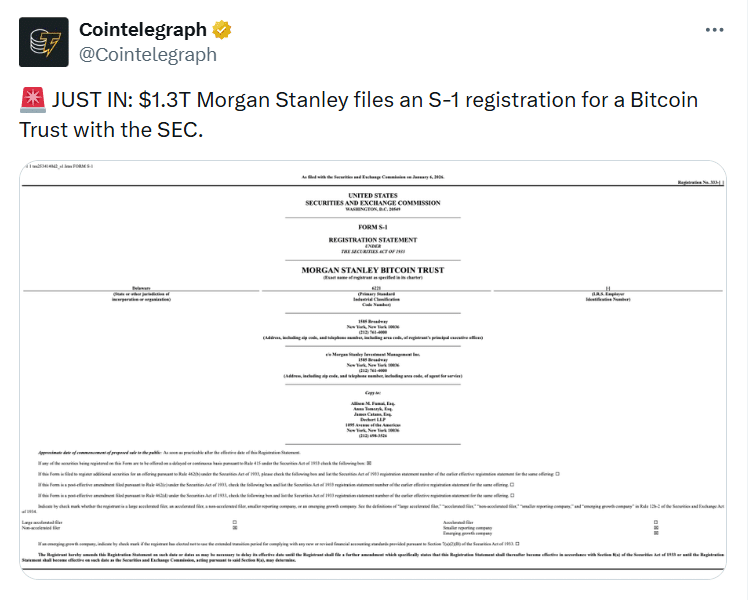
The Morgan Stanley Bitcoin Trust filing marks a major step as the firm seeks to offer clients regulated access to Bitcoin. The S-1 registration submitted to the U.S. Securities and Exchange Commission outlines a proposed trust structured within established regulatory frameworks.
Managing more than $1.3 trillion in assets, Morgan Stanley is positioning the product to provide Bitcoin exposure through traditional brokerage and wealth-management channels, without requiring investors to hold the cryptocurrency directly. The filing begins the SEC review process, signaling growing institutional interest in regulated Bitcoin investment products.
How Did Morgan Stanley File the Bitcoin Trust and What Does It Offer?
The Morgan Stanley Bitcoin Trust filed an S-1 registration statement with the U.S. Securities and Exchange Commission, outlining Morgan Stanley’s plan to provide Bitcoin exposure without requiring investors to hold the cryptocurrency directly. Through this filing, the firm has described its intent to structure the trust within existing securities regulations, ensuring transparency on risk, custody, and operational considerations.

This type of trust is designed to offer Bitcoin exposure through traditional brokerage and wealth-management channels, rather than via crypto-native platforms.
The Morgan Stanley Bitcoin Trust filing represents a notable step in bridging traditional finance and digital assets. With more than $1.3 trillion in assets under management, Morgan Stanley’s decision to file the S-1 for the trust underscores growing institutional confidence in Bitcoin as a recognized asset class.
How would the trust be structured if approved?
According to the Morgan Stanley Bitcoin Trust filing, the product is designed as a passive investment vehicle. It is intended to track the price of Bitcoin after fees and expenses. The trust would hold Bitcoin directly. Rather than relying on derivatives or complex trading strategies.
Morgan Stanley Investment Management is identified as the sponsor. This indicates that product would be managed within the firm’s existing asset-management infrastructure. This structure aligns the trust with other regulated investment products familiar to institutional and high-net-worth investors.
What does this say about institutional adoption of Bitcoin?
The Morgan Stanley Bitcoin Trust filing represents a notable step forward in how leading financial institutions are embracing Bitcoin exposure. Rather than restricting access to private placements or exclusive advisory allocations, this filing underscores Morgan Stanley’s initiative to deliver Bitcoin through a regulated and standardized investment structure.
By designing the trust within recognized regulatory frameworks, the product enables clients to gain exposure to Bitcoin via traditional brokerage and wealth management platforms, eliminating the need to directly hold or manage the cryptocurrency themselves.
How does this fit into the broader regulatory landscape?
The timing of the Morgan Stanley Bitcoin Trust filing is notable. The markets track U.S. regulatory developments around Bitcoin investment products. While SEC approval remains unconfirmed the filing adds to the growing list of institutional Bitcoin products under review.

By following standard regulatory processes, Morgan Stanley positions the trust to integrate Bitcoin into regulated investment channels. This enables clients to access it through conventional financial platforms rather than holding it directly
Conclusion
The Morgan Stanley Bitcoin Trust S-1 filing doesn’t include details on approval, funding, or launch timing. It simply shows the firm’s intention to offer clients regulated Bitcoin exposure through a structured investment product.
With the SEC review underway, this filing demonstrates how big institutions are gearing up to address steady demand for compliant crypto access. Industry watchers will keep a close eye on its progress and what it could mean for institutional Bitcoin adoption.
Glossary
Morgan Stanley Bitcoin Trust: A regulated trust giving clients access to Bitcoin.
S-1 Filing: A SEC form to register a new investment product.
Passive Investment Vehicle: A fund that tracks an asset’s price without active trading.
Derivatives: Contracts tied to an asset’s value for risk or profit.
Custody: Safe storage of financial or digital assets.
Frequently Asked Questions About Morgan Stanley Bitcoin Trust
Who filed the Bitcoin trust?
Morgan Stanley a large U.S. financial institution with over $1.3 trillion in assets filed the trust.
How will trust give access to Bitcoin?
The trust will allow clients to invest in Bitcoin. Through regulated channels like Morgan Stanley’s brokerage and wealth-management platforms.
How is the trust structured?
The trust is designed as a passive investment vehicle. It directly holds Bitcoin and tracks its price after fees and expenses.
Will clients need to hold Bitcoin themselves?
No, clients will get Bitcoin exposure without holding or managing the cryptocurrency directly.
Why is this filing important for the crypto market?
It shows that large financial institutions like Morgan Stanley are increasing their confidence in Bitcoin. And moving toward regulated crypto offerings.
Sources