




Cryptocurrency trading has grown very fast in the last few years. Millions of people now use crypto not only to invest but also to send money, save, or buy digital goods. The center of this activity is the crypto exchange. Exchanges are the marketplaces where crypto gets traded between users.
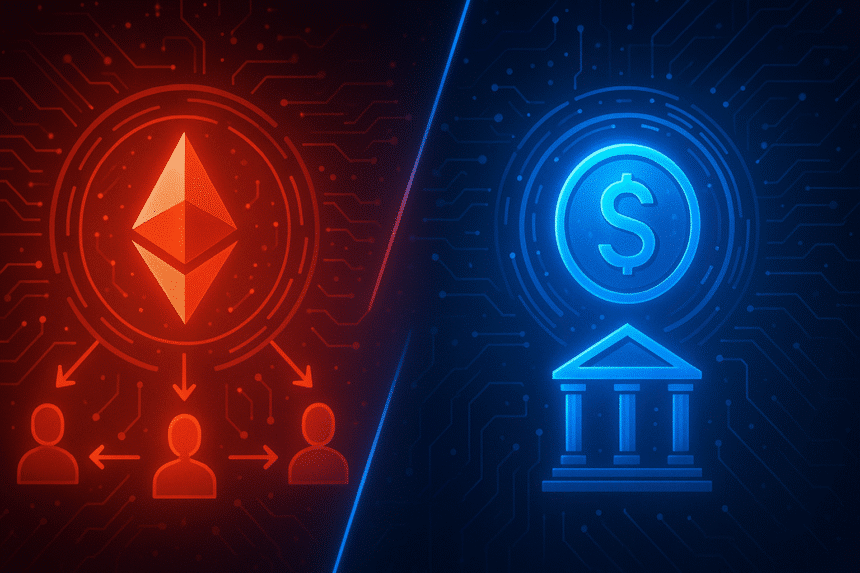
Exchanges can be divided into two. A single one is known as a Centralized Exchange (CEX), and it is operated by a company or an organization. The other type is called Decentralized Exchange (DEX), which works directly on blockchain without any middle company. Both of them help in buying and selling crypto, but they are very different in how they work.
Many new traders wonder which one is better. Some think centralized exchanges are easier, while others believe decentralized exchanges are safer. This guide explains the difference between the two in simple words. The goal is to show how both systems work, what are the good and bad sides, and what to expect in 2025.
What Is a Centralized Exchange (CEX)?
A centralized exchange, often called CEX, is like a regular stock exchange but for crypto. The platform, servers, and customer accounts are all under the management of the same company. Binance, Coinbase, and Kraken are a few examples.
A person must register, provide personal information, and deposit funds or cryptocurrency in order to trade on a CEX. The exchange facilitates trades between buyers and sellers and keeps the money in its system. This indicates that the business is the intermediary that governs how everything operates.
CEX platforms are popular because they are easy to use. They have apps and websites with simple buttons. Many allow direct payments with bank accounts or credit cards. For beginners this makes it very simple to start.
But centralized exchanges also have problems. Since they control user funds, they can freeze accounts. Hackers also attack them because large amounts of money are stored in one place. Some exchanges have been shut down in the past, which caused users to lose money.
What Is a Decentralized Exchange (DEX)?
A DEX is a decentralized exchange and it functions differently. There is no preferred company to keep the money. Trades occur instead in direct blockchain transactions via smart contracts. Some of them are Uniswap, PancakeSwap, Curve and dYdX.
With a DEX, the user will not have to open an account with his or her personal information. They attach their wallets such as MetaMask and trade right within it. They keep the wallet in their possession and do not hand over their personal keys to anybody.
Control and privacy is the major benefit of DEX. No one is able to freeze the money since the wallet belongs to the user. No complex signup processes are also necessary. Other individuals like DEX, as it is more reminiscent of the original ethos of crypto, which is freedom and decentralization.
But DEX also has challenges. It is harder for beginners to use, since it requires knowledge about wallets and gas fees. The fees can also be higher during busy times on the blockchain. Liquidity is sometimes low, which makes trading slow or costly for big orders.
Key Differences Between DEX and CEX
Now that both types are explained, it is easier to compare them side by side. Centralized exchanges focus on speed, service, and user support. Decentralized exchanges focus on privacy, control, and no middleman.
Here is a simple table showing the main differences between DEX and CEX:
DEX vs CEX – Main Differences
| Feature | Centralized Exchange (CEX) | Decentralized Exchange (DEX) |
| Control of Funds | Exchange holds user funds | Users keep control in personal wallets |
| KYC/Verification | Usually required (ID, documents) | Not required in most cases |
| Ease of Use | Very easy, apps and customer support | Can be hard for beginners, more complex |
| Liquidity | Usually high, fast trading | Depends on liquidity pools, can be low |
| Security Risks | Hacking of exchange is possible | Smart contract bugs or scams possible |
| Fees | Trading fees + withdrawal fees | Gas fees + liquidity provider fees |
Pros and Cons of Centralized Exchanges
Centralized exchanges have played a big role in bringing millions of new users into crypto. They look and feel very much like online banking apps, so beginners feel comfortable.
The first big advantage is ease of use. Centralized exchanges have polished apps with simple buttons. Many allow users to buy Bitcoin or Ethereum using a debit card in seconds. The trading screens are designed to be easy for anyone.
Another strong point is liquidity. Big CEX platforms like Binance or Coinbase have millions of users and billions in daily trading volume. This means trades are fast and the price difference between buy and sell is small.
Customer support is also an advantage. If something goes wrong, centralized exchanges often have live chat or email support. For a beginner who is not sure how things work, this is very helpful.
But CEX platforms also come with downsides. One of the biggest issues is trust. Since they hold user funds in their own wallets, they can freeze or block access. If the exchange is hacked or collapses, funds may be lost.
Centralized exchanges also ask for full identity verification. Many require ID cards, photos, and sometimes even proof of address. This creates privacy concerns.
Another problem is fees. Most CEXs charge both trading and withdrawal fees. While they are not always very high, they can add up over time.
Pros and Cons of Decentralized Exchanges
Decentralized exchanges bring a very different experience. They remove the middleman and allow users to trade directly from their wallets. This keeps full control of the funds.
The main advantage is privacy. Most DEX platforms do not require identity checks. A person only needs a crypto wallet, which makes trading fast and anonymous.
Control is also important. Since funds remain in the user’s wallet, nobody can freeze or block them. Even if the exchange website goes offline, the smart contracts on blockchain continue to run.
DEX platforms are also more open. Anyone can become a liquidity provider by depositing tokens into a pool and earning a share of trading fees. This gives more power to the community.
Still, decentralized exchanges have drawbacks. One issue is complexity. Many beginners find it confusing to connect wallets, pay gas fees, or understand liquidity pools.
Another weakness is liquidity. Some DEX platforms have lower trading volume, especially for smaller coins. This can cause high slippage, which means the price changes a lot while trading.
Smart contract risks are also real. If a bug exists in the code, hackers can exploit it and steal funds from the pool. There have been cases of DEX hacks in the past.
Security on DEX vs CEX
Security is one of the most important parts of crypto trading. Both CEX and DEX come with risks, but the risks are very different.
Centralized exchanges store large amounts of user funds in their wallets. Hackers often target them because breaking into one exchange can give access to billions of dollars. History has many examples, such as Mt. Gox in 2014 or more recent exchange hacks.
CEX platforms also control private keys. This means users do not truly own their coins. If the company decides to freeze an account, the user cannot move the funds.
Decentralized exchanges solve this by letting users keep full control of their keys. The funds stay in personal wallets, and only the owner can move them. This removes the risk of exchange hacks stealing all funds.
But DEX security is not perfect. Smart contracts can have bugs. Once deployed on blockchain, fixing these bugs is not always easy. Attackers sometimes find ways to drain liquidity pools.
Also, some DEX projects are scams. Developers launch a fake platform, attract liquidity, and then disappear with the money. This is called a rug pull.
Security Features: CEX vs DEX
| Security Aspect | Centralized Exchange (CEX) | Decentralized Exchange (DEX) |
| Custody | Exchange holds funds and private keys | Users hold their own funds in wallets |
| Hacking Risk | High, due to large central wallets | Lower, but smart contract bugs possible |
| Account Freeze | Possible by the company | Not possible, wallet is fully controlled |
| Scams | Fake exchanges exist but regulated ones safer | Rug pulls and fake tokens more common |
| User Responsibility | Lower, exchange manages security | Higher, user must protect wallet & keys |
Fees and Costs Compared
Costs are one of the biggest factors for traders. Centralized and decentralized exchanges charge fees in very different ways.
Centralized exchanges usually have two main charges. The first is a trading fee, which is a small percentage of each trade. The second is withdrawal fees, which apply when moving funds out of the exchange. Many also add hidden costs like higher spreads on simple “buy crypto” options.
Decentralized exchanges work differently. They charge gas fees to use the blockchain. On networks like Ethereum, these fees can sometimes be very high. On cheaper chains like Binance Smart Chain or Polygon, they are much lower.
DEX platforms also charge liquidity provider fees. These are usually smaller, but they go directly to people who supply tokens to the pool.
Overall, CEX may be cheaper for small trades since they handle costs in bulk. But DEX may be cheaper for active traders who value control and avoid high withdrawal fees.
Fee Comparison Example – CEX vs DEX
| Type of Fee | Centralized Exchange (CEX) | Decentralized Exchange (DEX) |
| Trading Fee | 0.1% – 0.5% per trade | 0.2% – 0.3% per trade, goes to liquidity providers |
| Withdrawal Fee | Fixed or % based, depends on token | No withdrawal fee, only network gas fee |
| Gas Fee | Not charged | Charged, depends on blockchain traffic |
| Hidden Costs | Higher spreads on instant buy options | Slippage possible if liquidity is low |
Liquidity and Trading Volume
Liquidity refers to the ease with which an item can be purchased or sold without altering the price significantly. It is highly considered in trading as the low liquidity may render the trade to be costly.
Liquidity in centralized exchanges tends to be very high. They unite millions of users, and the company tends to inject more liquidity into itself to make markets easier. This simplifies the speed and stability of trading large orders.
Liquidity pools are used in decentralized exchanges. Other users, referred to as liquidity providers, fund these pools. In the case of a small pool, the price may change significantly in one trade. This is known as slippage.
Large DEX platforms like Uniswap and PancakeSwap have solved this for popular tokens, but smaller tokens still suffer from poor liquidity. Traders who use DEX must always check the pool size before making big trades.
CEX is often better for very high-volume trades. But for people trading smaller amounts or focusing on privacy, DEX is a good choice even if liquidity is not as deep.
User Experience and Accessibility
User experience is one of the biggest reasons people choose centralized exchanges. Platforms like Coinbase or Binance are made to look friendly, like online banking apps. A person can download the app, sign up, and buy crypto in minutes. Many exchanges even allow deposits with debit or credit cards, which makes things very simple.
CEX platforms also offer customer service. Beginners often face problems with passwords, deposits, or withdrawals. Having live chat or email support helps solve these issues.
Decentralized exchanges are not as smooth for new users. A DEX does not have a signup system or email recovery. Instead, users connect wallets like MetaMask. They also need to pay gas fees, which sometimes confuse beginners.
The layout of a DEX can also be less polished. Many DEX platforms look technical, with charts and options that are hard to understand. There is no customer support. If something goes wrong, the user is on their own.
Still, advanced traders like DEX because it gives more control and privacy. Over time, new DEX platforms are working to improve user experience by creating simpler designs.
Regulations and Legal Issues
Regulation is one of the biggest differences between CEX and DEX. Centralized exchanges are companies that must follow government rules. This means they often require KYC, which includes ID verification and sometimes even proof of income.
Because of these rules, CEX platforms are safer for those worried about scams. Governments can track and control them, and many are insured for losses. However, strict rules can also limit freedom. In some countries, people are blocked from trading certain coins or using features.
Decentralized exchanges are much harder to regulate. They are run by smart contracts on blockchain, not by a company. This makes it almost impossible for governments to shut them down completely.
The downside is risk. Since there are no regulations, scams and rug pulls are more common on DEX. Also, if something goes wrong, there is no legal protection for the user.
In 2025, regulators are paying more attention to DEX platforms. Some countries are trying to set new laws that require decentralized projects to follow basic compliance. But for now, most DEX continue to run without much regulation.
Popular Centralized Exchanges in 2025
Centralized exchanges remain the most popular entry point into crypto. Some of the biggest names in 2025 include:
Coinbase – One of the most beginner-friendly exchanges, especially in the United States. Known for its simple design and strong security.
Binance – The largest global exchange by volume. It has hundreds of tokens, advanced features, and competitive fees.
Kraken – A trusted name with strong security and good fiat-to-crypto support. Popular in Europe and the U.S.
KuCoin – Known for listing many smaller coins early. It attracts users who want to trade new projects before they are listed elsewhere.
Bitfinex – A long-standing exchange with deep liquidity. It is often used by professional traders.
Top Centralized Exchanges in 2025
| Exchange | Key Features | Best For |
| Coinbase | Easy app, insured funds, strong U.S. base | Beginners and casual investors |
| Binance | Hundreds of tokens, low fees, huge liquidity | Global traders and active users |
| Kraken | High security, fiat support, good for pros | U.S. and European traders |
| KuCoin | Many small coins, active community | People looking for altcoins |
| Bitfinex | Deep liquidity, pro trading tools | Advanced and institutional users |
Popular Decentralized Exchanges in 2025
Decentralized exchanges have grown fast since 2020. By 2025, many have billions of dollars locked in liquidity pools. Here are some of the most popular DEX:
Uniswap – The largest DEX on Ethereum. It offers simple swaps, liquidity pools, and governance features. It is the leader in decentralized trading.
PancakeSwap – Built on Binance Smart Chain. It has lower fees compared to Ethereum-based platforms, making it popular with smaller traders.
dYdX – A decentralized platform focused on derivatives and advanced trading. It is popular among serious traders who want leverage.
Curve Finance – Specializes in stablecoin swaps. Known for its very low slippage when trading stablecoins.
SushiSwap – Started as a fork of Uniswap but now has its own ecosystem with staking and yield farming.
Decentralized exchanges continue to improve in both liquidity and user experience. For privacy-focused traders, they remain an attractive choice.
Which Is Better: DEX or CEX?
The question of which exchange is better does not have one answer. Both DEX and CEX bring unique strengths and weaknesses.
Centralized exchanges are better for beginners. They have apps that are easy to use, customer support for help, and very high liquidity. This makes them great for quick trades, big orders, and simple crypto buying with bank cards.
Decentralized exchanges are better for people who value privacy and control. They allow trading without sharing identity documents. Users hold their own funds in personal wallets, which reduces risks of account freezes or hacks on company servers.
For most traders in 2025, the best option is to use both. Many people buy and sell on centralized exchanges for convenience, but then move some funds to decentralized exchanges for private trading or yield farming.
So the real answer depends on the goal. If the priority is ease of use and customer service, CEX wins. If the priority is freedom, privacy, and full control of funds, DEX is the better choice.
Future of Crypto Exchanges in 2025 and Beyond
The future of exchanges looks exciting. Both centralized and decentralized platforms are making changes to improve.
Centralized exchanges are becoming more regulated. In 2025, many governments have started passing stricter laws. Exchanges like Binance and Coinbase are working closer with regulators to ensure compliance. This will bring more trust from big investors but may reduce freedom for some users.
Decentralized exchanges are growing in both liquidity and popularity. Uniswap and PancakeSwap already handle billions in trades each day. More users are learning how to use wallets, and blockchain fees are dropping as new scaling solutions appear.
Hybrid models are also rising. Some platforms are combining the best of both worlds. They act like centralized exchanges with customer support, but they also let users keep custody of their funds. This model could dominate in the future.
Another trend is AI integration. Artificial intelligence is being tested to improve trading bots, detect fraud, and create better liquidity models. Both CEX and DEX may become smarter with these tools.
In the long term, the competition between centralized and decentralized systems will continue. But instead of one winning over the other, it is more likely both will survive side by side.
Frequently Asked Questions
What is the main difference between DEX and CEX?
The main difference is control. Centralized exchanges hold user funds and run the trading system, while decentralized exchanges let users trade directly from their own wallets. CEX is managed by a company, while DEX runs on blockchain smart contracts.
Is DEX safer than CEX?
DEX is safer in the sense that users hold their own funds, so there is no central wallet for hackers to attack. But DEX can still be risky if smart contracts have bugs or if the project is a scam. CEX is safer in terms of customer support and regulations, but funds can be frozen.
Which is cheaper: DEX or CEX?
It depends on the situation. CEX charges trading and withdrawal fees, but they may be low for small trades. DEX charges gas fees, which can be high on some blockchains, but there are no withdrawal fees. The cost can change depending on the network and the amount traded.
Can beginners use decentralized exchanges?
Beginners can use DEX, but it is not as easy as using CEX. DEX requires a wallet like MetaMask and an understanding of gas fees. Many beginners find CEX easier at the start and move to DEX once they learn more about crypto.
Will DEX replace CEX in the future?
It is unlikely that DEX will completely replace CEX. Centralized exchanges are trusted by big investors and follow government rules. Decentralized exchanges offer privacy and freedom. Both will continue to exist, and many traders will use a mix of both depending on needs.
Glossary
Liquidity – How easy it is to buy or sell an asset without changing its price too much.
KYC (Know Your Customer) – A process where centralized exchanges ask for identity documents before allowing trades.
Smart Contract – A piece of code on blockchain that runs automatically when conditions are met. Used in DEX for trades.
Custody – Who holds the funds. In CEX, the exchange holds them. In DEX, the user keeps custody in a personal wallet.
Slippage – The price difference between when a trade is started and when it is finished, often caused by low liquidity.
Liquidity Pool – A pool of tokens supplied by users on a DEX to allow others to trade. The providers earn small fees in return.
Final Summary
Crypto exchanges are the backbone of trading. In 2025, there are two main types: centralized exchanges (CEX) and decentralized exchanges (DEX).
CEX platforms are easy to use, full of liquidity, and supported by customer service. But they require ID verification and they hold user funds, which can be risky in case of hacks or freezes.
DEX platforms offer more privacy and control by letting users trade directly from wallets. They are safer from exchange hacks but can be harder for beginners, with higher risks of scams and smart contract bugs.
Neither system is perfect. For many traders, the best path is using both: CEX for convenience and DEX for freedom. As crypto grows, both models will keep improving, and hybrid solutions may even combine the best of both worlds.