





Digital money is a rapidly changing world. New tokens, coins, and other financial tools are introduced in the market every year. There is one argument still in the spotlight, though: stablecoins vs crypto.
To newcomers, the disparity may also appear minor. Both live on blockchains. Both can be sent online. But the truth is much deeper. Stablecoins are constructed to be price stable. Open markets and volatility are favorable to cryptocurrencies such as Bitcoin and Ethereum.
This article explores the distinctions in plain, simple terms. It also compares and contrasts stablecoin vs bitcoin, revealing why one is more suitable to day to day payments and the other is an investment powerhouse.
What Is Cryptocurrency?
Digital money is cryptocurrency. It is powered by blockchain technology, which is a distributed ledger of transactions on a large number of computers.
Bitcoin, the first cryptocurrency, was released in 2009. It aimed at designing a non-bank peer-to-peer money system. Since that time thousands of other coins such as Ethereum, Solana, and Dogecoin have been introduced to the market.
Key traits of cryptocurrencies:
- Decentralization: No single government or bank controls them.
- Volatility: Prices rise and fall quickly, often within hours.
- Utility: Some of them can be used to pay, others can be used to download apps, games or decentralized finance.
Crypto is a thrilling investment for investors. It is risky however, because of price volatility.
What Are Stablecoins?
A cryptocurrency is referred to as stablecoins. They are pegged or tied, as is typical, to a stable asset, in contrast to Bitcoin or Ethereum. They tend to be pegged on the U.S. dollar.
Examples include:
- Tether (USDT): the largest market value stablecoin.
- USD Coin (USDC): is backed by controlled financial reserves.
- DAI: a smart token that operates on Ethereum code that is considered an automated stable coin.
Key traits of stablecoins:
- Stability: pegged against such assets as the dollar, gold or government bonds.
- Speed: transactions are executed faster than in the traditional bank transfers.
- Utility: useful in remittance, trade and payment.
In a nutshell, stablecoins represent a combination of blockchain speed and stability of fiat money.
Stablecoins vs Crypto: Key Differences
The debate of stablecoins vs crypto comes down to use and design. Both have strengths, but they serve different purposes.
Here’s a quick comparison:
| Feature | Stablecoins | Other Cryptocurrencies |
| Price Stability | Pegged to assets (USD, gold, bonds) | Highly volatile |
| Use Cases | Payments, remittances, savings | Investment, speculation, apps |
| Backing | Reserves or algorithms | Market demand, mining, staking |
| Adoption Speed | Growing fast with regulation | Driven by hype, innovation |
| Regulation | Increasingly clear (US, EU) | Mixed, often unclear |
This table shows why the two are often compared but rarely interchangeable. Stablecoins act like digital cash. Crypto acts like a digital assets.
Security, Regulation, and Adoption
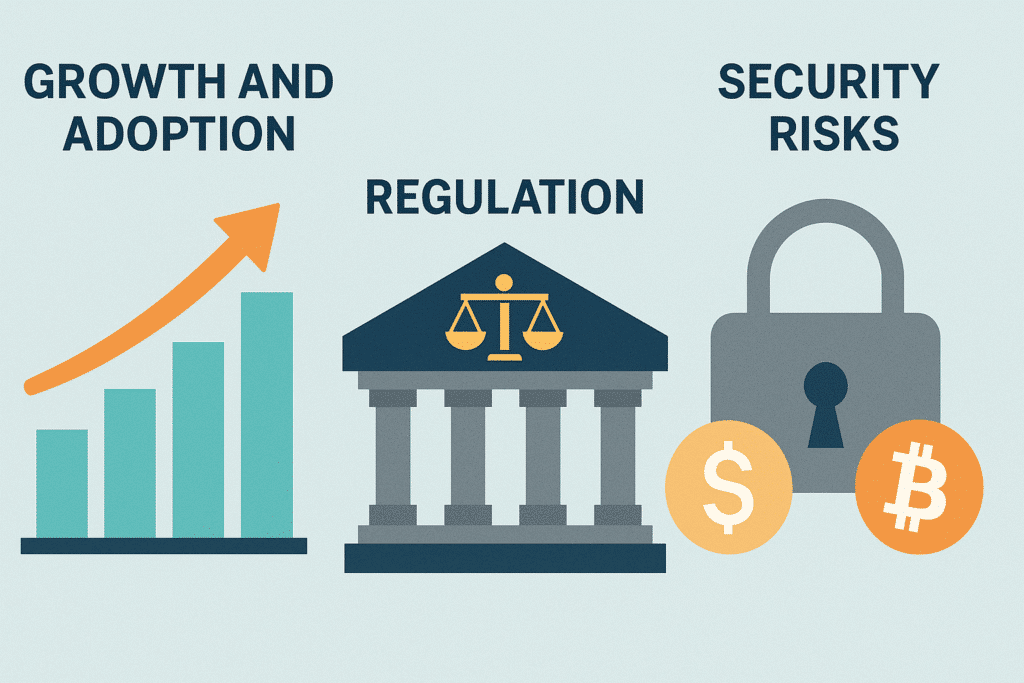
Growth and Adoption
Stablecoins are no longer small players. The report CoinDesk states that global stablecoin transactions reached more than 27 trillion in 2024, excessing Visa and Mastercard as a combined entity. Messari documents the aggregate market worth of stablecoins to be in excess of 246 billion in 2025, increasing over 1200 percent since 2020.
Daily, stablecoins handle about $30 billion in transfers, according to MIT research. That’s less than 1% of global payments, but the growth trend is clear.
Regulation
The U.S. passed the GENIUS Act in July 2025. It sets clear rules for stablecoins backed by cash, government debt, or other safe reserves. Under this law, big banks and fintech firms can now issue stablecoins legally.
The SEC has warned about risks when stablecoins lack reserves. Some past failures, like the collapse of TerraUSD, proved that weak models can hurt investors.
Over the European Union, regulators sounded alerts that U.S. dollar-backed stable-coins would undermine the position of the euro in international trade.
Security Risks
- Stablecoins depend on trust in issuers. If reserves are weak, the peg may fail.
- Cryptocurrencies depend on open networks. Hacks and scams remain threats.
- Both face regulatory uncertainty in some regions.
The mix of adoption and regulation shows that stablecoins may become mainstream, while crypto keeps pushing innovation.
Stablecoin vs Bitcoin
This section looks at stablecoin vs bitcoin directly.
Price Behavior
- Bitcoin is volatile. Its price can move 5–10% in a single day.
- Stablecoins hold steady, pegged at around $1 or the chosen asset.
Speed and Cost
Bitcoin is slower for small payments. It processes about 7 transactions per second. Fees can rise during busy times. Stablecoins on networks like Solana or Polygon move funds almost instantly at very low cost.
Purpose
- Bitcoin: Long-term store of value, “digital gold,” hedge against inflation.
- Stablecoins: Everyday money, payments, remittances, and trading tools.
Stablecoin vs Bitcoin Usage in 2025 (Approximate data from Messari & CoinDesk):
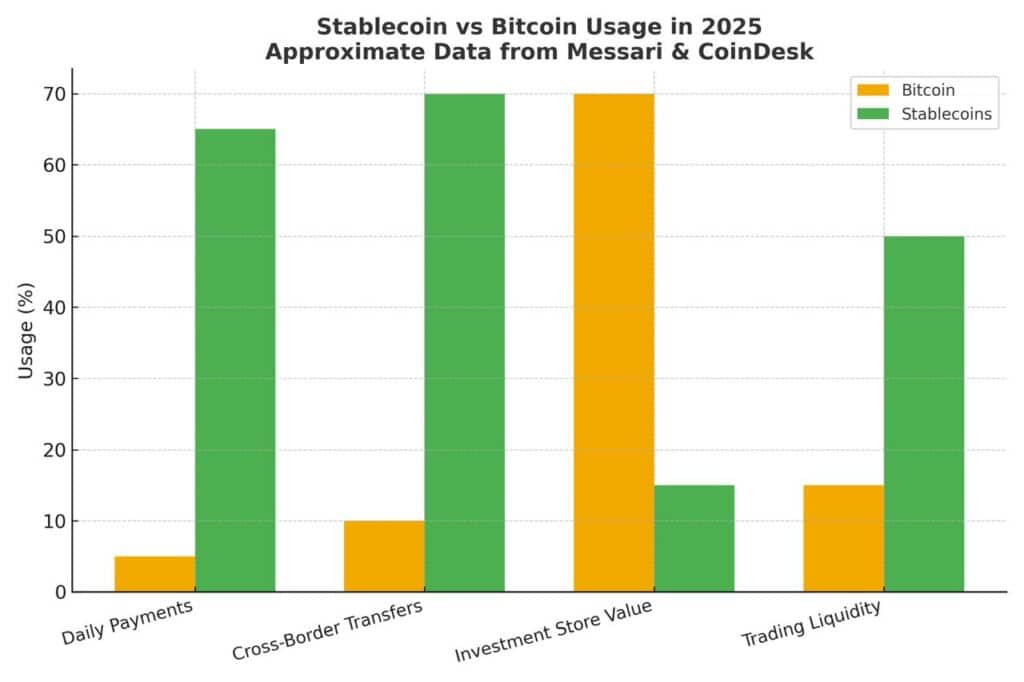
This chart shows Bitcoin’s strength as an investment and stablecoins’ dominance in real-world payments.
Real-World Use Cases
- Remittances: Stablecoins allow transferring money to loved ones back home inexpensively and in real-time.
- E-commerce: There are online shops where USDC or USDT can be paid.
- Trading: Stablecoins are adopted by traders as secure storage of volatile assets.
- DeFi Lending: There are platforms such as Aave which enable users to lend stablecoins to receive a yield.
- Bank Integration: Banks in the U.S. and Asia are experimenting with stablecoins, which have been regulated to settle instantly.
Meanwhile, Bitcoin still keeps drawing the attention of investors who are willing to invest in a currency that will appreciate over time without the need to use it on a day-in day-out basis.
Investment Perspectives
Investors often ask: should I hold Bitcoin or stablecoins?
- Bitcoin: High risk, high reward. Great for long-term growth if adoption rises.
- Stablecoins: Low risk, no big upside. Good for liquidity, stability, and quick transfers.
Both play roles in portfolios. Many investors keep part of their holdings in Bitcoin and part in stablecoins to balance growth and safety.
Conclusion
The debate of stablecoins vs crypto shows two sides of the digital money revolution. Stablecoins have stability, speed and usefulness during payments. Cryptocurrencies like Bitcoin offer volatility, growth, and long-term investment value.
The comparison of stablecoin vs bitcoin highlights why both matter. Stablecoins will be able to define the future of everyday payment. Bitcoin can stay a store of value for decades.
With the development of regulations such as the U.S. GENIUS Act, the stablecoins will become trusted. It is ideal that both assets will coexist, but play a different role.
Readers can explore more insights at The Bit Journal for updates on stablecoin regulation and crypto innovation.
Frequently Asked Questions For Stablecoin vs Crypto
What is the main difference between stablecoins and crypto?
Stablecoins are pegged to stable assets. Crypto like Bitcoin fluctuates based on market demand.
Are stablecoins safer than Bitcoin?
They are safer in price stability but depend on issuers. Bitcoin is riskier in price but independent of trust.
Can stablecoins replace banks?
Not yet. They may reduce the need for middlemen, but banks still dominate finance.
Why do regulators care about stablecoins?
Because they connect directly to the dollar system. They can affect money supply and global finance.
Is Bitcoin better for investment?
Yes for growth potential, no for short-term stability. Stablecoins are better for daily use.
Can stablecoins fail?
Yes, if reserves are weak or mismanaged. TerraUSD’s crash is a warning.
Do stablecoins pay interest?
Some platforms offer yield, but it comes with risk. Always check where returns come from.
Glossary of Key Terms
- Stablecoin – A digital token pegged to a stable asset like USD or gold.
- Cryptocurrency – Digital money secured by blockchain, like Bitcoin or Ethereum.
- Blockchain – A shared ledger that records transactions across many computers.
- Volatility – Rapid price changes, up or down.
- Peg – A fixed link between a stablecoin and its backing asset.
- Fiat-Backed – Supported by real-world money in banks.
- Algorithmic Stablecoin – Uses code and supply rules to maintain stability.
- GENIUS Act – 2025 U.S. law setting standards for stablecoin issuers.
- Remittance – Sending money across borders, often by workers to families.
- Liquidity – How easily an asset can be traded without affecting its price.
Summary
This article describes stablecoins vs crypto. It starts with a definition of cryptocurrency and stablecoins, followed by the comparison of their applications in an elaborate table. Stablecoins are based on the assets, such as the dollar, whereas cryptocurrencies, such as Bitcoin, are priced erratically. In the real world, the transactions in stablecoins hit 27 trillion in 2024 and a market size of 246 billion in 2025. A section on stablecoin vs bitcoin highlights their contrasting roles: Bitcoin as “digital gold” and stablecoins as tools for payments and remittances. A chart indicates that the stablecoins dominate in everyday usage whereas Bitcoin is a store of value. Regulation is discussed, as well as U.S. GENIUS Act and EU issues. The conclusion observes that both stablecoins and Bitcoin are likely to co-exist.