







The latest wave of Chainlink whale accumulation is intensifying yet the price remains lagging behind expectations. In mid-March, LINK fell to as low as $8.2 after losing the $10 support level and has since struggled to regain steam. However, large holders have been proactive and steadily mopping up supply from exchanges.
That increasing disconnect between accumulation and the price action does reveals that supply is tightening, and the market is yet to enter a full recovery phase.
Chainlink Whales are Accumulating Fast On Binance
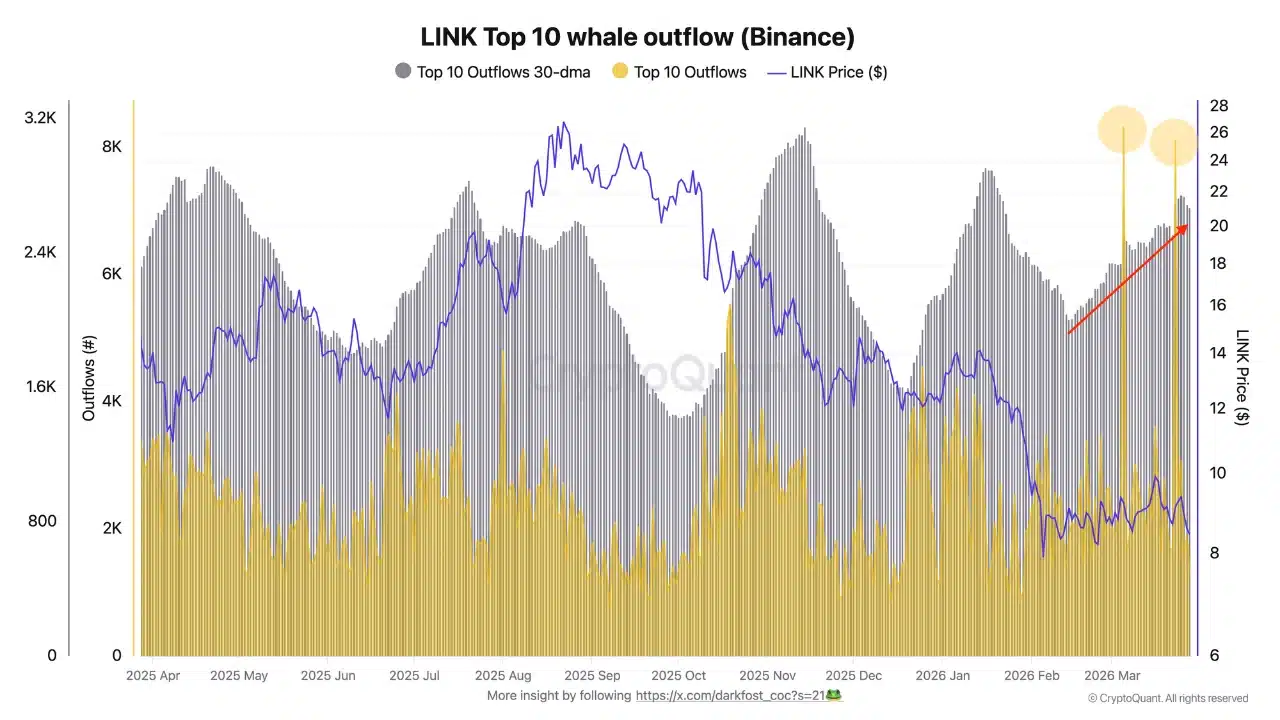
Recent data shows a large scale of whale activity, mainly through Binance. The top outflows reveal that more than 8,000 LINK tokens are withdrawn each day, suggesting that the large holders aggressively accumulate.
Conversely, average daily outflows have jumped from 2,000 to about 2,600 LINK since mid-February, another sign of a sustained accumulation rather than isolated peaks.
Such behavior is a deliberate positioning in the face of market weakness. Analysts observe that these types of withdrawals usually suggest a transition to off-exchange storage, which decreases immediate sell pressure and represents medium- to long-term holding intentions.
Additionally, exchange supply metrics continue to drop. The Exchange Supply Ratio has fallen to 0.127, close to monthly lows, supporting the fact that accumulation has been the reality for weeks.
Supply Shock Becomes Real But Price Has Yet to Catch Up
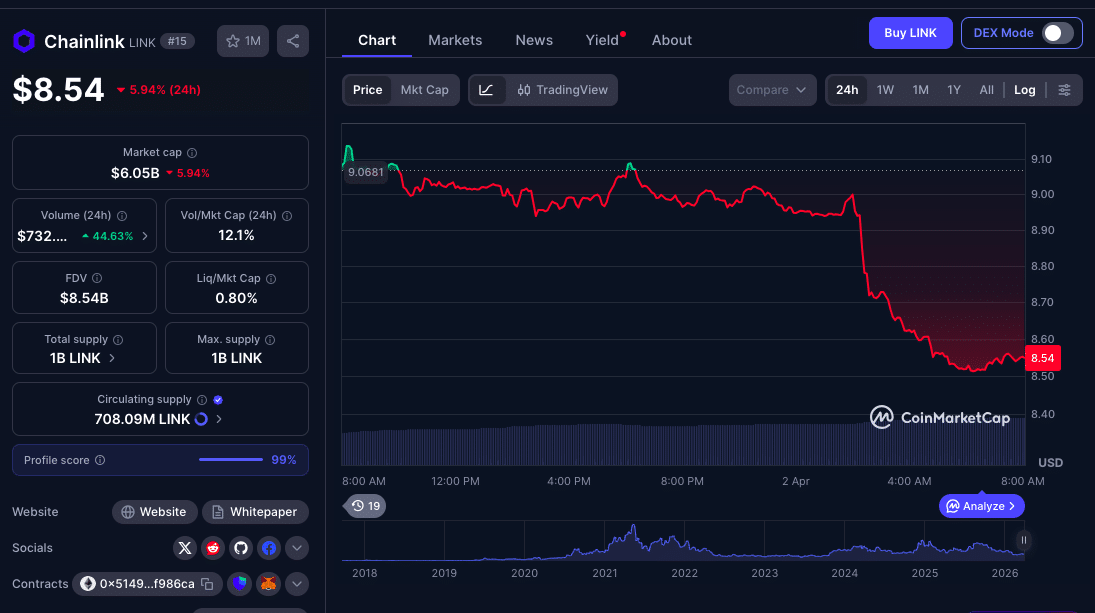
LINK price has so far failed to react meaningfully to this aggressive Chainlink whale accumulation. Latest data has LINK sitting at $8.5-$9.0, still trading below crucial resistance and within a wider bearish structure.
Even with supply tightening, analysts caution that previous accumulation phases in this correction did not result in a breakout.
The fact remains that accumulation here isn’t enough. Without ongoing demand and wider market support, price expansion are limited .
From a technical standpoint; Link is had shown signs of stabilization. After a level as low as $8.2, price had begun making higher highs in what appears to be a minor ascending channel that does suggest short-term recovery while the larger trend is still decidedly bearish.
Over the same timeframe, LINK posted nearly 5% in gains daily before the most recent decline; while trading volume also surged over 70% in recent periods.
The most notable increase in volume, which indicates participation is usually one of the first signs that market sentiment has changed.
$9.5-$10 is the Key Breakout Region
The Momentum Indicator flipping positive at 0.41 is a sign that the selling pressure was becoming less severe and buyers were gaining strength. In a similar sense, the Relative Strength index (RSI) has crossed over its neutral level confirming a bullish crossover and strengthening demand conditions.
These signals indicate that although the longer term trend is still fragile, shorter-term momentum is slowly turning in favor of buyers.
To affirm a recovery, LINK needs to reclaim higher resistance levels. Immediate resistance is showing up between $9.0 and $9.5, with much stronger resistance back near the $10 region.
A firm move above this range would confirm that the ongoing Chainlink whale accumulation is real, and could prompt more buying. However, downside risks remain.
In the past few weeks of price recovery, netflows from exchanges have given a positive reading of around 190K LINK since some selling activity remains visible. If this selling pressure continues, LINK could return to lower support levels around $8.4.
Liquidity Constriction Signals a Possible Breakout Setup
Exchange reserves have really declined with LINK supply on exchanges falling to multi-year lows. That sets up what analysts call a “liquidity crunch,” in which decreased supply of tokens can exaggerate price moves when demand returns.
Meanwhile, whale activity keeps increasing as big players position themselves ahead of a potential move. Such a mix of tightening supply and rising Chainlink whale accumulation often precedes vigorous price expansion, though timing is uncertain.
Conclusion
The recent spike in Chainlink whale accumulation has laid strong fundamentals for LINK by substantially lowering supply and amplifying the confidence of long term holders.
Whales are absorbing supply; momentum is improving., participation is increasing. But the price is still under $10, because demand has yet to catch up with this accumulation. The current structure could, if buyers can get LINK above $9.5 and reclaim $10.
In the meantime, the market is in a fragile balance, caught between strengthening fundamentals and stubborn rejection.
Glossary
Whale Accumulation: Large investors purchasing and holding a substantial quantity of a cryptocurrency.
Exchange Supply Ratio: Indication of how much of a token is held on exchanges.
Netflows: Inflows minus outflows on exchanges.
RSI: Shows momentum and pressure to buy/sell.
Liquidity Crisis: A decrease in available supply leading to higher potential volatility.
Frequently Asked Questions About Chainlink Whale Accumulation
Why is Chainlink whale accumulation happening?
Whales are buying during price weakness, taking supply off and getting ready to profit when the price rises again.
Why is LINK still below $10?
Despite accumulation, continued selling pressure and resistance levels are holding a breakout back.
What is the critical level for LINK?
The $9.5-$10 area is the important breakout zone.
Is Chainlink bullish right now?
Not exactly; near-term momentum is getting better, but the overall trend is more cautious.
What if LINK does not break resistance?
The price may retreat towards the support around $8.0-$8.4.
References