

Europe’s crypto market has a way of humbling even the biggest names in the business, and Binance is finding that out the hard way this month. For years the exchange operated as the default choice for millions of traders across the continent, backed by sheer volume and a reputation that made regulatory hurdles feel like someone else’s problem.
That confidence looks a little shaky now that the missed MiCA license deadline has locked the exchange out of some of its most important markets, and the way traders have responded in just a few short weeks says something bigger about where European crypto is headed.
Why the MiCA License Suddenly Carries So Much Weight
Before MiCA came along, exchanges navigated a messy patchwork of national rules that shifted depending on which EU country a user happened to be trading from, and honestly, that inconsistency worked in favor of larger platforms that could absorb the complexity.
MiCA was supposed to fix that by giving every exchange one clear rulebook to follow, with a compliance deadline landing on July 1. Binance simply didn’t get there in time, and the moment that date passed, the platform lost its ability to process new trades for customers in France and several other EU member states.
Withdrawals still function normally, so nobody’s funds are actually trapped, but the inability to buy or sell has left close to 2 million French users sitting on the sidelines watching a market they can no longer participate in.
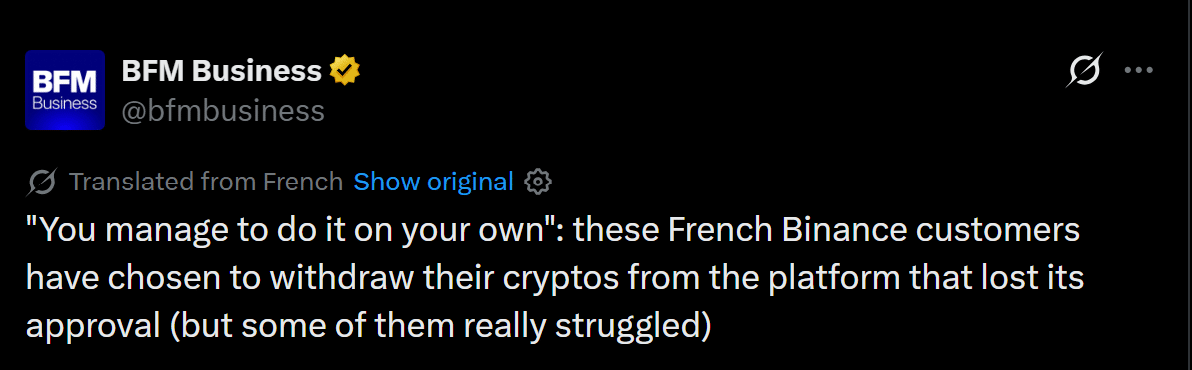
That’s a meaningful chunk of Binance’s European user base, and losing access to it overnight is the sort of disruption that doesn’t stay contained to one country for long.
Capital Doesn’t Sit Still When Trust Wavers
Traders rarely wait around to see how a situation resolves itself, and this case has been no exception. Industry estimates put net withdrawals from Binance at roughly $1.6 billion a month since the suspension began, with some of that money heading into self-custody wallets where users answer to nobody but themselves. A good portion, though, appears to be flowing straight into exchanges that treated their MiCA license as a priority rather than an afterthought.
Kraken and Coinbase are the two names picking up most of that displaced liquidity, and the figures back it up in a way that’s hard to dismiss. Kraken currently shows something like $431 million in spot liquidity spread across 1,703 trading pairs, a level of depth that took years of quiet compliance work to build. Coinbase isn’t far off either, holding around $347 million across 1,073 markets. Crypto.com sits smaller at roughly $131 million, but even that figure represents a real shift in trading behavior over a very short window.
None of this puts Binance anywhere near collapse, to be clear. The exchange still commands an estimated $114 billion in total crypto assets, a war chest most rivals can only look at with envy. Still, in a business where perception moves markets almost as fast as fundamentals do, the momentum has clearly tilted away from Binance for the time being.
A Market That No Longer Forgives Downtime
What makes this whole episode worth paying attention to isn’t really the dollar figures changing hands, even though those numbers are eye-catching on their own. It’s what the reaction reveals about what European traders actually prioritize heading into the back half of 2026.

Deep liquidity still matters, obviously, but plenty of users have learned through past exchange freezes that uninterrupted access matters just as much, if not more. Nobody wants to open an app and find the trading button grayed out because a company dragged its feet on paperwork it had years to sort out.
This is where the MiCA license conversation stops being a dry regulatory footnote and starts functioning as a genuine competitive divide. Exchanges that treated licensing as urgent rather than optional are now converting that head start into fresh deposits and long-term user trust, the kind that’s difficult to win back once lost. Platforms that delayed are discovering, somewhat painfully, that European regulators aren’t in the business of handing out grace periods.
What Comes Next for Binance in Europe
There’s no confirmed timeline yet for when Binance expects its MiCA license to clear, and until that happens, trading in the affected markets stays frozen. Whether the exchange manages to win back its former user base will probably depend less on brand loyalty and more on how fast regulators move through the approval process.
In an industry where a handful of weeks can quietly reshuffle who holds the advantage, that’s not a small gap to close, and the exchanges that stepped into the void during this stretch aren’t likely to give up that ground without putting up a fight.
Frequently Asked Questions
What is a MiCA license?
It’s the approval required under the EU’s Markets in Crypto-Assets framework, allowing an exchange to legally serve customers across all member states under one shared standard.
Why did Binance lose trading access in France?
The exchange missed the July 1 deadline for MiCA compliance, which triggered an automatic suspension of new trading activity in France and other EU markets.
Can Binance customers still withdraw their funds?
Yes. Withdrawals remain fully operational. Only new trades have been paused.
Are other exchanges facing the same MiCA license pressure?
Any exchange operating in the EU needs to secure approval eventually, so this situation could repeat itself for platforms that haven’t finished the process.
Glossary of Key Terms
MiCA: The European Union’s unified regulatory framework governing crypto-asset markets.
Spot liquidity: The funds available on an exchange for immediate buying and selling of an asset.
Self-custody: Holding crypto assets directly in a personal wallet instead of leaving them on an exchange.
Disclaimer: This article is for informational purposes only and should not be taken as financial or investment advice.
Sources