







This article was first published on The Bit Journal.
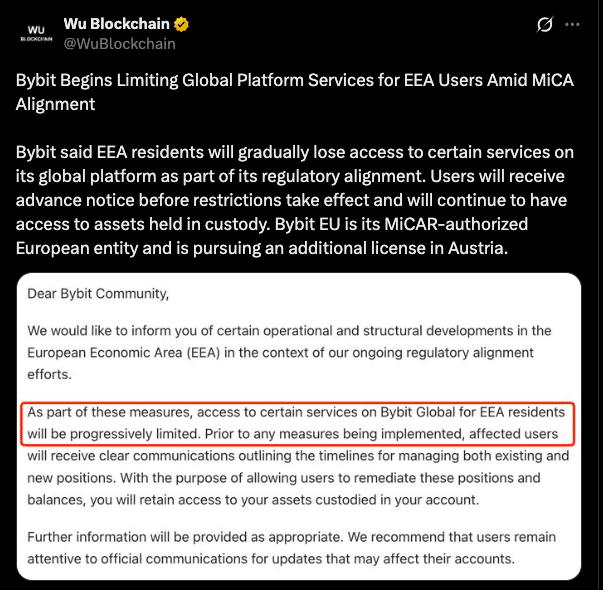
Bybit is about to lock down access to certain areas of its global platform for users in the European Economic Area (EEA) as Europe’s MiCA regulation reaches its full enforcement on July 1.
The exchange said users who will be affected will get advance notice of what exactly is changing for them, including when they’ll need to wrap up any open positions and balances. Following Bybit MiCA compliance, the exchange is reassuring users that they’ll still be able to get to their assets while they make the transition.
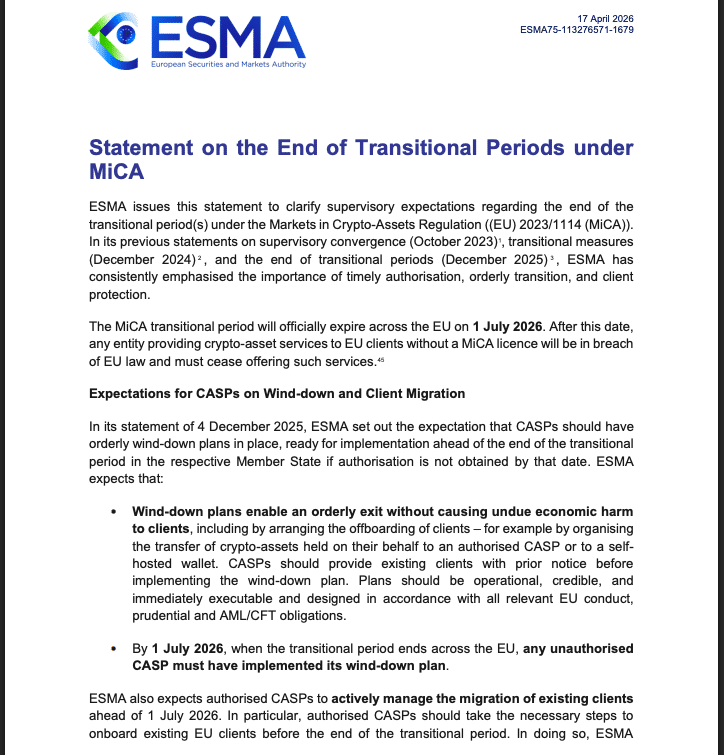
The European Securities and Markets Authority (ESMA) has just reiterated that any firms without permission must stop taking on new EU customers and begin orderly wind-down procedures where necessary.
Bybit Moves Users Toward Its Regulated European Platform
Instead of pulling out of Europe altogether, Bybit is redirecting activity toward its licensed European business.
The company’s regulated arm, Bybit EU GmbH, received authorization from Austria’s Financial Market Authority in May 2025. That authorization allows the platform to offer services including crypto custody, crypto-to-fiat exchanges, crypto-to-crypto trading, transfers, and crypto-asset placement across much of the EEA through passporting rights.
This latest statement affects people in countries like France, Germany, Italy, Spain, the Netherlands, Ireland, Austria and Sweden. Malta is still out of the picture for now because Bybit still hasn’t got its permission documents to work there, and they don’t serve Maltese residents.
Unlike exchanges facing a complete shutdown of European operations, Bybit already has a proper setup for Europe.
The current changes primarily reduce reliance on the global platform while encouraging EEA customers to use the compliant regional alternative.
User Assets Remain Accessible During the Transition
One of the big worries users get when there’s a regulatory change is losing access to their money.
Bybit has stated that customers will still be able to get their funds while they sort out their open balances and positions. The company did not indicate that assets would be frozen, confiscated, or otherwise restricted beyond the phased service limitations.
To get the very latest under Bybit MiCA compliance plan , users should keep an eye on official communications from the exchange for any information on what needs to happen on their account. They’ll also be able to get in touch with customer support for any help they need throughout the transition.
MiCA Deadline Shakes Europe’s Crypto Market
The real impact of Bybit MiCA compliance runs a lot deeper than just one exchange.
MiCA creates a unified rulebook for crypto service providers across the European Union and EEA. Once authorized in one member state, firms can generally offer services throughout the bloc using passporting rights.
The idea is that it will strengthen investor protection, governance standards, and custody requirements. It also means crypto firms have to be stronger and resilient.
ESMA has had to reconfirm that the end date for the transitional period is July 1, 2026 and that it is final. Any firms that don’t get the necessary permission will have to cut their losses and get out of the EU market.
While licensed platforms are positioning themselves to pick-up business from European users, unlicensed firms are facing increasingly tough restrictions.
Latest reports are showing that hundreds of crypto businesses operating under older national rules have either gotten the authorization, put in a license application, or are drawing up plans to pull out early ahead of the deadline.
Conclusion
For Bybit MiCA compliance, the immediate objective is to migrate European activity toward its regulated infrastructure while maintaining service continuity for customers.
The exchange has also stated that it is pursuing additional Austrian licensing approvals that could support a wider range of products in the future.
While some platforms are facing the very real possibility of being shut out, Bybit’s regulated European presence gives it a pathway to remain active in one of the world’s most important crypto markets as MiCA comes into full effect.
Glossary
MiCA (Markets in Crypto-Assets Regulation): this is the European Union’s all-encompassing regulatory framework that governs crypto-asset service providers
EEA (European Economic Area): The EU member countries plus a few others like Iceland, Liechtenstein, and Norway.
CASP: A Crypto Asset Service Provider is a company that has been given permission to carry out crypto-related services under MiCA.
Passporting: This is a way for a licensed firm in one country to offer services across other EU nations.
Custody Services : Holding onto and looking after peoples crypto assets on their behalf.
Frequently Asked Questions About Bybit MiCA Compliance
Why is Bybit limiting some of its services in the EEA ?
Bybit is making sure it is playing by the new rules set out by MiCA and directing its EEA users over to its regulated European platform.
Are EEA users going to lose access to their crypto ?
No. Bybit has said that users will still be able to get to their assets, but they may have to manage their balances and open positions.
When does MiCA properly come into force ?
The transitional period is set to end on July 1st 2026 and then unauthorized crypto firms will no longer be legally able to service EU clients.
Does Bybit have a MiCA-compliant operation ?
Yes. Bybit EU GmbH operates under authorization granted by Austria’s Financial Market Authority.
References