







Stablecoin reserves have decreased by nearly $4 billion over the past week, moving total balances down approximately 5.18% to $66.37 billion. In the same period, Bitcoin is hovering near $80,000, creating a gap between price stability and liquidity.
For traders following market structure, it is not a small drop. Stablecoins are the main source of deployable capital in crypto, when reserves shorten, it is usually a sign of tightening below the surface.
Liquidity Drain Signals Risk-Off Behavior Across Crypto Markets
Analysts tracking flow of exchanges have pointed to a contraction of available liquidity, stating that capital is increasingly moving away from crypto trading venues.
This pattern is similar to previous ones observed earlier in 2026. Big stablecoin outflows have consistently coincided with periods of market stress, lowering buying pressures and driving downside momentum;
Simply put, stablecoins are commonly regarded as “dry powder”. When reserves are increasing, it typically indicates that investors are getting ready to put money to work in risk assets. When they drop, either capital has exited the entire ecosystem or it sits idly outside of exchanges.
But the latest data shows that this latter cause may not be enough to fully explain the move. The size of the drop points to a more hesitant approach when it comes to trading where investors are retreating into their shells.

Macro Pressure Builds as Yields Rise and Oil Prices Climb
U.S. Treasury yields are up, with the 10-year yield approaching 4.5% and the 30-year over 5%, making traditional financial instruments more appealing. As yields rise, capital naturally rotates toward government bonds; which offer relatively safer returns compared to volatile assets like Bitcoin.
Meanwhile; inflationary pressures are increasing as oil again breaks above $110 per barrel, maintaining tighter financial conditions.
This combination has created a challenging environment for crypto markets.
As seen earlier in 2026, billions were pulled from stablecoins resulting in a much deeper liquidity withdrawal that subsequently dragged the rest of the market down with it.
The recent stablecoin reserves drop seems to follow suit; implying investors may be preparing for fresh volatility than responding to one event alone.
Bullish Long-Term Outlook: Stablecoins Still Set for Massive Growth
Despite the short-term liquidity contraction, the long-term outlook for stablecoins remains strong.
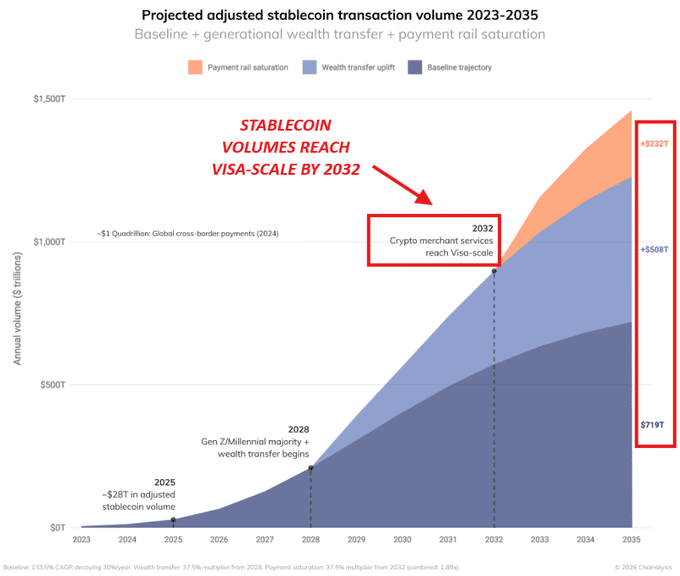
An industry report released recently predicted the volume of adjusted stablecoin transactions could top $719 trillion by 2035 as they increasingly become the go-to for digital payment and on-chain settlement systems.
Large companies are already moving toward this. Western Union, along with other big financial institutions and tech giants are working on stablecoin-backed offerings as the industry readiness for blockchain-enabled payments grows.
Meanwhile, top issuers keep growing their stablecoin reserves and infrastructure. Tether, for example, reported more than $191 billion in assets backing its stablecoins to go along with record excess reserves of more than $8 billion at the beginning of 2026.
Despite the ups and downs of short-term liquidity, this suggests that institutional interest in stablecoins is growing.
Why the Signal Looks Bearish for Bitcoin and Risk Assets
From a network perspective, rising stablecoin adoption is clearly bullish. It reveals wider adoption, greater integration into financial systems and growing transaction volumes.
However, this changes when market sentiment is considered.
When stablecoin liquidity sits on the sidelines or exits exchanges, it weakens the immediate support for assets like Bitcoin. This is because fewer funds are actively available to absorb selling pressure or drive price higher.
Recent data shows that although total stablecoin supply is still very high, actual activity and deployment has really slowed down compared to the times before this BTC consolidation.
As such, this also explains why Bitcoin can remain near $80,000 but still have elements of frailty.
Conclusion
As the stablecoin reserves drop further, a widening gap between short-term pessimism and long term bullishness in crypto is being shown.
On one hand, stablecoins are expanding rapidly, with projections pointing to trillions in future transaction volume and increasing adoption by major institutions.
On the other hand however, depreciation of $4 billion in reserves indicates that investors are paying less attention to those signals than they were a few months earlier, weighed down by rising yields, inflationary pressures and wider macro uncertainty.
Liquidity is still present in the system, but it is not fully committed. Until that changes, the market may remain sensitive to downside pressure, even as long-term fundamentals continue to strengthen.
Glossary
Stablecoin reserves: the total of stablecoins held on exchanges and thus available to trade.
Liquidity: refers to how easily assets can be bought or sold without affecting price.
Risk-off environment: where investors seek to move capital into safe haven assets.
Treasury yields: the return on U.S. government bonds.
On-chain activity: transactions and operations that occur on blockchain networks.
Frequently Asked Questions About Stablecoin Reserves
Why are stablecoin reserves important?
They indicate how much capital is available to flow into crypto markets..
Why did reserves fall by $4B?
The main causes are rising yields, macro pressure and investor caution.
Is this bearish for Bitcoin?
It can be, as lower liquidity means less buying support.
Are stablecoins still growing overall?
Yes, the long-term forecasts are still very bullish.
What should traders watch next?
Stablecoin inflows to exchanges returning or declining further.
References