





The Fusaka upgrade is not a cosmetic tweak to Ethereum. It is a structural shift in how the network handles data, scales Layer 2 activity, and protects decentralization over the long haul. Scheduled for mainnet activation on 3 December 2025, it arrives as the second major hard fork of the year after Pectra and pushes Ethereum deeper into a rollup centric design.
At a high level, Fusaka focuses on three big themes: scale the data layer for rollups, tighten gas and block limits so the system remains stable under load, and modernize user and developer experience. For investors who track fundamentals rather than just price candles, this fork is one of the clearest on-chain signals that Ethereum is preparing for another decade of growth.
What Is The Fusaka Upgrade And Why does it Matters Now
The Fusaka upgrade combines changes on both the execution layer (often referred to as Osaka) and the consensus layer (Fulu). Together, they refine Ethereum into a more efficient settlement engine for Layer 2 networks that already handle the majority of transactions and fee volume.
Today, rollups bundle thousands of transactions and post compressed data to Ethereum in “blobs”. That blob space is already a premium resource. As more DeFi, gaming, and social activity migrates to Layer 2, competition for blob space threatens to push data costs up and, in turn, squeeze users. The roadmap answer is simple in theory and difficult in practice: raise capacity while keeping regular nodes cheap to run.
This is the backdrop in which the Fusaka upgrade appears. It is Ethereum’s attempt to keep blockspace affordable without drifting into a world where only data center-style operators can participate.
Where The Fusaka Upgrade Sits In Ethereum’s Roadmap
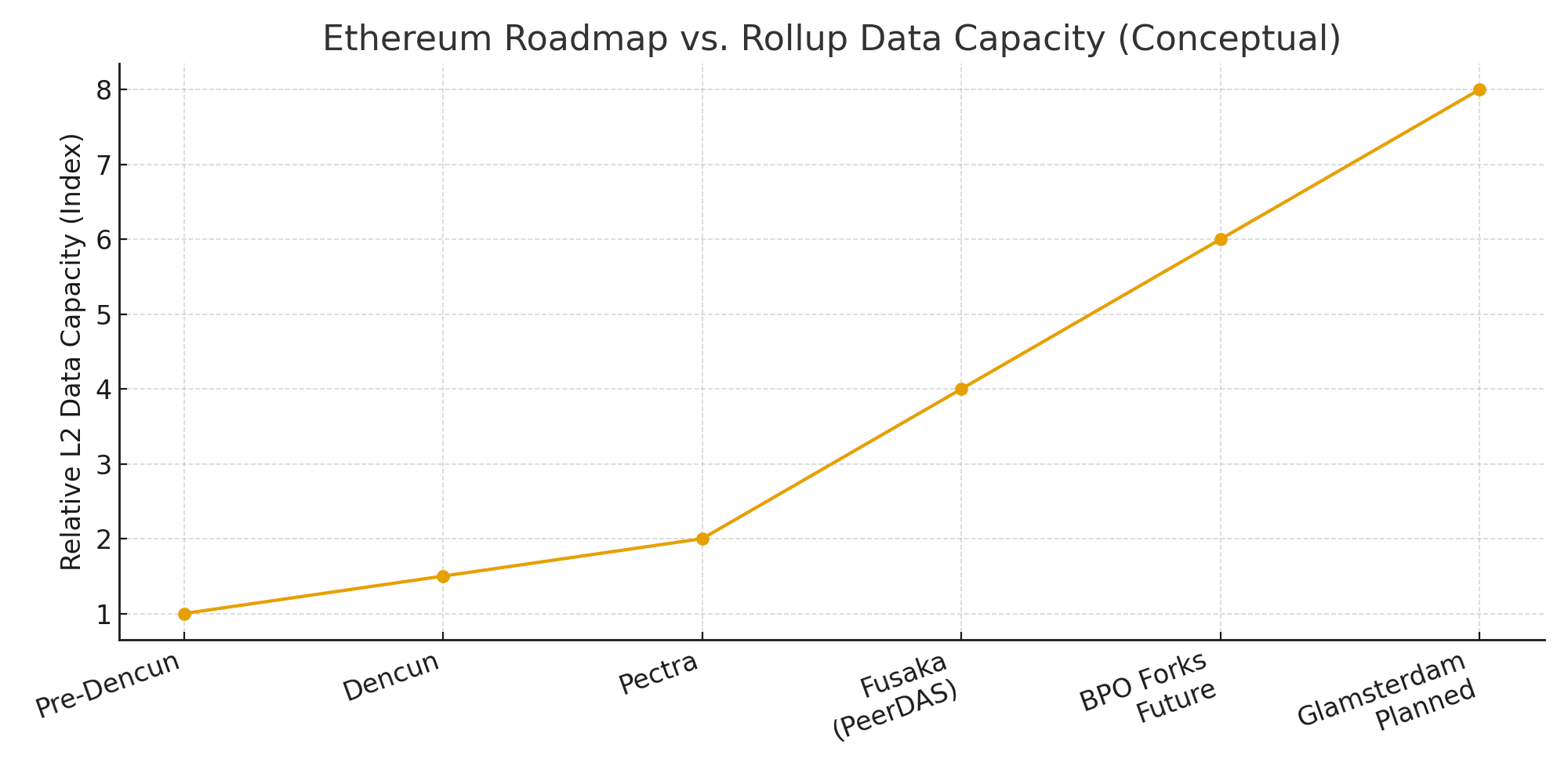
In the roadmap language, Ethereum has moved from the Merge into a long Surge phase that focuses on scaling. Shapella, Dencun, and Pectra were earlier pieces of that puzzle. The Fusaka upgrade follows Pectra and prepares the chain for repeated data capacity increases, not just one time jumps.
This matters for long term investors. A network that can regularly dial blob capacity up or down based on real demand looks more like a flexible economic system than a rigid protocol. It is similar to a city that plans for more lanes and public transit before congestion reaches a breaking point.
Inside The Tech: PeerDAS And Smarter Blob Scaling
At the center of the Fusaka upgrade sits EIP 7594, better known as PeerDAS, or peer data availability sampling. Pre Fusaka, every full node that participated in data availability had to download entire blobs. As Layer 2 activity scales, that model becomes expensive and pushes bandwidth and storage requirements higher each year.
PeerDAS changes the shape of the problem. Instead of downloading all blob data, validators and full nodes sample small random pieces and rely on erasure coding to reconstruct, guaranteeing that the full dataset exists. In practice, that means nodes handle much less data, yet the network can confidently raise blob throughput several times over. Some analyses suggest that an eightfold increase in data capacity is possible over time, which flows directly into cheaper data costs for rollups.
This scaling path fits Ethereum’s philosophy. Rather than moving all activity back to Layer 1, the network becomes a high capacity data and settlement layer that empowers many Layer 2 environments on top.
Blob Parameter Only Forks And Flexible Capacity
Raw capacity increases are not the only story. The Fusaka upgrade also introduces the idea of Blob Parameter Only (BPO) forks through EIP 7892. Instead of waiting for a giant hard fork to raise blob targets, the protocol can schedule small, focused forks that adjust only blob parameters like target count and maximum capacity.
For rollup teams, this is similar to predictable “bandwidth upgrades” on a backbone network. The community can plan for step changes, such as moving from 6 to 10 to 14 blobs per slot, and measure how fees and performance respond at each stage. For long term holders, that translates into a more responsive economic system that can adapt to demand instead of lagging behind it.
Gas Economics, Security, And Node Health
Whenever capacity rises, there is a risk that blocks become too heavy or complex and open the door to denial of service vectors. The Fusaka upgrade addresses this with tighter gas and block size rules. EIPs in the fork adjust gas limits per block, bound overall block size at around 10 MB, and reprice expensive operations such as the MODEXP precompile so a single transaction cannot monopolize compute resources.
For node operators, this is important. The network aims to support more throughput while still allowing reasonably provisioned machines to participate. A healthier node set improves decentralization, which is a key indicator for any crypto asset that brands itself as neutral infrastructure. A chain that scales only by silently pushing operators out of the set would undermine its own value proposition.
UX, Passkeys, And New Tools For Builders
While scaling grabs headlines, the Fusaka upgrade quietly improves user and developer experience too. One of the most talked about changes is a new precompile for secp256r1, the curve behind many modern passkey systems on phones and laptops.
This addition allows wallet developers to tap into platform secure enclaves and biometric systems more directly. Over time, an everyday investor may approve a transaction with the same gesture used to unlock a banking app, while still interacting with self-custodial or smart contract wallets under the hood. That is a significant move toward friendlier onboarding.
On the developer side, new opcodes, configuration tools, and clearer proposer schedules reduce friction. Deterministic proposer lookahead, for example, lets Layer 2 systems coordinate around which validator will propose a block, which helps design faster pre-confirmations without sacrificing finality guarantees.
All of this makes the Fusaka upgrade feel less like a one-note scaling patch and more like a multi-dimensional push toward a more mature platform.
How The Fusaka Upgrade Shapes Key Crypto Indicators
Investors often watch a handful of core indicators when comparing crypto networks: transaction throughput, average fees, decentralization of validators, security against data withholding, and developer activity. The Fusaka upgrade touches each of these in a measurable way.
Higher blob throughput and PeerDAS support more transactions per second at the Layer 2 level, which should translate into lower average fees for end users if rollups pass savings through.
Data availability sampling improves security against withholding attacks without forcing every node to become a storage giant. That supports a larger, more geographically distributed validator set, which boosts decentralization metrics. New gas and block rules, along with revised pricing for heavy operations, harden the protocol against resource exhaustion attacks, which reduces tail risk for long term holders.
Finally, an upgrade that ships a dozen EIPs and unlocks new patterns for passkey wallets and pre confirmations is likely to keep developer engagement high. In a market where capital and talent flow toward platforms with the richest tooling, that is a non trivial signal.
What Comes After Fusaka
The Fusaka upgrade is not the end of Ethereum’s roadmap story. The next named step is Glamsterdam, targeted for 2026, which is expected to introduce enshrined proposer builder separation and further optimizations for block construction and MEV handling.
In that context, Fusaka looks like the foundation layer for a rollup centric future. It delivers a new data model, safer gas economics, and more modern cryptography so future upgrades can build on a stable base.
Conclusion
The Fusaka upgrade represents a turning point in how Ethereum balances scale, security, and accessibility. It raises the ceiling for Layer 2 throughput, cuts the cost of data, and reinforces decentralization at the node level, while quietly improving wallet UX and developer ergonomics.
For traders focused only on short term price action, it may read as another technical milestone. For builders, validators, and long horizon investors, the Fusaka upgrade signals a network that is still willing to evolve aggressively while defending its core values. In a crowded field of smart contract platforms, that combination may be one of Ethereum’s strongest indicators of staying power.
Frequently Asked Questions (FAQ)
What is the Fusaka upgrade in simple terms?
It is a major Ethereum hard fork that introduces data availability sampling, new blob scaling tools, refined gas and block limits, and better support for modern wallet and developer features.
When will the Fusaka upgrade go live on mainnet?
The target activation date for mainnet is 3 December 2025, following earlier activations on multiple testnets.
How does Fusaka affect Layer 2 transaction fees?
By increasing blob capacity and making data handling more efficient, the upgrade should reduce data costs for rollups, which can lead to lower average fees on Layer 2 networks over time.
Does the Fusaka upgrade require users to move or upgrade their ETH?
No. Holders do not need to move coins or sign any special transaction for Fusaka. Client upgrades are handled by node operators and validators.
Is this upgrade good or bad for decentralization?
Fusaka aims to keep ordinary nodes viable by lowering per node data requirements, while still expanding network capacity. If implemented as designed, that is supportive for decentralization in the long run.
Glossary Of Key Terms
Blob
A special data container used by Ethereum to store compressed transaction data from Layer 2 networks. Blobs are not kept forever and are designed for scalable rollup data.
Data Availability Sampling (PeerDAS)
A technique that lets nodes verify that data exists by checking small random samples instead of downloading the full dataset. This reduces bandwidth while keeping strong security guarantees.
Rollup
A scaling solution that processes transactions off chain, then posts compressed data and proofs back to Ethereum for settlement and security.
Blob Parameter Only (BPO) Fork
A small network upgrade that changes only blob related parameters, such as how many blobs are targeted per block, without touching the rest of the protocol.
Gas Limit
The maximum total amount of computational effort that all transactions in a block can consume. Adjusting this limit affects throughput and node hardware requirements.
Secp256r1 Precompile
A built in cryptographic function that enables Ethereum smart contracts and wallets to use the same key curve that powers many passkey and biometric systems on phones and laptops.
Sources