





This article was first published on The Bit Journal. Ripple has unveiled a new proposal aimed at bringing institutional-grade credit to the XRP Ledger through its XRPL Lending Protocol, arguing that tokenized assets need a financing layer to unlock their full potential. Despite the fast pace of tokenization’s progress, the company feels onchain finance is still missing out on lending infrastructure needed for widespread institutional adoption.
XRPL Lending Protocol Seeks to Bridge the Credit Gap
Ripple published the proposed XRPL Lending Protocol in a blog post on June 29 which outlines a proposal for banks, payment providers and financial institutions to borrow against tokenized assets on the XRP ledger. The protocol would allow Institutions to utilize their digital assets as a collateral for working capital rather than leaving them idle.
Ripple contends that tokenizing assets like government bonds, stablecoins, commodities and money market funds is just the beginning. The company claims that traditional financial markets use credit markets such as repo markets, margin lending and structured credit to ensure that capital is used productively. Even though tokenized assets are onchain, they are not well used without similar tools.
Dual-Layer Framework Targets Institutional Finance

The company also said that the credit assessment should not be on-chain. The lenders would be the same entities that would evaluate their borrowers, enforce compliance, and handle the legal paperwork, while the XRPL Lending Protocol would handle the creation of the loans, repayment plans, calculation of interest, and management of defaults.
The proposed framework will have two elements. The Single Asset Vault (XLS-65) would offer standardized pools of individual digital assets, and the Lending Protocol (XLS-66) could convert those pooled assets into structured loans, with a specific repayment term.
The separation follows a pattern familiar to traditional capital markets, in which asset custody and financing are separate, said Ripple. These components will help institutions to manage the liquidity on the XRP Ledger more efficiently, and together, they will be the foundation of the XRPL Lending Protocol.
XRPL Lending Protocol Reduces Institutional Lending Risks
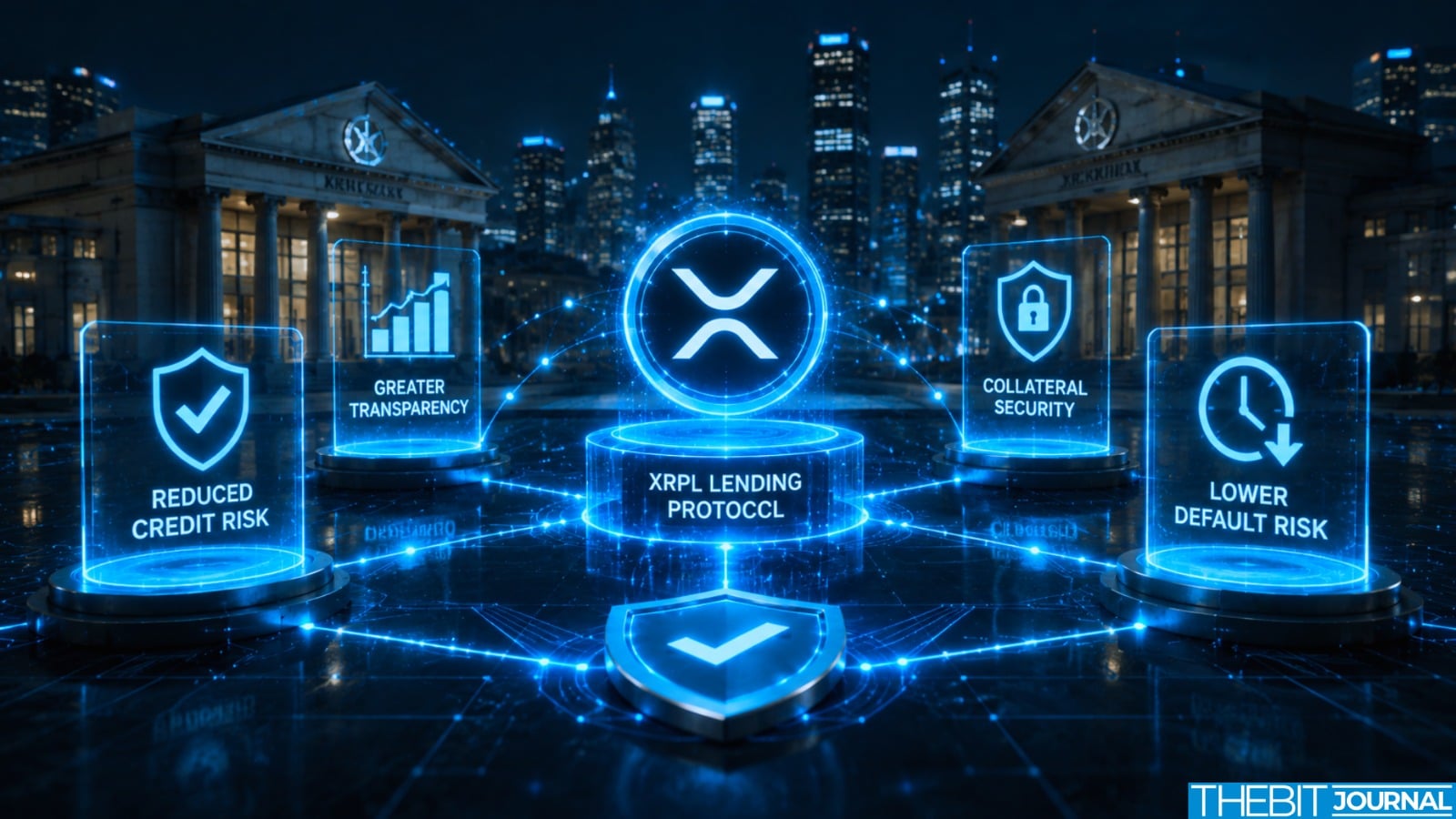
All of the lending facilities would be isolated to minimize systemic risk. Losses in a single vault would not have an impact on any other vaults, and any losses in the first loss capital provided by the administrators or underwriters would be covered by the initial defaults without senior liquidity providers being exposed. Compliance would also need to be verified and participation would be enabled by permissioned credentials, as would access to borrowers and lenders.
Ripple provided several examples of institutional applications, such as payment service providers using the reserves of RLUSD as collateral when awaiting settlement rather than paying for expensive bank credit lines. The company also identifies inventory financing and treasury management options with the XRPL Lending Protocol by putting idle tokenized assets to work.
Ripple made the offer sound like a business-oriented solution rather than a decentralized lending platform, saying that the governance changes on public DeFi platforms bring in “unpredictable risks” for regulated institutions.
XRPL Lending Protocol Awaits Validator Approval
The XRPL Lending Protocol has not yet been launched on the XRP Ledger. XLS-65 and XLS-66 are both in validator review and will only be activated once more than 80% of trusted validators approve it for two weeks. According to Ripple, the decision will come in the next few weeks and developers can now test the protocol on the devnet.
In order to improve security prior to launch, Ripple also hosted a $200,000 Immunefi Attackathon, which brought in independent security researchers to find vulnerabilities.
The XRPL Lending Protocol, if approved, could boost transaction volume on both the XRP and RLUSD networks, as more people are incentivized to lend their assets and engage in more lending activities. Even with all this investment in infrastructure, XRP has recently been trading near $1.04, despite the company’s continued efforts to grow its institutional blockchain offerings.
Conclusion
The XRPL Lending Protocol is a move that could be a significant step in unlocking institutional financing on the XRP Ledger if validators approve it. Ripple’s off-chain credit assessment and automated lending infrastructure will pave the way for more productive and extensive use of tokenized assets as well as for the wider adoption of compliant, enterprise-grade blockchain financial services.
Follow us on Twitter and LinkedIn, and join our Telegram channel to be instantly informed about breaking news!
Summary
- Ripple proposed the XRPL Lending Protocol to enable institutions to borrow against tokenized assets.
- The framework combines off-chain underwriting with automated on-chain lending through XLS-65 and XLS-66.
- The protocol awaits validator approval and could increase utility for XRP and RLUSD if adopted.
Glossary of Key Terms
XRPL Lending Protocol: Ripple’s proposed institutional lending framework.
XRP Ledger (XRPL): Ripple’s blockchain for digital assets.
Tokenized Assets: Assets represented on a blockchain.
Onchain Credit: Blockchain-based lending services.
Single Asset Vault (XLS-65): A pool for one digital asset.
Lending Protocol (XLS-66): A system for automated lending.
Off-Chain Credit Assessment: Credit checks performed outside the blockchain.
RLUSD: Ripple’s U.S. dollar-backed stablecoin.
Validator Approval: Required consensus for XRPL upgrades.
Immunefi Attackathon: A security testing program.
Frequently Asked Questions XRPL Lending Protocol
1. What is the XRPL Lending Protocol?
It is Ripple’s proposed institutional lending framework for the XRP Ledger.
2. How does the Protocol work?
It combines off-chain credit checks with automated on-chain lending.
3. Is the Protocol live?
No, it is currently awaiting validator approval.
4. Why is the Protocol important?
It could increase XRP and RLUSD utility through institutional lending.
References
Disclaimer
The article is purely informational and it is not a financial, investment, or a trading advice. Cryptocurrencies are extremely risky and volatile. Before investing, the readers are to conduct personal research and seek the advice of a qualified financial expert.