
A new governance proposal is putting long-term participation at the center of one of the market’s most closely watched stablecoin ecosystems. World Liberty Financial’s community is weighing a framework that would require holders of unlocked WLFI to stake tokens for a minimum of 180 days to gain voting access, a staking model, while layering in added benefits tied to USD1 usage and a tiered “Node” model aimed at power users.
The proposal reads like a course correction after a rapid growth phase, where the project argues that outside traders captured meaningful, low-risk arbitrage while the protocol itself paid subsidies to keep redemptions smooth.
At a glance, the plan is about governance mechanics as under the surface, it is also about aligning economics, reputation, and liquidity at a time when stablecoins are being judged less by marketing and more by how they behave under stress.
WLFI governance staking would reshape who gets to vote
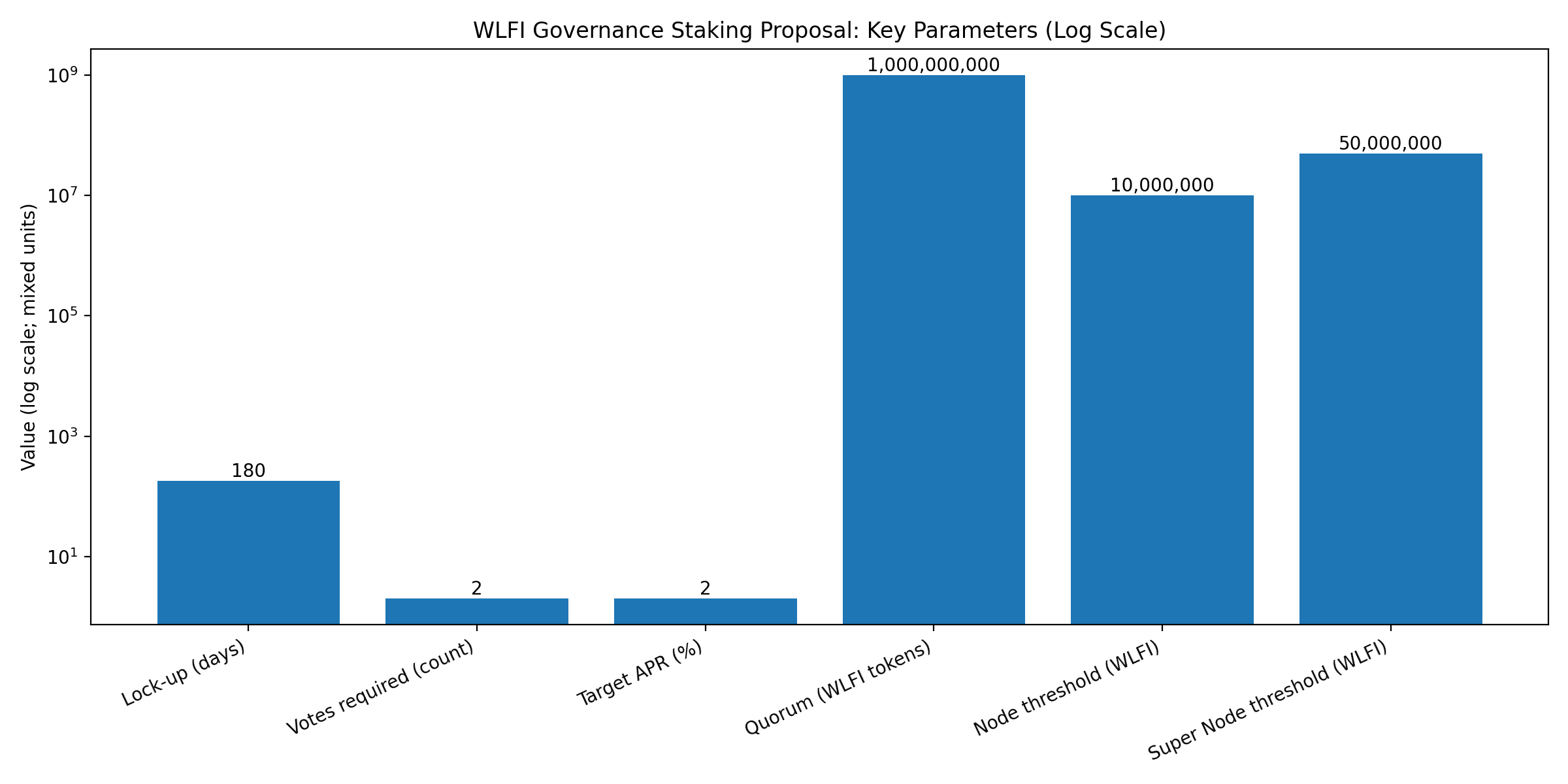
The proposal introduces a simple rule with big implications: if WLFI tokens are unlocked, they must be staked to vote, and that stake must run at least 180 days. Locked tokens remain eligible to vote without staking, which is an important nuance because it preserves governance participation for long-term holders who are already time-bound. The intent is straightforward: voting power should tilt toward people willing to stay put through a cycle rather than those who arrive for a quick headline.
To reinforce behavior, the proposal ties rewards to participation. It outlines a target yield near 2% APR for stakers, but only if the staker participates in at least 2 governance votes during the lock period. That condition matters because it turns staking into an accountability mechanism, not just a passive yield product.
This is where WLFI governance staking becomes more than a technical toggle. It is a bet that attention is a scarce resource in crypto, and that governance without engaged voters becomes a hollow ritual.
Voting weight, concentration risk, and why the formula matters
The most technical piece is also the one that sophisticated readers will scrutinize first: how voting power is calculated. The proposal describes a weight that blends amount staked with time remaining, and it points to a non-linear, square-root style approach designed to dampen concentration effects. In plain terms, the system tries to make it harder for a single whale to dominate outcomes purely by size, while still rewarding commitment.
For markets, this is not trivia. Governance design often becomes a proxy for credibility. When a protocol’s rules appear to favor insiders or quick-flip behavior, liquidity can become jumpy. When rules visibly reward durable participation, liquidity can become stickier, even if the token price is volatile. That is why WLFI governance staking will be watched as a signal, not just a feature.
USD1 perks and the push to deepen real usage
The proposal also links governance participation to stablecoin adoption. It describes added benefits for USD1 usage, including incentives connected to deposits on the project’s markets product built on existing infrastructure. The message is clear: the ecosystem wants USD1 to be used, not merely traded.
The timing is not random. Recent reporting has put USD1 in the top tier of stablecoins by size, around the $5B range, and highlighted how concentrated holdings can be on major venues. Concentration is not automatically a flaw, but it is a risk factor worth tracking because it can amplify volatility during fast outflows.
In other words, WLFI governance staking is being paired with a business objective: make USD1 feel useful across more contexts, so demand is not reliant on one channel.
Node and Super Node tiers introduce a new “membership economy”
The proposal introduces two high-bar tiers that are likely to spark debate. A “Node” tier is framed around staking 10,000,000 WLFI, while a “Super Node” tier is framed around staking 50,000,000 WLFI. The stated perks range from 1:1 stablecoin conversion pathways via third-party providers to priority partnership discussions, with a later-stage mention of a revenue-share framework for top-tier participants.
These tiers can be read two ways. Supporters may see a rational incentive for large stakeholders to contribute liquidity and relationships. Critics may see a gating mechanism that formalizes influence.
The market’s reaction will likely depend on transparency: who qualifies, what the benefits cost the ecosystem, and how conflicts are managed. Either way, WLFI governance staking becomes intertwined with access, status, and economics, which raises the stakes of the vote.
Why the proposal is arriving now: arbitrage, subsidies, and trust
One of the most revealing lines in the proposal is its description of the USD1 expansion phase. It argues that market makers captured “millions” in low-risk arbitrage, citing roughly 15 bps per mint-and-sell cycle, while the protocol also paid “millions” in subsidies to facilitate redemptions. The proposal’s implied promise is that future value capture should lean more toward aligned participants rather than external opportunists.
That framing lands in a moment when USD1 has already faced a public test of confidence. Recent reports described a brief deviation from the $1 peg to about $0.994 amid online account issues affecting project figures, followed by stabilization.
For stablecoins, small moves can still create big headlines, which is why governance and incentives matter. They shape who shows up during stress. This context explains why WLFI governance staking is being sold as a trust-building measure, not just a yield feature.
What indicators traders and long-term holders will watch next
If the proposal passes, the next signals will be measurable. Analysts will look for changes in governance turnout, the share of supply locked into long-duration stakes, and whether USD1 usage grows in a way that is not purely incentive-driven.
They will also track stablecoin health markers: peg stability during volatility, reserve transparency, and how quickly large holders can move supply without spiking slippage. For WLFI specifically, token distribution, unlock schedules, and on-chain participation rates will matter because they shape how much influence sits with insiders versus the wider community. In practical terms, WLFI governance staking will be judged by outcomes: steadier governance, steadier liquidity, and fewer perverse incentives.
Conclusion
The proposal is a classic crypto trade-off, packaged in modern language as longer lock-ups can reduce short-term churn, but they can also reduce flexibility. Tiered access can attract deep-pocketed partners, but it can also fuel perceptions of exclusivity. The next vote will show whether the community prefers an ecosystem that feels more like a long-term cooperative or one that remains open to fast capital rotating in and out.
If the system works as intended, WLFI governance staking could become the lever that shifts attention from short-term speculation toward repeat participation, and that is often where durable ecosystems begin.
Frequently Asked Questions (FAQs)
What is the main change proposed for voting?
The proposal would require holders of unlocked WLFI tokens to stake them for at least 180 days in order to vote, while holders of locked tokens would still be able to vote without staking.
How would staking rewards work?
The proposal outlines a target yield near 2% APR, with eligibility tied to participating in at least 2 governance votes during the staking period.
What are Nodes and Super Nodes?
Nodes and Super Nodes are higher tiers tied to larger WLFI stakes, described as 10,000,000 WLFI for Nodes and 50,000,000 WLFI for Super Nodes, with benefits related to conversions, access, and potential future revenue frameworks.
Why does USD1 matter in this proposal?
The proposal links added benefits to USD1 usage and positions incentives as a way to deepen real demand, while recent coverage places USD1 around the $5B scale among top stablecoins.
Glossary of key terms
Governance staking: A system where tokens are locked or staked to gain voting rights, typically used to align decision-making power with long-term commitment.
Lock-up period: The minimum time tokens must remain staked before they can be withdrawn, used to discourage short-term participation.
APR: Annual percentage rate, a standardized way to express yield over a year, which may vary based on conditions and participation rules.
Peg: The target price relationship a stablecoin aims to maintain, usually $1.00, where small deviations can still signal market stress.
Arbitrage: A strategy that attempts to capture price differences across markets, often low-risk when liquidity is deep, but capable of extracting value during rapid expansion phases.
Sources