





XRP has moved back into the spotlight after a senior Ripple executive said the project must learn from Solana’s strategy to stay competitive. The comments highlight a clear reality for every layer 1 network: strong code matters, but execution, narrative and developer support now decide who captures users and liquidity.
The debate centers on Luke Judges, global partner success lead and director at Ripple. In a recent public reflection, he described his experience running a large Solana validator that once held more than $30 million in staked tokens through a full market cycle. Watching that network climb, crash and recover led him to a simple conclusion. Solana’s rise came from pragmatism, speed, and a sharp go-to-market playbook, not from elegant design alone.
Ripple executive calls for Solana-style urgency
Judges argued that some chains still act as if they are the only option for builders. For XRP Ledger, he said, that mindset is risky. Developers and institutions already have many alternatives. Rival networks roll out upgrades, grants and partnerships quickly and explain their value in very plain language. If XRP wants attention, it has to do the same.
He pointed to three habits XRP can adopt. First, developer experience must feel smooth, with clear documentation, solid tools and simple examples that let teams launch in days instead of months. Second, major features such as smart contracts and new token standards need real go-to-market plans. That means live demos, use cases and case studies, not just release notes. Third, staking and validator rewards must support decentralization instead of slowly concentrating power at the top, a concern he drew from watching validator dynamics on competing chains.
XRPL smart contracts change the conversation
This debate arrives just as XRP Ledger is testing smart contracts on a dedicated AlphaNet environment. For years, XRPL focused on fast, low-cost cross-border payments through its consensus model. Programmability now puts it in direct competition with chains that already host active ecosystems for trading, DeFi, gaming and consumer apps.
The bar has moved. It is not enough to be fast and cheap. The network also has to show that builders can turn those features into real products and liquid markets. That means connecting technology upgrades with actual user interfaces, liquidity pools, payment flows and enterprise integrations that prove XRPL can handle more than simple transfers.
Reliability versus speed inside Ripple
Not everyone at Ripple shares the same emphasis. David Schwartz, chief technology officer and original architect of XRPL, continues to stress reliability over raw throughput. He describes the ledger as a system built for consistent finality, very low fees and strong uptime. In his view, those traits matter more for serious money flows than peak transactions per second.
Schwartz has been critical of chains that chase headline speed and then suffer outages, with Solana’s past downtime often used as an example of that trade off. From his perspective, a settlement network loses trust as soon as it becomes unreliable, even if it looks impressive in perfect conditions.

Together, his stance and Judges’ message create a useful balance. One side pushes for Solana style urgency in business development and community building. The other defends a conservative technical base that aims to keep XRP Ledger boring in the best possible way: always on, always cheap, always predictable.
What it means for XRP in the next cycle
For XRP holders, Judges’ comments read as a strategic wake-up call, not a crisis alert. The asset already benefits from clearer regulation in key regions, rising institutional interest, and growing attention around exchange-traded products. If the ecosystem pairs those strengths with faster, more coordinated outreach to builders and partners, XRP could enter the next cycle in a stronger position than before.
For builders, the message is direct. XRP Ledger offers predictable settlement, low fees and a long operating history that already fits payment, remittance and enterprise use cases. If tools, documentation, and funding routes keep improving, the network may attract teams that want a middle path between cautious financial infrastructure and more experimental high-speed platforms.
Conclusion
The claim that XRP needs a Solana-style strategy does not call for a copy of Solana’s code. It reflects a wider shift in the layer 1 race, where reliability, speed and story move together. XRP Ledger has already proved that it can deliver stable rails. The next chapter will show whether it can match that base with Solana level urgency in how it courts developers, users and institutional partners.
Frequently Asked Questions
What did the Ripple executive suggest about XRP and Solana?
He said XRP Ledger should learn from Solana’s pragmatism and speed, especially in developer support and go-to-market planning.
Why does David Schwartz defend XRPL’s current design?
He believes that reliability, low fees and stable performance matter more for real world finance than chasing maximum throughput.
Which indicators are most important for XRP and Solana?
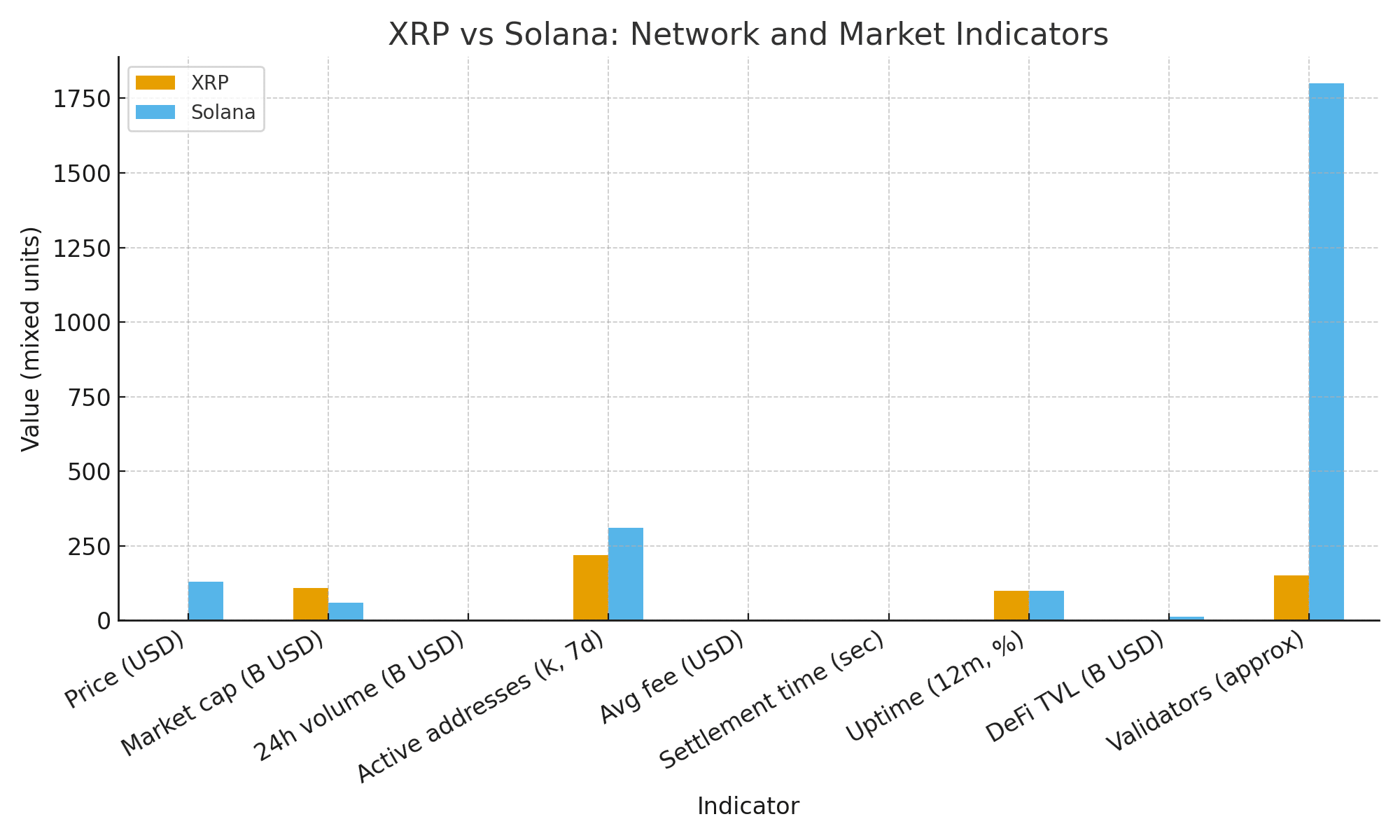
Key indicators include price, market cap, trading volume, on chain activity, developer engagement, DeFi value locked and uptime history.
Does this debate mean XRP is losing ground?
It shows that competition is intense, but it also shows that leaders inside the project are actively discussing how to stay competitive.
Glossary of key terms
XRP Ledger (XRPL)
The native blockchain that processes XRP transactions and supports token and payment functions.
Layer 1 (L1)
A base blockchain that settles transactions directly and secures the assets and applications built on it.
Validator
A network node that helps reach consensus and confirm transactions according to the rules of the chain.
Smart contract
Code that runs on a blockchain and executes agreements or actions automatically when preset conditions are met.
Go to market (GTM)
The strategy used to launch and promote a product or network, including messaging, partnerships and distribution.
References