

The stablecoin sector has reached an unexpected scale and hit remarkable numbers. As of late May 2026, the combined supply of fiat-backed tokens had surpassed $320 billion, reaching a new all-time high.
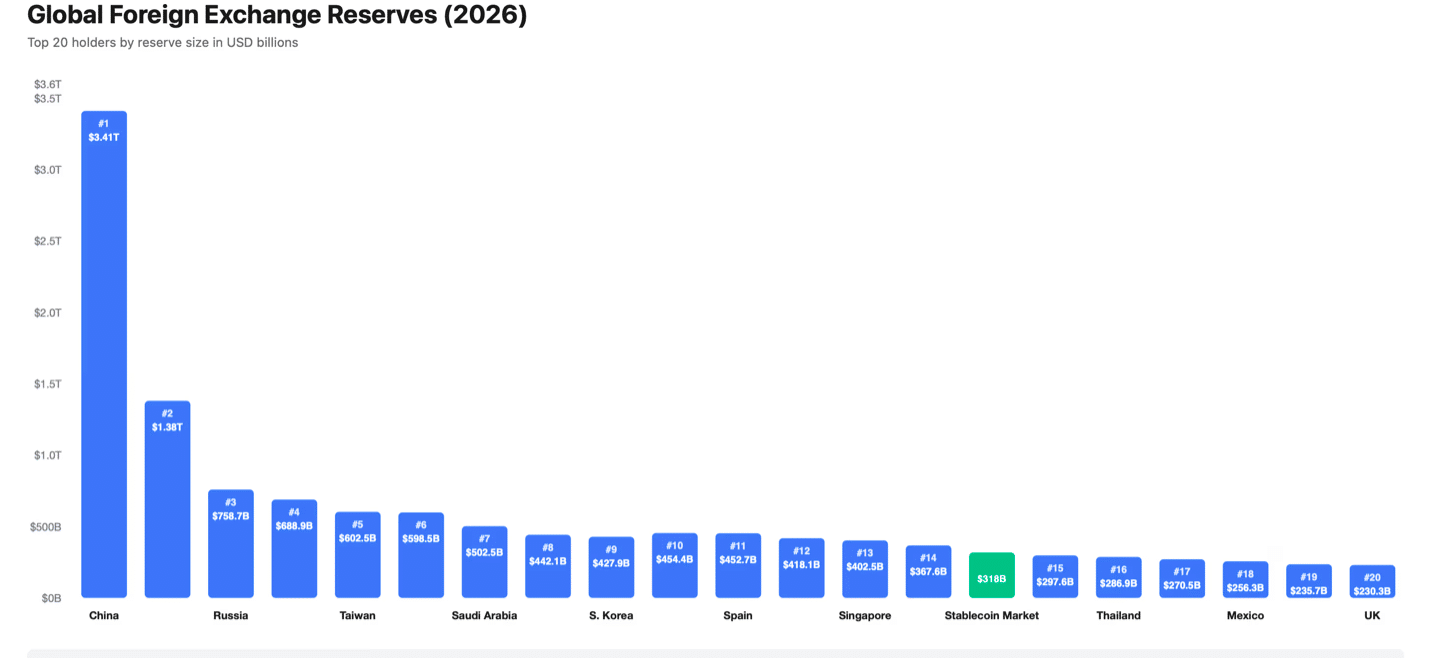
These stablecoin growth numbers exceed the foreign-exchange reserves of dozens of countries. This is glaring evidence that a massive amount of capital has moved onto the blockchain. To put this in context, Tether (USDT) and Circle’s USD Coin (USDC), the two largest stablecoins now account for 80% of the $320 billion market cap.
Tether’s USDT is currently sitting at around $188 billion, while USDC is at about $78 billion. A few other coins like DAI and algorithmics make up the rest of the remainder.
Key Stablecoin Growth Metrics (2026)
| Metric | Value (2026) |
| Total stablecoin market cap | $321 billion |
| USDT (Tether) market cap | $188 billion (58% share) |
| USDC (Circle) market cap | $78 billion (24% share) |
| Top 2 (USDT+USDC) share of total | 80% of market |
| Stablecoin share of crypto trading volume | 75% |
| Expected share of US dollar payments (2026) | 3% |
These figures reveal the surging demand for stablecoins which is quite impressive given the general crypto market was sluggish in early 2026.
However, in spite of a 20% pullback in crypto prices during Q1 2026, stablecoin issuance kept on going. In fact, total stablecoin supply went from about $315 billion at the end of March to $321 billion by late April. That is a testament to the role stablecoins play. Traders and institutions are increasingly turning to them as a defensive asset and a liquidity buffer whenever volatility spikes.
On-chain data shows that stablecoins are now dominating crypto trading. Based on available data, 75% of all on-chain crypto transactions now involve stablecoins.
In other words, stablecoin growth has effectively dollarized blockchain activity and most crypto buys, sells and DeFi settlements are now using USDT or USDC as the base.
A report from TRM Labs confirms this, noting that stablecoins now make up 30% of all on-chain crypto transaction volume which reached $4 trillion in annual volume by mid-2025.
In essence, stablecoins have become the digital dollar within crypto and are vastly more adopted than any other token.

Beyond Trading: Stablecoins Power Payments and Remittances
The stablecoin growth and success story doesn’t stop at crypto trading either. Their real-world utility especially when it comes to payments is growing rapidly. Because stablecoins are programmable and settle instantly on blockchains, they can slash costs and time in cross-border money transfers. Traditional remittances often require multiple correspondent banks and days of settlement but payment stablecoins can cut out the middlemen.
Businesses can send a dollar-equivalent stablecoin on a Sunday night and have it arrive overseas in minutes whereas old payment rails only operate on banking schedules.
Major payment firms are taking notice. In 2025-2026:
- Stripe (via its Link wallet) kicked off enabling USDC payouts for businesses, making it possible for crypto-native payroll and merchant settlements to happen with less hassle.
- Meta (Facebook) launched USDC wallet payments inside its apps allowing people in markets like the Philippines to get paid in stablecoins without the complexity of traditional payment systems.
- Western Union announced a plan for a USD stablecoin on Solana, in the hopes of making remittances a lot faster.
- Visa gave transaction settlement in USDC and other stablecoins a test run.
- PayPal started letting users integrate crypto-backed stablecoins (PYUSD) into their accounts.
All these moves show just how far stablecoins have come in getting into the mainstream of finance.
Stablecoins also offer a way to earn on-chain returns. Many traders and treasury managers are putting their funds into yield-bearing USD-pegged tokens like USDe, sUSDS or the interest accounts that some protocols offer, this way, they can earn returns on the blockchain.
Stablecoins are involved in 75% of trading volume and the yield products that have popped up as a result are pulling huge amounts of money from DeFi and institutional treasuries.
As investors become more confident in these stablecoin yields, while being able to preserve their capital, new products are springing up, and even attracting investor interest. Circle’s IPO-listed stock is up around 12% this year (as of April 2026) on the confidence that the regulated fiat-backed model has to offer.
Institutional and Regulatory Acceptance
Stablecoin growth has coincided with a rise in institutional legitimacy. Between 2024 and 2026 new laws and proposals have clarified stablecoin rules globally. In the US, the 2025 GENIUS Act officially put regulated stablecoins on the same level as payment instruments, prompting banks to prepare issuance and custodial roles.
The federal agencies (Treasury, FDIC, and FinCEN) all rolled out multiple rule proposals in early 2026 to govern reserve requirements and anti-money laundering for stablecoin issuers.
In Europe, the 2024 MiCA framework brought stablecoins under EU law, and major banks are now working on euro-backed coins for clearing and cross-border trade.
This regulatory clarity has emboldened incumbents. Big financial firms are launching crypto payment rails and custodial services around stablecoins. Bank consortia are planning MiCA-compliant euro-stablecoins (e.g. a BNP Paribas-led effort) for the second half of 2026.
ECB President Lagarde says it is no longer a question of whether stablecoins will exist, but rather whether jurisdictions can afford to live without them. So, in short, governments and bankers are recognizing stablecoins as a new payment backbone , an institutional stamp of approval on what began as a crypto innovation.
Success Drivers: Why Stablecoins Keep Thriving
There are a few reasons why stablecoins have managed to succeed where other crypto projects have struggled:
Price Stability: By pegging tokens 1:1 to fiat (usually USD), stablecoins eliminate the volatility that has always been a major headache for crypto users. Users can transact or save their crypto-value without having to worry about losses. This stability is a real breakthrough for payments, payroll, and remittances, making stablecoins more practical for everyday use than Bitcoin or Ether.
Blockchain Advantages: Stablecoins bring together the stability of fiat currencies with the speed and programmability of cryptocurrencies. They can settle trades 24/7/365 in a matter of minutes, all on a public ledger. Stablecoins are like the missing link between the world of cryptocurrency and the stability that is necessary for users to do everyday transactions. This has allowed them to power billions of dollars of volume in DeFi and enable instant cross-border transfers.
Wide Acceptance: Major platforms and DeFi protocols accept stablecoins for a whole range of tasks such as trading, staking, lending and collateral. Exchanges and DEXs list dozens of stable-pegged pairs, and DeFi apps often require USD tokens just so they can have enough liquidity for their pools and loans. This means that every new user gets into the world of crypto via a stablecoin.
Regulated Issuers and Trust: The largest stablecoins like USDT and USDC are run by regulated entities that hold high quality reserves (cash, short-term Treasuries). Innovations like regular audits and third party checks have really increased confidence in their peg. For example, Circle’s USDC does monthly reserve statements, while newer coins (like PayPal’s PYUSD) are operating under proper trust-law licenses.
Financial Inclusion: In a lot of developing countries, the local currency is volatile or people just don’t have access to banking services. Stablecoins offer a kind of ‘dollar on-chain’ that people can hold in their mobile wallets. This taps into exactly what users are looking for, a reliable place to store their value and a low cost way to send money around. Right now, stablecoins are really popular in high-inflation corridors.
Expert Validation: Crypto analysts like Nic Carter acknowledged stablecoin growth, dubbing them “crypto’s first killer app”, because they have seemingly “dollarized the crypto market” and are now a dominant global settlement layer. His view encapsulates the narrative that stablecoins solved a hard problem (volatility) and unlocked real-world utility.
In short, stablecoins have been a success by combining the best of two worlds: the solid unit of fiat money and the speed and programmability of crypto. Over time, they have become the backbone of both on-chain finance and emerging digital commerce.
What Could Go Wrong?
No matter how good an idea is, there are always risks. Despite stablecoin growth, critics point to potential issues like reserve transparency (are the issuers always going to hold full backing?), regulatory pitfalls (like capital controls) and the danger of algorithmic stablecoin failures (like what happened with Terra’s UST collapse in 2022).
On-chain data has shown that when users suddenly withdraw a lot of stablecoins from an economy, it can actually make local currencies get weaker. This has raised alarms at central banks with reports warning that unchecked stablecoin flows could start to undermine monetary policy in developing economies.
However, the overall sentiment remains positive. Major issuers are adopting conservative reserve management and seeking sound regulation (bank-like oversight). The two-day redemption rule in the GENIUS Act is a good example of this, because it forces issuers to always remain liquid.
Nic Carter makes the point that stablecoin projects have become a lot more risk-averse: Tether and Circle are holding mostly very short term Treasuries now, and new entrants are favoring bankruptcy-proof structures.
Of course, no stablecoin pegging mechanism is perfect, but the industry has learned its lesson from past fragilities.
Importantly, the question is shifting from “Should stablecoins exist?” to “How can we use them safely?”.
It is clear that stablecoins are here to stay for the time being and the debate now is about how to integrate them wisely rather than trying to keep them from existing at all.
Continuous stablecoin growth is going to depend on finding the balance between innovation and sensible regulation and a good measure of transparency.

Expert Analysis: Stablecoin Growth and Impact
Leading voices are saying that stablecoins have a huge amount of potential. Christine Lagarde from the ECB notes that stablecoins were essentially created to bridge the world of crypto with fiat. She argues that stablecoins address real and deep-seated frictions that traditional systems struggle with (like the slowness of cross-border payments).
Others have also likened stablecoins to “digital dollar” infrastructure. JPMorgan Research has observed that stablecoins are now getting used for everyday payment flows, from managing company treasuries to sending money overseas at a scale that is getting hard to ignore.
The BIS and IMF have also highlighted stablecoins in their latest reports, which reinforces the fact that these tokens have grown to an enormous size in a very short amount of time and now hold more value than many countries’ official reserves.
Only 14 nations, led by China, Japan, Russia, India, Taiwan and Germany, hold more FX reserves than the market value of stablecoins.
Overall, the consensus is that stablecoins have proven themselves to be very useful indeed; their steady 1:1 peg, 24/7 settlement, and the fact that they’re available all over the world has made them incredibly useful.
Their design has helped bring mainstream capital onto blockchains, and opened up uses for crypto that go beyond just speculation.
Conclusion
Stablecoin growth and success story is still going strong. From record-breaking market caps and trading volumes to payment innovations and the adoption by mainstream companies.
With over $320 billion in circulation, and 75% of crypto transactions involving them, stablecoins have effectively laid the tracks for digital modern finance. Regulatory frameworks are finally starting to catch up and mainstream companies are starting to integrate stablecoins into their operations for real-world payouts.
There are still challenges around reserve transparency and regulatory framework but stablecoins have already shown they can function at a massive scale and deliver real benefits.
Stablecoins are crypto’s biggest success story so far because they solved the hardest problem in crypto (volatility) and delivered a practical digital dollar that both crypto-heads and traditional banks can use.
Glossary
Stablecoin: A digital currency pegged to a stable asset, typically a fiat currency.
Peg: The mechanism that keeps a stablecoin’s value tied to the value of the asset it is pegged to.
USDT (Tether): The largest stablecoin issued by Tether Ltd.
USDC (USD Coin): A major regulated stablecoin, issued by Circle (and now also backed by Coinbase).
DeFi (Decentralized Finance): A blockchain-based financial ecosystem where stablecoins are widely used for lending, trading, and yield farming.
GENIUS Act: U.S. legislation from 2025 that has started to define and regulate stablecoin issuers as banking/payment entities.
Frequently Asked Questions About Stablecoin Growth and Success Story
What is a stablecoin?
Stablecoins are cryptocurrencies designed to keep their value stable, usually pegged 1:1 to a reserve asset, most often the US dollar. E.g, USDT or USDC.
Are stablecoins regulated?
Regulation is changing all the time. In the EU, there’s a law that explicitly covers major stablecoins. In the US, the GENIUS Act of 2025 laid down some rules to govern stablecoin issuers.
Can stablecoins break their peg?
Most “fully-backed” stablecoins like USDT and USDC have managed to keep their peg close to $1, due to large reserve holdings and market arbitrage. However, stablecoins that don’t have the same level of backing (like TerraUSD was in 2022) have had problems staying pegged during stress.
How do stablecoins fit into crypto’s future?
A lot of experts think that stablecoins will be a solid part of how digital finance works, almost as normal as using US dollars in everyday life. In fact, economist Nic Carter says that once stablecoins hit a certain level of size (around $300-$500B) then central banks might have to take them into account when making policy.
References
Disclaimer: This article is for general information only and should not be taken as financial or investment advice. Stablecoin values and uses carry risks. Always do your own research and consult a professional if you are considering using stablecoins or any other cryptos.