

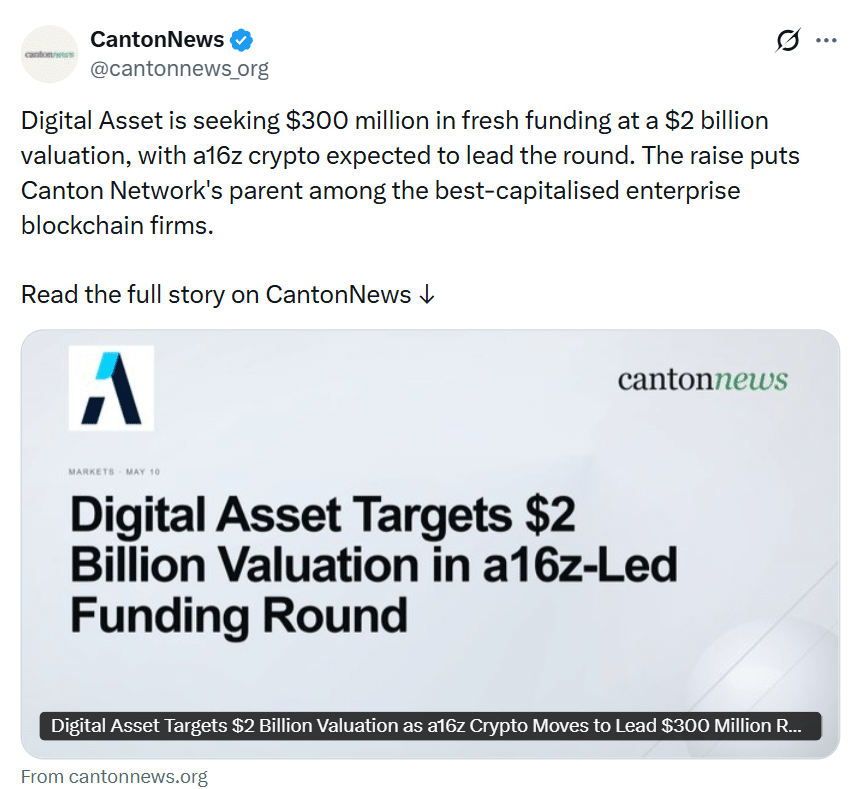
Canton Network developer Digital Asset Holdings is seeking about $300 million at a reported $2 billion valuation, according to Bloomberg. The company builds privacy-focused blockchain infrastructure for banks, trading firms, and regulated financial market participants.
Andreessen Horowitz’s crypto arm is leading the funding round, Bloomberg reported. The report cited people familiar with the matter who asked not to be named because the talks are private.
The financing has not closed yet. The final amount could still change before the round is completed. Digital Asset and a16z did not respond to Bloomberg’s requests for comment.
Canton Network Targets Institutional Blockchain Finance
According to the report, the round would give Canton Network another major institutional funding signal. It also follows Digital Asset’s $50 million raise late last year. That earlier round included Bank of New York Mellon and Nasdaq.

Canton Network operates as a public blockchain with built-in privacy controls. Its structure is designed for financial institutions that need shared infrastructure without exposing sensitive transaction data to all users.
This model is different from many open blockchain systems. Public networks often allow broad visibility of transaction activity. That transparency can create issues for banks, clearing firms, and trading platforms.
Digital Asset is positioning the network for regulated finance. The company’s focus remains on tokenization, settlement, privacy, and institutional coordination.
Funding Talks Come During Slower Crypto Market
The reported funding talks come as crypto venture capital activity remains below its 2021 and 2022 highs. Investment in the sector has slowed as market conditions changed.
Some historically active crypto funds have also shifted attention toward artificial intelligence and robotics. That shift has made large blockchain funding rounds less common than in earlier cycles.
Against that backdrop, the reported raise stands out. It suggests that investors still see demand for institutional blockchain infrastructure. It also shows that market infrastructure projects are being viewed separately from retail crypto speculation.
Privacy Design Targets Financial Institutions
The design places Canton Network in a specific part of the blockchain market. It is aimed at firms that need privacy, auditability, and controlled access.
Banks and trading firms cannot expose client records, trade terms, or internal positions across a fully open system. They also need technology that can work within compliance rules.
A privacy-focused blockchain may help such firms test tokenized assets and settlement activity. It can also support shared records while protecting sensitive information.
Institutional Backers Add Credibility
Digital Asset has support from several major financial and trading firms. Its backers include DRW Holdings and Citadel Securities. Both are major names in global trading.
Tradeweb Markets is also linked to Digital Asset and its ecosystem. Several investors tied to Canton Network are already using the platform or are connected to the Global Synchronizer Foundation.
That foundation supports coordination across the network. These relationships give the project a stronger institutional profile than many crypto infrastructure startups.
a16z Crypto Strategy Fits the Round
For a16z, Canton Network appears to fit its latest crypto investment thesis. The firm recently closed its fifth dedicated crypto fund at $2.2 billion.
That raised a16z’s total crypto capital to nearly $10 billion across five funds. In its fund announcement, the firm pointed to stablecoins, prediction markets, and tokenization as areas with long-term adoption potential.
Those sectors match many of Digital Asset’s target use cases. The reported investment shows continued interest in blockchain tools linked to capital markets and regulated financial products.
Tokenized Securities Plans Add Context
The timing also supports Canton Network as market infrastructure firms test tokenized securities. DTCC has said it plans to pilot tokenized versions of some assets it already custodies.
Testing is expected in July. A broader launch has been targeted for October. These plans show that tokenized securities remain an active area for financial market operators.
Digital Asset has also built links with Moody’s, Japan Securities Clearing Corporation, and Swiss crypto bank Amina. These links support its focus on regulated finance rather than retail crypto trading.
Conclusion
If completed, the round could help Canton Network expand its role in institutional digital asset infrastructure. It would also strengthen Digital Asset’s position as banks and market firms test blockchain-based settlement tools.
The financing remains unfinished. The final amount may still change. Still, the talks show that privacy-focused blockchain systems continue to attract capital from major investors.
Appendix Glossary of Key Terms
Digital Asset Holdings: The company developing Canton Network and related market infrastructure tools.
Tokenization: The process of representing real-world or financial assets on a blockchain.
Privacy Controls: Features that limit who can view sensitive transaction data.
Institutional Blockchain: Blockchain infrastructure designed for banks, trading firms, and market operators.
Global Synchronizer Foundation: The governing entity linked to coordination across the Canton ecosystem.
Venture Funding: Capital raised from investors to support company growth and product expansion.
Public Blockchain: A blockchain network that allows broad participation while recording transactions digitally.
Frequently Asked Questions About Canton Network
1- What is Digital Asset Holdings raising?
Digital Asset Holdings is reportedly seeking about $300 million at a $2 billion valuation.
2- Who is leading the reported funding round?
Andreessen Horowitz’s crypto arm is leading the round, according to Bloomberg.
3- Has the financing closed?
No. Bloomberg reported that the financing has not closed yet.
4- Why is the project important for finance?
It focuses on privacy, tokenized assets, and shared infrastructure for regulated institutions.
References