






HSBC tokenized deposits Canton Network development is rapidly becoming one of the most talked about matters in digital finance. This is a deeper institutional shift, HSBC’s blockchain pilot signals the Canton Network as emerging infrastructure for regulated on-chain finance. This decision is part of a broader trend in bank tokenization crypto, where traditional financial systems incorporate blockchain rails for improved efficiency.
The HSBC tokenized deposits launch bolsters institutional blockchain adoption confidence for 2026, as it gives evidence of the notion that major banks have graduated from experimentation and are now building future-ready financial systems upon blockchain infrastructure.
HSBC Blockchain Payments System and Tokenised Deposit Mechanics
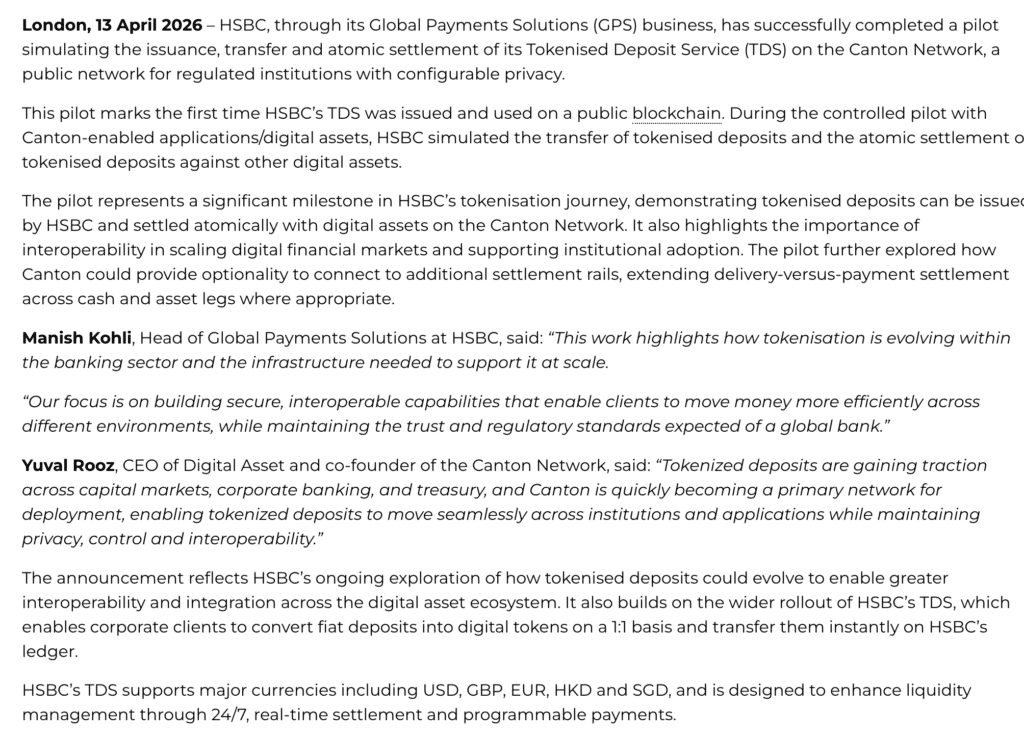
HSBC tokenized deposits Canton Network initiative shows what a modern HSBC blockchain payments system can look like. HSBC’s Tokenised Deposit Service demonstrates how regulated bank money can exist natively on an underlying blockchain infrastructure. These solutions provide tokenized bank deposits that are fully backed by commercial bank money and under a regulated environment unlike stablecoins.
This leads to a regulated but efficient space for financing. This boosts smaller transactions to an equitably-upscaled place (ultimately time-sellable) while also reducing counterparty risk, so extra banks may discover their on-chain model completely scalable and regulated for digital property integration.
Canton Network: Use Case Expands Beyond a Crypto Experiment
The HSBC tokenized deposits Canton Network launch represents a tangible transition from experimentation to execution. This Canton Network crypto use case is being adopted quickly by financial institutions as they look at its interoperability features. With increasing institutional participation, it seems the Canton Network is becoming part of institutional DeFi infrastructure.
This model provides privacy and regulatory compatibility, making it attractive for enterprise-scale financial activities compared to public chains. Another aspect of the Canton Network HSBC integration is that it points toward hybrid finance, where blockchain technology complements traditional banking services rather than replacing them.

HSBC Strategy of Tokenizing Real World Assets in 2026
HSBC tokenized deposits Canton Network fits strongly into the wider HSBC digital asset strategy 2026, and helps bridge the real world asset tokenization HSBC initiatives. The tokenized deposits are Progressive Step To Digitizing bonds, equities, and public-private financial instruments. The trend is already establishing as institutions are looking for better settlement mechanisms and liquidity.
Crypto’s broader implications of the HSBC blockchain pilot aren’t limited to deposits either, and could redefine capital markets. Continuing to Tokenize the world for much larger businesses, asset tokenization is simply waiting to be paid attention to and engaged in; it will probably change many elements of standardized funding there, as very well Sooner or later we could see that “As tokenization continues to scale up, zero believe in and flexibility interactions during the Canton Network may position the institution at a critical role from regulated digital finance throughout 2026.”
The Great Debate: Tokenized Deposits Vs. Stablecoins
The HSBC tokenized deposits Canton Network development has brought back the conversation of tokenized deposits vs stablecoins. Stablecoins have taken a hold on the retail and decentralized finance space, while tokenized deposits provide a regulated alternative that remains anchored in existing traditional banking infrastructure. It begs the question: are banks undercutting stablecoins with deposit tokenization? The answer appears nuanced.
While stablecoins are still serving open ecosystems, institutions rather want controlled environments. The launch of HSBC tokenized deposits shows that banks are working to build parallel systems, not compete as their own rivals in a dual-track financial future.

Institutional Blockchain vs Canton Network
The HSBC tokenized deposits Canton Network initiative also invites comparisons between Canton Network vs Ethereum institutional blockchain models. Ethereum remains dominant in decentralized finance, but Canton focuses on permissioned access and compliance. This distinction is crucial for institutional adoption. The Canton Network crypto use case emphasizes interoperability and privacy, features often required by large financial entities.
While Ethereum supports innovation and open participation, Canton offers a tailored environment for regulated finance. This divergence highlights how different blockchain ecosystems are evolving to serve distinct market segments.
Analyzing Market Reaction and Price in the Canton
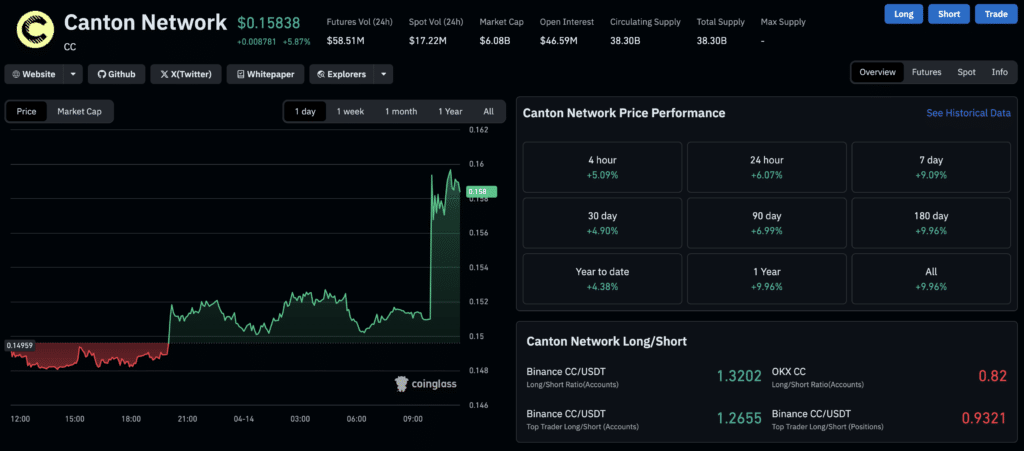
This announcement by HSBC to offer tokenized deposits on the Canton Network has impacted market sentiment, especially with regard to the Canton token. Canton Price Live Data The live Canton price today is $0.158994 USD with a 24-hour trading volume of $26,229,951 USD. Canton (CANTON) is 7.91% during the last 24 hours. Its launch was in 2012, and it has a circulating supply of 38,307,233,075 CC coins.
These numbers reflect increased investor interest in the aftermath ofthe HSBC blockchain pilot. While focused on the latest narrative, however, longterm sustainability of the HSBC tokenized deposits Canton Network trend is pinned to broader adoption and utility.
Tokenized Deposits and Their Implications for Crypto Market Structure
The HSBC tokenized deposits Canton Network shift carries significant implications for the broader crypto market. What tokenized deposits mean for crypto market dynamics is a gradual institutional takeover of infrastructure layers. The HSBC digital deposits crypto implications 2026 suggest a move toward regulated ecosystems where compliance and efficiency dominate.
This transformation may limit the role of decentralized protocols in institutional finance but could also legitimize blockchain technology globally. The HSBC tokenized deposits Canton Network model represents a bridge between traditional finance and blockchain innovation.
Conclusion
The HSBC tokenized deposits Canton Network development marks a pivotal moment in the evolution of digital finance. By integrating tokenized deposits into a regulated blockchain environment, HSBC is signaling a strong institutional commitment to blockchain adoption. This shift underscores the growing importance of hybrid financial systems that combine traditional banking with advanced technology.
Market participants should closely monitor how this trend evolves, as it may redefine liquidity, settlement, and asset ownership. Staying informed and adapting strategies accordingly will be essential in navigating this rapidly changing financial landscape.
Appendix: Glossary of Key Terms
Tokenized Deposits: Digital representations of bank-held funds issued on blockchain.
Canton Network: A blockchain designed for institutional financial applications.
Stablecoins: Cryptocurrencies pegged to stable assets like the US dollar.
Real World Assets (RWA): Physical or traditional financial assets tokenized on blockchain.
Institutional DeFi: Blockchain-based financial systems designed for regulated entities.
Frequently Asked Questions About HSBC Tokenized Deposits Canton Network
What is HSBC tokenized deposits Canton Network?
It refers to HSBC’s blockchain pilot enabling tokenized bank deposits on the Canton Network for institutional use.
How do tokenized deposits differ from stablecoins?
Tokenized deposits are issued by banks and fully regulated, while stablecoins are typically issued by private entities.
What is the HSBC blockchain pilot impact on crypto?
It strengthens institutional adoption and validates blockchain as financial infrastructure.
Is Canton Network replacing Ethereum?
No, Canton serves institutional needs, while Ethereum supports decentralized applications.
What are HSBC digital deposits crypto implications 2026?
They point toward increased regulation and institutional dominance in blockchain finance.
References