




Blockchain is often seen as a very complex technology. But at the heart of it, blockchain is just a way to record information so that nobody can change it secretly. Everything is open and transparent. A smart contract is one of the most important parts of blockchain. It is like a digital agreement that runs on its own when certain conditions are met.
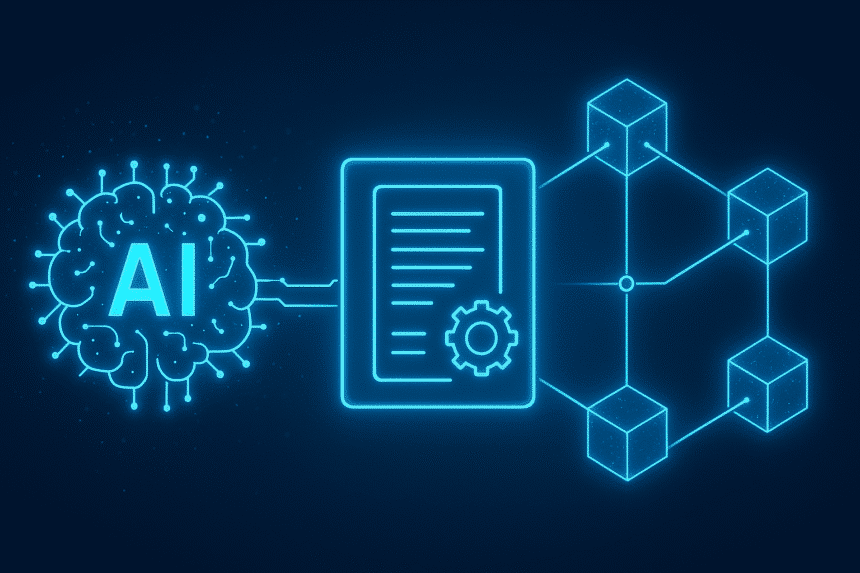
Now with artificial intelligence, or AI, these smart contracts are going to the next level. AI makes smart contracts more flexible, faster, and smarter. Instead of only following simple yes or no rules, AI can help contracts think in a way. AI and blockchain together are now called AI-powered blockchain networks. These are networks where automation is stronger and human mistakes are lower.
This blog will explain how smart contracts work, the problems they face, and how AI helps in fixing them. It will also show examples from the real world and how the future may look when AI and blockchain work side by side.
What Are Smart Contracts in Blockchain?
A smart contract is a computer program stored inside the blockchain. It runs automatically when certain terms are met. Think of it like a vending machine. If money is inserted, the machine gives out a soda. There is no need for a shopkeeper to check. In the same way, a smart contract will do what it is coded to do without needing a lawyer, bank, or any third party.
For example, if a person wants to buy digital land in a game, the smart contract can transfer ownership once payment is confirmed. No one can change the rules after the contract is made. This makes smart contracts very useful for many industries like finance, real estate, and healthcare.
Smart contracts remove the need for trust in a middleman. The trust is built into the code and the blockchain. Once a contract is written and placed on the chain, it will always follow its rules. This is why many companies are starting to use them for deals, payments, and record keeping.
Problems With Traditional Smart Contracts
While smart contracts sound very powerful, they also have some problems. One big problem is that traditional smart contracts can only follow strict rules. If something changes in real life, the contract cannot adapt. It only knows the conditions that were coded when it was created.
Another issue is coding errors. If the developer writes the code wrong, the contract may not work correctly. Once the contract is live on the blockchain, it cannot be changed easily. This can lead to money being locked or even lost.
Smart contracts also cannot make complex decisions on their own. They are limited to “if this happens then do that.” Real life situations are not always that simple. For example, in insurance, a claim may need different kinds of evidence, not just one data point. A normal smart contract cannot handle this.
Security is another challenge. Hackers can look for weaknesses in the contract’s code and try to exploit them. Since the contract runs without human approval, any mistake can be used by attackers right away. This has already happened many times in blockchain history, where millions of dollars were lost.
All these problems show why smart contracts need more automation and intelligence. This is where AI comes into the picture. AI can make contracts stronger, smarter, and more useful for real world needs.
How AI Improves Smart Contracts
Artificial intelligence is like giving smart contracts a brain. A normal contract just follows rules but AI lets it learn, predict, and make better decisions. This makes contracts more useful in real life where things are not always black and white.
AI can read big sets of data and tell the contract what to do. For example, in finance, AI can check market data and decide if a payment or loan should be approved. In healthcare, AI can look at patient records and confirm if an agreement for medicine delivery should move forward.
AI also helps in reducing mistakes. A lot of smart contract errors come from wrong coding. AI tools can review the code and find weak points before it is launched. This makes contracts safer and less open to hackers.
Another big point is automation. AI allows contracts to handle situations that would normally need humans to decide. This cuts time, lowers cost, and increases trust.
AI in automating decision making
AI makes smart contracts flexible. Instead of only yes or no rules, AI can look at data patterns and then make a fair decision. This is very helpful in banking, supply chain, and even government records.
AI in fraud detection and monitoring
Smart contracts on their own cannot see if fraud is happening. AI can. AI can track unusual behavior, flag bad transactions, and stop fraud before it gets worse.
AI in predictive analytics for contracts
AI can study past data to predict what might happen in the future. For example, in farming insurance, AI can check weather data and predict the chances of crop loss. Then the smart contract can act early and release payments if needed.
AI-Powered Blockchain Networks Explained
An AI-powered blockchain network is just a blockchain where AI is part of the system. It differs from a traditional blockchain in that it does more than just store data and execute contracts. It learns and improves over time.
Contracts in a traditional blockchain only function as coded. Contracts on an AI-powered blockchain can evolve in response to fresh data. This makes the entire network smarter and more efficient.
One benefit is speed. AI can process data much faster than humans. It can decide and execute contracts in seconds. Another benefit is less human input. Since the network learns, people do not have to watch every step.
These networks can also connect better with real world data. AI can bring outside information, check it, and then update the blockchain. This creates trust because the network is not limited to only what was written in the past.
In short, AI-powered blockchain networks are like the upgraded version of normal blockchains. They are faster, safer, and more ready for real-world challenges.
Use Cases of AI and Smart Contracts Working Together
AI and smart contracts are already delivering outcomes in a variety of industries.
In banking and finance, AI smart contracts can quickly assess credit history, analyze spending, and approve loans. Payments can also be automated, which reduces the possibility of fraud.
AI is used in the supply chain to trace items from the production to the client. A smart contract can validate when a product advances from one stage to the next, and AI ensures that the data is accurate and not manipulated.
AI-powered insurance contracts may evaluate medical reports, accident images, and meteorological data. This allows claims to be processed rapidly, without the need for lengthy human reviews.
In healthcare, contracts powered with AI can manage patient records. They can check if a prescription is valid and release medicine orders safely.
Advantages of AI in Blockchain Networks
AI in blockchain networks brings many clear benefits. When contracts get smarter, industries save money and time. People trust the system more because less human error is involved.
One big advantage is speed. AI can check data, verify conditions, and run contracts much faster than humans. A process that used to take days in banks or hospitals can now happen in minutes.
Another advantage is safety. Normal smart contracts are open to bugs and hackers. AI can scan and test contracts before they are placed on the blockchain. This reduces risks of attack. AI can also watch live activity to spot fraud.
AI also makes contracts more flexible. Real life changes often and normal contracts cannot handle it. AI helps contracts to learn and adapt. For example, a farming contract can change based on weather forecasts.
Cost savings for companies
Businesses spend less money on middlemen when contracts are smart. Lawyers, brokers, and agents are not needed for every step. AI cuts costs further by reducing mistakes and disputes.
Better security for users
Users gain more safety because AI monitors unusual activity. If a hacker tries to break in, AI can alert the system or block the move.
Trust without human oversight
In a normal deal, people must trust other people. In AI-powered blockchain networks, trust is embedded into the system. AI verifies everything, blockchain secures it, and no one can surreptitiously change anything.
Challenges of AI-Powered Smart Contracts
Despite these advantages, AI smart contracts confront numerous challenges.
One issue is technological. AI requires a lot of data to function successfully. If the data is incorrect or absent, the contract could make poor conclusions.
Energy consumption is also a major issue. Blockchain already consumes a lot of power. Adding AI makes it much heavier. This raises concerns about costs and the environment.
Another major difficulty is legal. Most countries do not have clear legislation governing AI or blockchain.
Data privacy risks
AI depends on personal data. But storing sensitive data on a blockchain can raise privacy issues. Once data is on-chain, it cannot be deleted easily.
Bias in AI decisions
AI learns from data, but data can be biased. If the training data is unfair, then the contract decisions may also be unfair.
Lack of global laws for AI-blockchain systems
Without clear rules, companies may be afraid to use AI contracts fully. Some countries may allow them, others may ban them. This makes adoption slower.
Traditional Smart Contracts vs AI-Powered Smart Contracts
| Feature | Traditional Smart Contracts | AI-Powered Smart Contracts |
| Speed | Runs only when coded rules are met | Runs faster with AI decision-making |
| Flexibility | Fixed, cannot adapt | Learns and adapts to new data |
| Security | Risk of coding errors and hacks | AI checks for fraud and errors |
| Cost | Saves money vs middlemen | Saves more by reducing disputes |
| Real-world data | Limited, needs external feeds | AI connects and analyzes live data |
Case Studies: Early Adoption of AI-Powered Smart Contracts
AI-powered smart contracts are not just theory. Some companies and startups are already testing them in real projects.
In fintech, firms are using AI contracts for loan approvals. Instead of long paperwork, the AI checks credit scores, income history, and market risks. The contract then releases funds if the conditions are right. This makes loans faster and cheaper.
In supply chain, big retailers test AI smart contracts to track goods. The AI checks shipping data, verifies delivery records, and stops fake reports. This gives customers more trust that what they ordered is real and safe.
In healthcare, hospitals are testing AI contracts to manage patient data. The AI checks if the prescription matches the patient’s health record. If all is correct, the medicine is released. This cuts errors and protects patient safety.
Insurance firms are also using AI contracts for claims. When a person files a claim, AI scans reports, photos, and records. If everything is valid, the contract pays out right away. This removes long waiting periods.
How AI Automation Changes Blockchain Governance
Governance is how rules are made inside a blockchain. In Delegated Proof of Stake (DPoS) or other systems, validators or nodes decide on upgrades, votes, and rewards. AI can make this process smoother and fairer.
AI can review network activity and suggest changes automatically. For example, if one validator is not doing work, AI can flag it and suggest penalties. This keeps the system honest.
Rewards can also be handled by AI. Instead of manual settings, AI can look at performance and give rewards to the best validators. This reduces unfair practices and rent-seeking behavior.
AI can also make voting smarter. In many blockchains, people do not vote because it is too complex. AI tools can help automate voting based on clear rules, making governance more active.
Overall, AI in governance reduces politics and increases fairness. The network becomes more self-running, with fewer risks of corruption.
Challenges vs Possible Solutions
| Challenge | Explanation | Possible Solution |
| Technical issues | Contracts need accurate and complete data | Use trusted data sources and AI verification |
| Energy cost | AI + blockchain can use high power | Develop green energy models and lighter AI tools |
| Legal uncertainty | No global rules for AI contracts | Create international standards and legal frameworks |
| Data privacy | Storing sensitive info on blockchain is risky | Use zero-knowledge proofs and off-chain storage |
| Bias in AI | AI may make unfair decisions | Train AI with diverse and balanced data |
Future of AI-Powered Blockchain Networks
The future of AI and blockchain together looks very strong. Many experts believe that this mix will change industries in the next five to ten years. When contracts can think and act on their own, the way deals are made will be very different.
In finance, AI smart contracts may replace many jobs in banks. People may no longer need loan officers or claims agents. In supply chain, AI can track every product from start to finish without human help.
Healthcare may also see a huge shift. AI contracts can manage patient data across hospitals, pharmacies, and insurance companies. This can make healthcare faster and safer.
There is also a chance that AI contracts will lower costs in governments. Public records, voting, and licensing can all be managed with smart automation. This may make services cheaper and more transparent.
Some experts even ask if AI contracts will replace lawyers and judges in the future. While this may sound extreme, automation is already reducing the need for human middlemen. The real test will be if laws and society are ready to accept AI as a trusted decision-maker.
Future Predictions of AI in Blockchain
| Area | Short Term (1–3 years) | Medium Term (3–5 years) | Long Term (5–10 years) |
| Finance | Faster loans and payments | AI replacing bank officers | AI contracts as global standard |
| Supply Chain | Better tracking of goods | Full automation of logistics | AI systems with no human input |
| Healthcare | Smarter insurance claims | Shared patient record systems | AI-managed global health networks |
| Governance | AI-assisted voting tools | Automated validator rewards | Full AI-based governance models |
Conclusion
AI-powered blockchain networks are the next big step in technology. Smart contracts are already changing how deals are made. But with AI, these contracts become faster, safer, and smarter. They can adapt to new data, check for fraud, and reduce errors.
The journey will not be easy. Challenges like energy cost, bias, and unclear laws still exist. But as more companies test and adopt AI contracts, solutions will also grow. In the next decade, AI and blockchain together may transform industries like finance, healthcare, and governance.
The big picture is clear. AI-powered smart contracts are not just another tech trend. They are a strong step toward automation where trust is built into the system itself. The future of business, government, and even daily life may soon run on contracts that can think and act on their own.
Frequently Asked Questions (FAQs)
1. What is an AI smart contract?
An AI smart contract is a normal blockchain contract with artificial intelligence added. It can learn, adapt, and make better decisions than simple coded contracts.
2. Are AI-powered blockchains safe?
They can be safer because AI checks for fraud and coding errors. But they also bring new risks like data privacy and AI bias.
3. How is AI used in Ethereum smart contracts?
AI is often used through external tools that connect with Ethereum contracts. It can help with fraud detection, data checks, and code testing.
4. What industries use AI with blockchain?
Finance, supply chain, healthcare, and insurance are the main ones. Governments are also testing it for records and voting.
5. Will AI replace humans in contract management?
AI may not replace humans fully, but it will reduce the need for middlemen like lawyers, brokers, and agents. Humans will still guide laws and fairness.
Glossary
Blockchain
A system of storing data in blocks linked together, making records safe from secret changes.
Smart Contract
A computer program on blockchain that runs on its own when conditions are met, like a digital agreement.
Artificial Intelligence (AI)
Technology that allows machines to learn, analyze data, and make decisions like humans.
AI-Powered Blockchain Network
A blockchain system that uses AI to make contracts smarter, faster, and more flexible.
Governance
The way decisions are made in a blockchain, like voting on upgrades or validator rewards.
Zero-Knowledge Proofs
A method in cryptography that proves information is true without showing all the details.
Validators
Members in a blockchain who confirm transactions and keep the network safe.
Summary
AI-powered blockchain networks are changing how smart contracts work. Traditional contracts can only follow strict rules and often face problems like coding errors, slow updates, and security risks. By adding AI, contracts can adapt, learn, and make better decisions. This means faster payments, safer data, and less need for human middlemen.
AI-powered contracts are already used in banking, supply chain, healthcare, and insurance. They help approve loans, track goods, manage patient data, and process claims automatically. AI also improves governance by monitoring validators and automating rewards.
Challenges remain, such as high energy costs, legal uncertainty, and risks of AI bias. But new solutions like green energy, diverse training data, and better global laws are being developed. Experts believe in the next 5 to 10 years, AI smart contracts could transform finance, healthcare, and even government systems. The future of automation may run on AI-powered blockchains.