



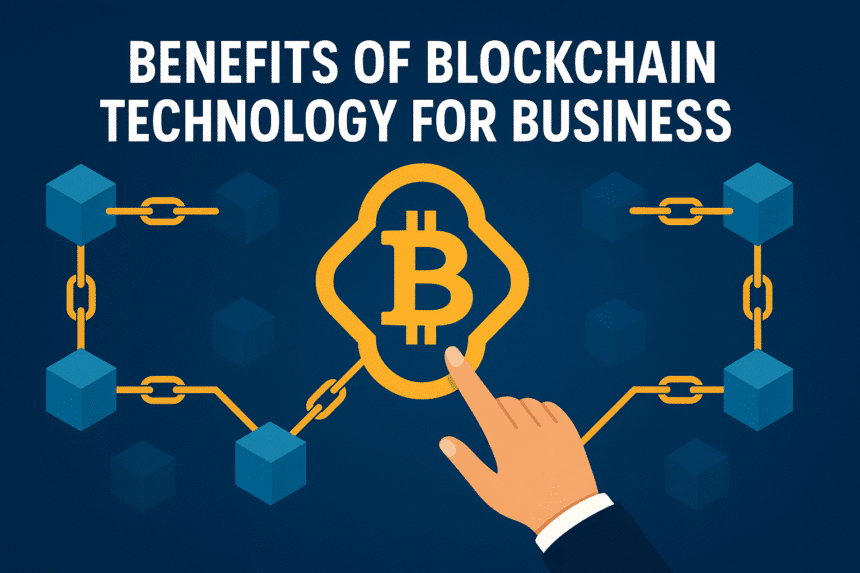

Blockchain has emerged from the innovation laboratory and into the real world.
Once seen as the foundation for cryptocurrency, it’s now driving measurable business value. Enterprise adoption is no longer a trend. It’s a shift. From banking to supply chains, businesses are weaving blockchain into their core operations.
The value of blockchain technology for business in 2025 isn’t hypothetical—it’s real-world practicality, scalability, and visibility at the bottom line.
How Blockchain Technology for Business Is Redefining Trust
Trust has always been expensive. Contracts, audits, and verifications cost both time and money. Blockchain flips that cost on its head by embedding trust into code.
All these transactions are maintained in a public ledger. It’s permanent, can be verified, and it’s time-stamped. Nobody can alter the record without the concurrence of the network.
That’s more important now than ever. At a time of false information and data breaches, companies must establish authenticity in real-time, not three 3-weeks later after an audit.
Case in point: IBM’s Food Trust initiative cut product tracking time from seven days down to 2.2 seconds. Retailers and regulators don’t find that speed a nice-to-have—it’s a must-have.
Smart Contracts Reduce Friction and Forms
The classical contract reverts to lawyers, manual approval chains, and fair dealing. That provides an opportunity for delays and errors.
They are self-executing agreements committed to the blockchain. Once conditions are fulfilled, the contract automatically concludes, no humans involved.
In 2025, insurance providers, transportation companies, and entertainment channels will be using these automated systems. Instant payout is done for claims. Royalties are settled without controversy. Vendors receive payment the moment products are delivered.
A report done by McKinsey in late 2024 estimated smart contract adoption as a major catalyst for reducing contract processing costs across the world by more than 60%.
It’s not only more efficient—it’s a game-changer.
Data Security Now Has a New Backbone
Cyber attacks keep increasing. Companies are battling more intensely in order to keep customer data, intellectual property, and sensitive money safe.
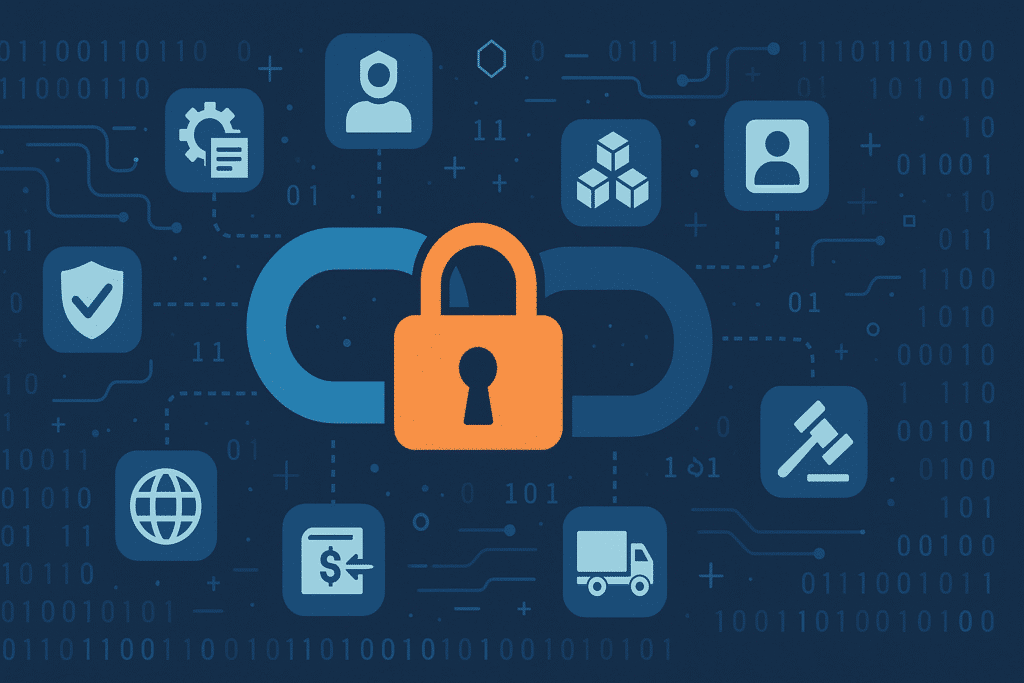
Blockchain offers a powerful edge. Its decentralized nature means there’s no central server to attack. Each node in the network holds a copy of the record, making mass tampering nearly impossible.
And once data is written, it stays that way. Immutable records don’t just protect against fraud—they streamline compliance.
In highly regulated industries such as healthcare or finance, that’s essential. Blockchain provides inherent audit trails that appease regulators and minimize overhead.
In-the-wild effect: Johnson & Johnson employs blockchain technology for approving the integrity of the data from clinical trials, so nothing gets modified or removed in between the process of review.
Blockchain Accelerates Transfers Across Borders
Legacy payment systems take a long time and incur high costs. Settlement delays, high charges, and conversion of currency contribute friction in international business.
Blockchain bridges this with settled funds within near-instant intervals. Money flows peer-to-peer within a matter of seconds, and with no intermediary correspondent banks.
Cross-border commerce in 2025 is highly dependent on blockchain rails. Fintechs such as Circle and Ripple drive real-time remittances and B2B payments at a small portion of the expense.
It has decreased the global average transaction costs at an 80% rate for cross-border payments, says the World Economic Forum.
Faster money isn’t just convenient—it boosts cash flow and lowers risk.
Supply Chains Are at Last Gaining Full Visibility
Global supply chains are complex, fragmented, and often opaque. Blockchain offers an end-to-end record of every product’s journey—from raw materials to the retail shelf.
This transparency helps businesses reduce waste, prove sustainability claims, and detect fraud.
By 2025, large companies use blockchain to track goods in real-time, verify certifications, and react more rapidly to disruptions. When cargo is delayed or conditions deteriorate en route, alerts activate automatically. Everyone across the chain sees the same authenticated record.
De Beers, for example, still employs blockchain to mark diamonds along the supply chain from mine to store to assure consumers of ethical provenance. That kind of trackability once required weeks. Now it’s done in real-time.
Regulatory Compliance Becomes Simplified with Blockchain
Regulatory compliance once involved paper trails of days gone by and reports manually filed. But regulators wised up about blockchain.
Many now encourage or even require digital records that are immutable, timestamped, and tamper-proof.
Blockchain automates that.
For public companies, it means cleaner audits. For financial institutions, faster Know Your Customer (KYC) screenings. For exporters, real-time tax and customs documentation.
The SEC has considered employing blockchain for the purpose of heightening securities transaction transparency. In 2025, additional jurisdictions will do the same.
It doesn’t merely assist businesses in compliance, but compliance hurts less with blockchain.
Digital Identity Will Be Decentralized
Passwords are weak. Centralized identity systems get hacked. In 2025, blockchain will enable users to control their digital identities directly.
Decentralized identity (DID) enables end-users to assert who they are—without sacrificing ownership of their data. Credentials can be verified on the blockchain, and end-users control when and with whom they share them.
Microsoft, with other ICT companies, is also introducing DID solutions that can simplify background investigations, loan disbursements, and even recruitments.
Companies also gain. Onboarding accelerates. Fraud risk decreases. And compliance gets better automatically.
Tokenization is Revolutionizing Access to Assets
It doesn’t just store data but allows assets to be digitized—securely and in fractional amounts.
This process, known as tokenization, is opening up markets once limited to the wealthy or well-connected. In 2025, real estate, fine art, and even intellectual property will be tokenized and traded in pieces.
It foresees tokenized assets reaching as much as $16 trillion by 2030. Companies entering early enjoy new liquidity, deeper investor pools, and programmable ownership rights.
It’s not theoretical. It’s a reality already in regulated markets with a helping hand from financial regulators.
Firms That Defer Will Repay Eventually
Innovators who were early with blockchain now operate leaner, faster, with fewer mistakes. Those still stuck in legacy still bask in growing gaps in confidence, speed, and cost efficiency.
In industries like logistics, payments, and compliance, blockchain technology for business isn’t optional anymore—it’s a requirement to stay competitive.
It’s no longer “nice to have” in 2025 for the benefits of blockchain tech. They become table stakes.
Conclusion:
Blockchain technology for business has crossed the curiosity mark to a point of necessity.
It simplifies trust. It protects data. It reduces costs. It expedites payments. It enforces compliance with zero latency.
From small startups to global giants, the companies embracing blockchain in 2025–2026 aren’t chasing buzzwords. They’re building systems that work better, move faster, and scale smarter.
In business, the ones who move more intelligently win.
Glossary of Key Terms
- Blockchain – A distributed digital record book that records indelible transactions.
- Smart Contract – Code that executes automatically once a condition is met.
- Decentralization – Information is stored on multiple computers rather than a single one.
- Immutable – Cannot be changed after it’s written to the blockchain.
- Node – A member of the blockchain network.
- Ledger – A record of transactions.
- KYC (Know Your Customer) – Laws for verifying identification and preventing fraud.
- Tokenization – Conversion of assets into blockchain-based digital units.
- Consensus – Network nodes agreeing on the current state of the blockchain.
- DID (Decentralized Identity) – A means for the user’s own identity data management.
FAQs
1. Which industries will apply blockchain in 2025?
Financial aspects, logistics, healthcare, real estate, insurance, and government.
2. Can blockchain be used with sensitive business data?
Yes. Its decentralized nature and encryption render it very safe.
3. Are all companies required to implement cryptocurrency with blockchain?
No. Most enterprise solutions use blockchain without crypto.
4. What’s the difference between public and private blockchains?
Public blockchains are public for anyone. Private blockchains are restricted for invited members.
5. How do smart contract costs decrease?
They reduce legal costs, eliminate manual approvals, and automate tasks.
Summary
Blockchain technology has progressed from an idea to the center of the main business infrastructure. 2025–2026 is the year business organizations in finance, supply chain, healthcare, and identity management discover value in it. Blockchain technology is reducing fraud to accelerate payments, the value is generating significant advances in trust, efficiency, and transparency. This isn’t the business future—it’s now being created in real time.