
This article was first published on The Bit Journal.
The small-cap crypto collapse of 2025 has given one of the clearest verdicts yet as to the validity of the long-standing Alt Season idea.
In data confirmed by several independent indexes and market reports, the smallest tokens on the crypto space bagged its worst performance on record in four years. At the same time, altcoin baskets posted negative returns compared to positive figures printed in major equity indices and top cryptocurrencies.
This sharp contrast between speculative digital assets and core established financial benchmarks discredits the notion that a conventional altcoin boom is coming, rather signaling heavy re-allocation of capital toward larger-cap digital assets and U.S. equities.
Crypto Small Caps Just Plummeted To Historically Low Lows
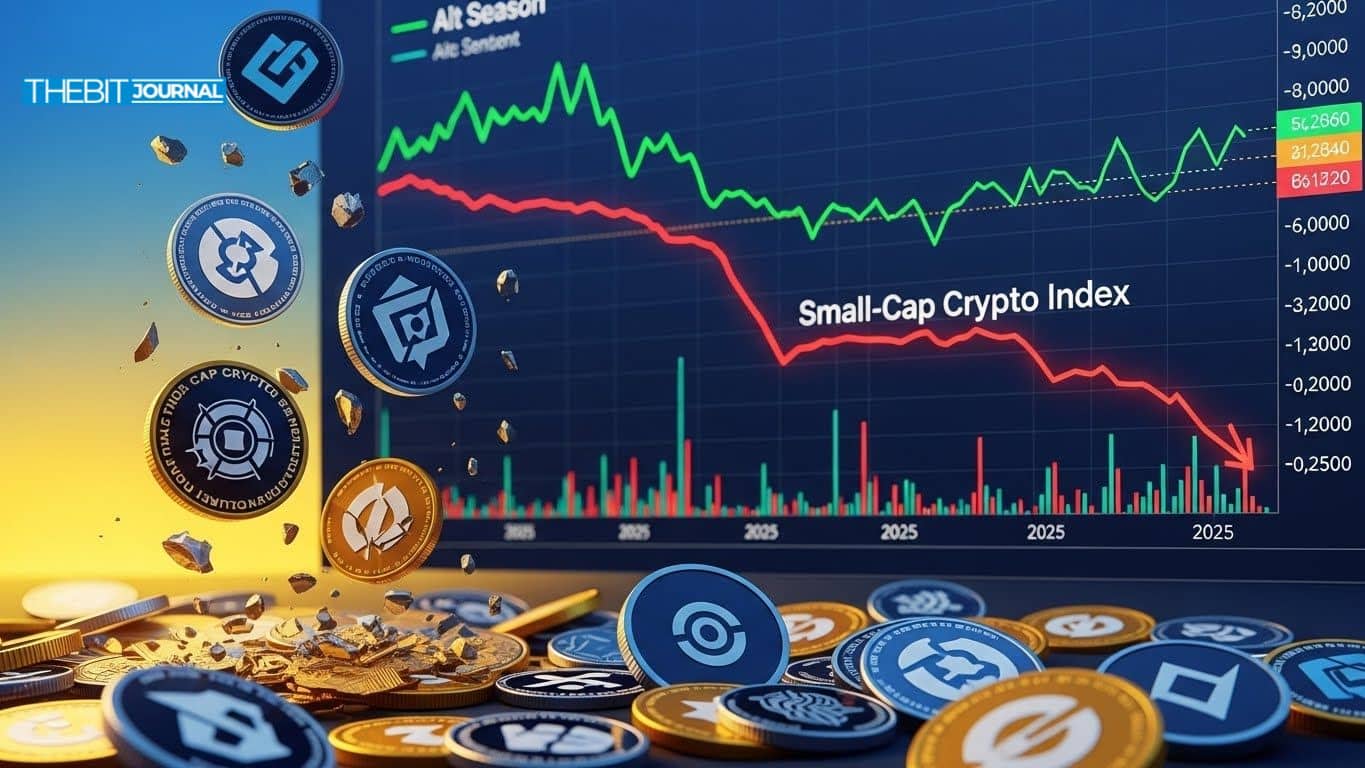
As at the end of November 2025, the MVDASC was at a new low for over five years since November 2020. Bloomberg had also reported this small-cap index tracking 50 of the smallest tokens in a larger 100-asset gauge lost big value while Bitcoin surrendered most of its gains from 2025.
MarketVector‘s own data reconfirms the gorilla-sized drawdown. MVDASC had lost more than 68% year-to-date, and nearly 75% over the past one year. These data points illustrate that the worst performers in the digital asset space have really underperformed both crypto and mainstream markets.
The next tier of altcoins beyond the top 20 assets that CoinDesk tracks in its CoinDesk 80 Index also endured enormous negative returns, losing more than half (46.4%) of their value in the first quarter of 2025 alone and about 38% year-to-date (YTD) through mid-July.
Comparison to US Equities and Large Caps
Against these savage losses, bona fide financial benchmarks like the S&P 500 and Nasdaq-100 have recorded healthy gains between 2024 and 2025.
The S&P 500 gain was nearly 25% in 2024 and about 17.5% in 2025, a combined growth of just under 47% over two years, while the Nasdaq-100 also flexed accordingl,y with cumulative gains approaching close to half over that same two-year period.
The picture was entirely different for the altcoin indices and only serves to highlight how in this market cycle, classical risk assets performed higher than speculative crypto.
Market Relative Still High; No Diversification Benefits
One notable insight from industry data is that large-cap and smaller altcoin indices have exhibited remarkably high correlation despite vastly different returns.
The CoinDesk 5 Index, featuring Bitcoin, Ethereum and three other leading tokens, did some heavy lifting, about 12% to 13% year-to-date return rate over the same period in mid-July), yet it sported a 0.9 correlation with the CoinDesk 80. That is, both moved generally in the same direction, but one lost value while the other gained some.
This dynamic, as Andrew Baehr of CoinDesk Indices succinctly put it, means “identical correlation, completely different P&L.”
This is a confirmation that the smaller tokens did not bring useful diversification; they simply followed the general market direction up and down, only to exaggerate losses further.
Liquidity Movement and Institutional Flows
While smaller altcoins have taken a beating, liquidity has not disappeared but instead consolidated in the top-quality assets.
Data through 2024 and 2025 shows market dominance of trading against BTC & ETH rallied to levels that are reminiscent of the 2021 cycle; however, this was dominated by a clear top 10 alts rather than healthy, broader-based alts.
Capital flows have tilted toward institutional-grade assets such as Bitcoin and Ethereum, and many smaller tokens had no regulatory clarity, tradeable derivatives markets or robust custody infrastructure, the types of features increasingly valued by institutional investors.
This implies that while crypto is still of interest to retail and institutions, investors are moving into liquidity, size, and regulatory certainty from speculative narratives.
Big cap assets such as Solana and XRP keep gaining interest with independent news catalysts or a more targeted regulatory angle.

Sharpe Ratios and Risk-Adjusted Outcomes
When comparing the returns on an asset risk adjusted basis, the small-cap crypto crash is even more apparent.
Both the small-cap and overall alt indices generated highly negative Sharpe ratios, meaning that returns failed to justify volatility. Whereas indexes such as the S&P 500 and Nasdaq-100 held better risk-adjusted returns over this time frame.
Even after adjusting for the fact that crypto markets are naturally more volatile, the disparity was striking. This indicates that not only did smaller altcoins deliver losses, but they also did so with outsized risk, unlike their equity counterparts.
Conclusion
The small-cap crypto collapse of 2025 can be tagged as a cryptocurrency’s coming-of-age moment beyond Bitcoin and Ethereum.
As large broad altcoin indices, and small token cohorts have all plunged to a magnitude never before seen on their respective charts, data now reveals that the notion of a repeated Alt Season doesn’t stand under careful examination.
Where large cap equities, such as the S&P 500 and Nasdaq-100, provided continuous returns to investors, values of small tokens crashed and neither brought diversification benefits when compared.
The market has ultimately rewarded liquidity, size, regulatory clarity and infrastructure leaving a lot of smaller tokens behind.
Glossary
Small-Cap Crypto Collapse: A time in 2025 when lowly rated digital assets plummeted to be trading at multi-year lows in pricing and performance.
AltSeason: A heavily talked about but now doubted season in crypto when altcoins outperform Bitcoin.
MarketVector Digital Assets 100 Small-Cap Index (MVDASC): This is an index that follows the MarketVector crypto index’s bottom 50 components.
Sharpe Ratio: A risk-adjusted return that compares excess return to volatility.
Correlation: A statistical measure of how two assets move relative to each other.
Frequently Asked Questions About Small Cap Crypto Collapse
What is the small-cap crypto crash?
It is a decline of smaller crypto tokens in 2025, as benchmark indices such as the MarketVector Digital Assets 100 Small-Cap Index reach four-year low depths.
Did altcoins do worse than stocks in 2025?
Yes. From 2024-2025, the majority of the altcoin baskets and smaller assets lagged behind equity indices S&P 500 and Nasdaq-100.
Did small-cap cryptos offer diversification?
No. While small-cap and mid/small-caps digital assets were highly (0.9) correlated with large caps they did not offer diversification benefits.
Which assets attracted liquidity instead?
Liquidity focused on Bitcoin, Ethereum and a few institutional-quality altcoins such as Solana, XRP.
Are alt seasons still possible?
2025 data reveals that Major alt season metrics have flatlined, calling into doubt the realistic prospect of wide-ranging altcoin pushups.
References
CryptoSlate
MarketVector Indexes
PYMNTS
Bitget
TodayOnChain