
This article was first published on The Bit Journal.
Real-World Asset (RWA) tokenization has surged rapidly, growing between 2024 and 2025, connecting legacy finance with blockchain. From 2022 to mid-2025, the on-chain RWA market increased five-fold from $5billion to around $24billion, fueled by the demand for digital assets with faster settlement, fractional ownership and global reach.
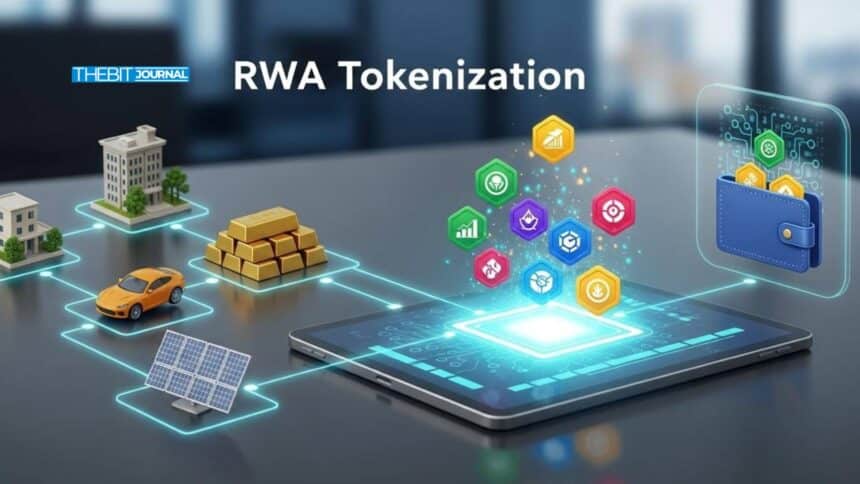
RWA tokenization platforms facilitate this process by creating tokens of real-world assets (bonds, equity, real estate), and placing them on a public blockchain. Premier platforms provide compliant end-to-end infrastructure, enabling institutions to “democratize capital markets” by trading digital asset securities around the clock.
Why RWA Tokenization Platforms Matter
RWA tokenization platforms are the enablers between legacy assets and blockchain. They allowed asset managers to digitize shares in, say, real estate or debt or private equity and then sell those as tokens to a global investor base. The advantages are fractional ownership, immediacy of settlement, and on-chain auditability.
For example, investors may purchase tokenized shares representing a stake in a real estate fund rather than the entire property thus reducing the cost of entry and increasing liquidity. Tokenization Providers process the legal and regulatory aspects as well as custody of the basic asset.
Regulators are closely watching as RWA platforms merge TradFi and crypto. Many RWA tokens are considered securities; thus, platforms need to be appropriately registered (e.g., SEC-regulated transfer agent, broker-dealer, Alternative Trading System).
The top platforms not only tokenize assets but also connect with banks, custodians and exchanges. Put simply, RWA tokenization platforms are bringing illiquid assets to trade more like stocks or stablecoins and it’s something that could help unlock trillions of dollars in value by 2030, according to analysts.
Market Growth of RWA Tokenization
2025 had been pitched as the year RWA tokenization breaks out. Industry sources note that tokenized assets (excluding stablecoins) reached $24billion on-chain by mid‑2025, more than 380% up from 2022. For perspective, total tokenized assets increased from $8.3B at the beginning of 2024 to $13.9B by year-end and the industry is expected to scale between $4-$30trillion by 2030.
That momentum is driven by the largest of the financial institutions, getting involved, banks and asset managers such as BlackRock, JPMorgan, Apollo etc. going from pilots to real deployments. BlackRock’s BUIDL money-market fund (short-term Treasuries) and Franklin Templeton’s tokenized money-market fund both debuted on blockchain in 2024-2025 with hundreds of millions in assets.
A RedStone report from June 2025 says Private Credit is now the largest RWA sector on-chain ($14B out of $24B total). Tokenized Treasuries and other fixed-income instruments are also taking off, as real estate and art among other asset classes, continue to come online gradually.
As of September 2025, there were $7.3B in US treasuries tokenized. The report implies that RWA is the second fastest growing sector in crypto (after stablecoins).
All in all, the market story is that RWA tokenization platforms ascended from experiment to mainstream, providing retail investors exposure to institutional-grade assets.
RWA Tokenization Platforms to Note in December 2025
Following is a list of some popular RWA tokenization platforms that are live as of late 2025. Each is influencing the market with distinctive assets, technology or alliances :
Securitize (USA): Often mentioned as the leading RWA securities tokenization provider. Securitize provides a compliant platform for issuing and trading tokenized securities, since it provides companies with all the necessary tools to issue such digital assets (SEC-registered transfer agent, broker-dealer, ATS and others).
As of October 2025, it had tokenized more than $4billion in assets, with the participation of companies such as Apollo, KKR, and BlackRock. Uniquely, Securitize powered BlackRock’s BUIDL, the largest single tokenized money-market fund on-chain and the first tokenized equity (Exodus, a Hong Kong-listed stock) to clear with the SEC.
Securitize CEO hammers on its mission to “democratize capital markets with tokenization. With its regulation compliance stack and institutions integrations around, Securitize is one of the best options to issue security tokens.
Ondo Finance (USA) : This is a top platform for tokenized U.S. Treasuries, now equities as well. Ondo Finance pioneered blockchain mutual funds such as OUSG (short-term U.S. Treasury fund) and USDY (yield token) with nearly $1.6billion TVL and $1.4billion in market cap as of mid-2025.
In September 2025, Ondo announced Ondo Global Markets to provide thousands of U.S. stocks and ETFs on-chain targeting international investors. Founder of Ondo hopes to build ‘Wall Street 2.0’ with around-the-clock trading of tokenized securities. With the investments on the platform, which is based on the infrastructure (group of funds) and also being backed by Pantera (with their $250M initiative), it shows its pioneering aspect in RWA.
Maple Finance (Ethereum/Solana): Maple allows institutional borrowers to access on-chain capital, essentially tokenizing private credit. Maple reported $777million of active loans and more than $3.3 billion in total loans outstanding as at June 2025.
Major banks and corporations have invested funds in Maple’s pools, making it one of the top places to finance real assets with cryptocurrency. Its model is more decentralized (DeFi-native) than traditional platforms, but it still underwrites institutional loans (mortgage-backed, inventory finance, etc.)
Maple’s year-over-year growth in 2024-25 shows the increasing demand for digital credi,t whereby Maple is being established as an RWA lending platform of choice.
Centrifuge (Ethereum): An open-source RWA protocol for asset-backed finance. Centrifuge enable businesses like DeFi apps, fintechs to build and fund tokenized “vaults” of assets like invoices, mortgages or art with crypto investors.
Towards the end of 2025, Centrifuge released Centrifuge Whitelabel, a plug-and-play issuer platform for institutions and startups. The company’s CEO says they are on a mission to make tokenization “a public utility”, delivering trusted infrastructure to the wider market.
So far, Centrifuge has onboarded over $1.3 billion of tokenized assets on-chain, ranging from credit funds to asset pools. Centrifuge only differs in its focus on modular, low-cost token issuance and the powering of DeFi lending (e.g. MakerDAO’s tokenized bonds).
Figure Technologies (on Provenance Blockchain): This is a fintech company specializing in large scale RWA offerings, specifically home equity and credit. Analytics indicate that Figure has about 75% of the tokenized private credit market and more than $10billion in tokenized assets.
Figure’s blockchain (Provenance) was already employed for JPMorgan’s PRISM bond program and its home equity line of credit platform. It has as well introduced a consumer finance token (YLDS stablecoin) that pools home mortgages.
In 2025, it partnered with banks to securitize traditional loans and bonds into on-chain tokens, Figure has arguably become the largest RWA platform by volume. Its emphasis on permissioned infrastructure and large bank clients sets it apart among platforms.
Tokeny Solutions (EU): A European enterprise-grade tokenization provider that has now secured the backing of Apex Group. Tokeny provides a White Label platform (the “T-REX” operating system) for institutions to issue and manage tokenized securities under EU legislation (e.g. MiCA).
Its products cover various assets (funds, real estate and debt) posted on the blockchain using ERC-3643 token standard. According to Tokeny, the company’s platform has been used to tokenize more than $32billion in assets.
Recent developments include collaborations with SkyBridge ($300M in hedge funds on Avalanche) and Lexon Insurance (tokenized funds for the Middle East). With the support and global reach of Apex, Tokeny is the European leader in on-chain asset management, serving banks and advisors who require a turnkey tokenization solution.
A couple of other notable mentions include: RealT (on Ethereum) for tokenized residential real estate, ADDx for Asian markets, and traditional players like Polymath in capital markets.
Startups like Gaia are popping up as well. All in all, these top RWA tokenization platforms have more than a few things in common. 100% compliance with local laws and regulations, compatibility with all blockchains on the market, and institutional agreements.
Table below provides a comparison of these platforms
| Platform | Primary Assets | Metrics (2025) | Notable Features |
| Securitize | Tokenized funds, equity | $4B AUM tokenized Partnered with Apollo, BlackRock, KKR | Fully regulated stack (SEC transfer agent, ATS, etc.); first to tokenize US-listed stocks and major funds |
| Ondo Finance | U.S. Treasuries, US stocks/ETFs | $1.6B TVL in Treasuries by Sept 2025 $1.4B combined OUSG+USDY cap | Focus on tokenized mutual funds (OUSG, USDY) and now stocks (Global Markets); layer-1 in development |
| Maple Finance | Institutional credit lending | $777M active loans; $3.3B total loans (mid-2025) | DeFi lending pools for real-world loans; underwritten, compliant lending |
| Centrifuge | Asset-backed lending (invoices, credit, real estate, etc.) | More than $1.3B RWA distributed | Provides Whitelabel issuance; integrates DeFi lending (e.g. MakerDAO bonds); programmable vaults |
| Figure | Home equity, bonds, credit | More than $10B tokenized private credit (75% market share) | Provenance blockchain; worked with major banks (JPM, etc.); consumer stablecoin YLDS based on mortgages |
| Tokeny Solutions | Securities (funds, private equity, real estate) | More than $32B assets tokenized | Enterprise platform (ERC‑3643); integrated with Apex Group; used in 120+ use cases globally |
Expert Insights on RWA Tokenization
As one industry report puts it, “the RWA revolution doesn’t occur with small players…It’s done by the largest financial institutions on the planet like BlackRock, JP Morgan, Apollo, VanEck, etc.”.
In reality, this is leading to top asset managers now working with crypto platforms. Securitize’s CEO, for example, has said that tokenization is the next chapter in making financial markets operate at internet speed.
Similarly, Centrifuge’s CTO has remarked that the company strives to make tokenization a “public utility” and provide institutional-grade infrastructure to any developer.
Strong compliance and infrastructure is important, experts say. Securitize was one of the first platforms to support a full SEC-licensed lifecycle for tokens. Interoperability is also crucial. Lots of platforms are built to accommodate more than a single blockchain or layer in order to accommodate the needs of their clients.
RWA.xyz data shows Ethereum hosts 65% of tokenized RWAs, but chains like BNB, Avalanche, and new rollups (e.g. ZKsync Era) are gaining ground.
Risks and Caution
Despite optimism, experts caution that tokenizing assets is still far from simple. Legal frameworks vary by jurisdiction. Experts say, token or no token, a security is a security. Hence, platforms face securities laws, fund regulations, and property law to begin with.
On top of that, the pricing for tokens is based on actual values in the real world. Accordingly, leading platforms stress audits, appraisals and partnerships with established custodians.
More generally, there is a consensus that platforms that combine strong tech with the traditional rigor of finance might be trusted and win in the end.
Conclusion
RWA tokenization platforms are quickly growing to become an indispensable financial infrastructure. By December 2025, players such as Securitize, Ondo, Maple Finance, Centrifuge, Figure and Tokeny have driven a movement that put tens of billions of dollars on-chain.
Each platform has its own strengths, such as compliance standards, asset specialization, and blockchain innovation, but they all agree on the goal: to tokenize the world of assets and make them safe, accessible, and liquid.
Market data and expert commentary suggest this industry will continue to grow, serving as a link between Wall Street and DeFi. Investors and institutions should keep a close eye on these platforms, as they are setting the benchmark for tokenizing everything from Treasuries to real estate in 2026 and beyond.
Glossary
Real-World Asset (RWA): Any tangible or conventional financial asset (i.e., anything not pure digital currency) in the world – i.e. real estate, bonds, stocks, commodities. RWA tokenization implies to tokenizing these on the blockchain.
Tokenization: The process of digitizing rights to an asset by recording them as a digital token on a blockchain. Tokenization allows for fractional ownership, programmable transactions and transferability.
Security Token: A digital token interpreted to represent an equity or debt interest in a company (subject to securities regulation). The vast majority of RWA tokens are security tokens.
Custody: Secure storage of assets. RWA token solutions typically rely on regulated custodians for to the underlying asset or collateral.
Smart Contract: A program on a blockchain that automatically implements rules for owning tokens belonging to assets.
SPV (Special Purpose Vehicle): A corporate vehicle holding an asset intended to be tokenized. The token holders, in turn, have a claim to the SPV’s asset.
Frequently Asked Questions About RWA Tokenization Platforms
What is an RWA tokenization platform?
It’s a blockchain platform that creates and trades ‘digital’ tokens, where each token represents the title or ownership of an asset (e.g. real estate, bonds, stocks). These platforms manage the legal compliance, custody and trading infrastructure necessary for real assets to be traded around the clock on crypto networks.
What makes RWA tokenization platforms so hot in 2025?
Because they open up new liquidity and investor access for traditionally illiquid or expensive assets, recent market growth demonstrates strong interest: the global RWA token market has grown from $8B to $24B in less than a year. Platforms support fractional ownership and faster settlement, which appeal to both institutions and retail.
Who are the leaders of RWA tokenization space?
Platforms such as Securitize, Ondo Finance, Maple Finance, Centrifuge, Figure Technologies and Tokeny Solutions, all with different asset focus and model to compliance.
Are tokenized assets regulated?
Yes. Many of the aforementioned RWA tokens are deemed as securities or similar financial instruments under existing laws. Platforms must follow securities laws and often register themselves as brokers or funds.
References