







A familiar Bitcoin bearish signal is once again beginning to take form and this time, the setup looks like the conditions that led to a sharp correction in early 2026.
After rallying from the low of around $62,000 to April peak price of about $79,000-$80,000 Bitcoin saw an extended period where price action started to stagnate. What was initially a healthy consolidation now shows signs of structural weakness as multiple indicators point in the same direction.
Price action, liquidity flows and demand metrics have finally disconnected from one another. The reversal usually begins at that disconnect.
Weak Reprieve Near $80K Reveals Fragile Market Structure
This Bitcoin bearish signal is already making itself seen in how price behaves around resistance.
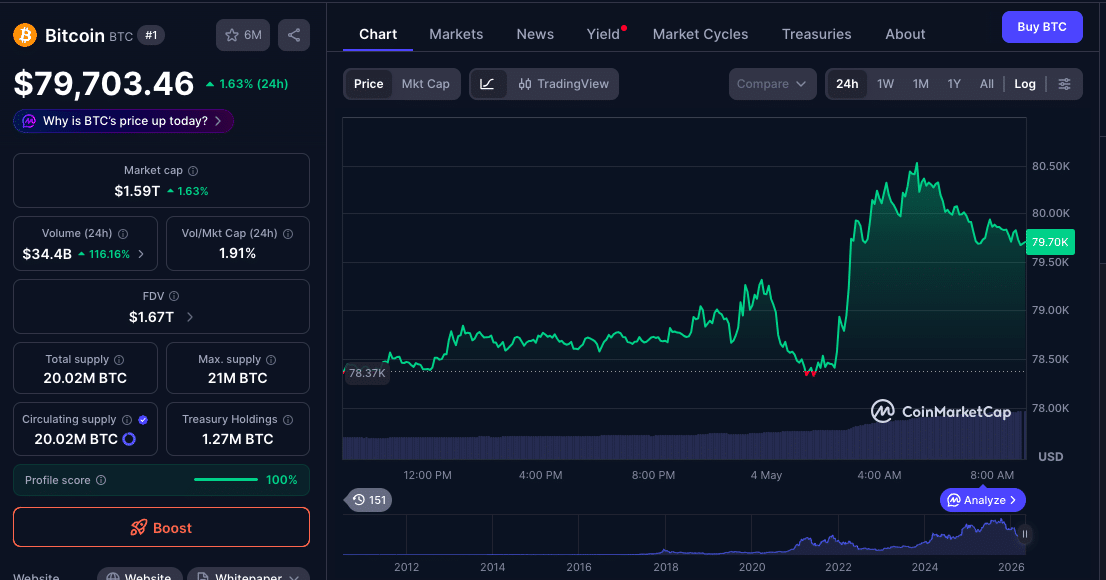
Data confirmed the move into $79,000-$80,000 levels for Bitcoin as a strong continuation of the rebound which began earlier in April supported by renewed demand and improved sentiment. Yet as price reached this zone, the structure turned.
The market started having weaker rebounds instead of breaking higher. Multiple tries to break above $79,000 failed over the past week but resulted in lower highs. This pattern indicates waning buyer conviction, rather than just straightforward consolidation.
Bitcoin price right now, sits around $79,703, after hitting the $80k mark earlier and then retracing, just roughly above the support level that is being tested repeatedly.
More often than not, repeated pressure at support without a strong bounce to the upside forms a great probability for a breakdown. Meanwhile, reclaiming $80,000 through a convincing surge powered by sustained volume would negate this Bitcoin bearish signal and imply strong demand has returned.
Right now the structure appears more fragile than strong.
Outflows from Binance Change the Liquidity
Another important Bitcoin bear signal is liquidity, specifically how capital moves on-exchanges.
During Bitcoin’s April rebound, Binance recorded consistent stablecoin inflows ranging between $548 million and $1.14 billion. That influx of capital provided the buying power needed to push BTC from $74K toward $78K and stabilize near resistance. That has however reversed sharply.
Stablecoin netflows have gone negative since April 25, with between $1.54 billion and $1.78 billion of outflows occurring over a number of consecutive sessions.
This is important because momentum is driven by liquidity. When capital leaves exchanges, fewer buyers are available to absorb sell pressure.
What makes this particularly notable is the historical parallel. Just before Bitcoin price plunged 15% from $89.5k to $76,000 earlier in January, the market experienced an outflow of $3.2 billion.
The current structure is not a perfect repeat but the pattern is close enough to be concerning. The market is no longer supported by liquidity, it is losing it.
Weak U.S. Demand and Realized Losses Intensify Selling Pressure
Another cause strengthening the Bitcoin bearish signal comes from the demand side indicators. The Coinbase Premium Index, widely used as a proxy for U.S. institutional demand, has flipped negative again after briefly supporting the April rally.
This is an indication that U.S.based buyers often viewed as the most reliable spot demand source in recent years, are backing off. Meanwhile, on-chain data reveals that as Bitcoin neared $78,000 towards the end of April, realized losses soared to almost $6 billion.
This indicates that most investors who bought at higher levels capitalized by exiting after the rally instead of increasing their stakes. In other words, supply is being distributed into strength rather than accumulated. And while some of those realized losses have shown a faint sign of rolling over, demand alone is not enough to counter selling.
Derivatives markets provide further confirmation. Recent data shows that open interest is barely increasing, while trading volume has decreased by hugely, which suggests traders are backing off and reducing positions rather than adding.
This lack of participation minimizes chances of a sustainable breakout.

Upside Potential is Limited by Macro Conditions and Liquidity Constraints
Beyond on-chain and exchange data, the general environment is also contributing to the Bitcoin bearish signal.
Bitcoin is entering May under conditions that are less supportive than in previous years. In past cycles, the month has been positive for BTC, but 2026 is showing weaker momentum and reduced participation.
Liquidity is still strained across markets, and macro factors like high interest rates and inflation concerns are weighing on risk appetite. There has been an uneven recovery even within crypto.
In April, Bitcoin was up around 16%, partly as a result of ETF fund flows and institutional buying. Nevertheless, futures positioning has stayed cautious, funding rates have been negative, another indication that traders are not yet completely confident in more upside to follow.
The stalled progress of crypto legislation, including ongoing debates around market structure in the U.S., also continues to limit institutional confidence.
Even when liquidity improves temporarily, it does not translate into sustained accumulation because the regulatory backdrop remains unclear. Until that changes, Bitcoin’s upside may remain capped, reinforcing the current Bitcoin bearish signal rather than invalidating it.
Conclusion
All in all, the current setup does not guarantee a drop, but it clearly shows Bitcoin bearish signals using that should not just be turned away.
Momentum is fading near resistance. Liquidity is flowing out of exchanges. Weak Spot demand especially in U.S. institutions and the overall market participation is getting thinner.
These are the same issues that led to January’s 15% initial drop.
At the same time, the situation could still be reversed. The structure could shift rapidly with a return of stablecoin inflows, continues strength in spot demand or a sustained break above $80,000.
Glossary
Bitcoin bearish signal: indicators suggesting increased probability of price decline.
Coinbase Premium Index: measures U.S. institutional demand by comparing BTC prices across exchanges.
Liquidity outflows: capital that is flowing out of exchanges, which indicates a drop in buying power.
Stablecoin inflows: a fresh supply of capital into the cryptocurrency market.
Resistance level: price area where the selling power increases.
Frequently Asked Questions About Bitcoin Bearish Signals
What is the biggest Bitcoin bearish signal right now?
Decreased momentum, Binance outflows, and declining spot demand
Why are Binance outflows important?
They show liquidity removed from the market which reduces buying pressure.
What does a negative Coinbase Premium mean?
It shows weaker demand from U.S. institutional investors.
Is this the same as January’s dip?
This is how the liquidity setup looked prior to price falling 15%.
Can Bitcoin still recover?
Definitely, if demand comes in and price reclaims $80K with strong demand.
References