






Bitcoin is trying to recover, but the market is not giving it a free pass. After another failed push toward $80,000, traders are watching the same narrow battlefield: Federal Reserve policy, oil-driven inflation fears, ETF demand, and on-chain cost basis levels.
The Bitcoin price remains close enough to the breakout zone to keep bulls interested, yet weak enough to remind investors that macro pressure still has a firm hand on risk assets. Recent market data showed BTC trading around the mid-to-high $70,000 area after failing near the $78,000 to $80,000 supply zone.
Why Bitcoin price Is Still Trapped Below $80,000
The Bitcoin price is struggling because $80,000 is not just a round number. It has become a psychological line, a technical ceiling, and a breakeven area for many recent buyers. When BTC moves close to that range, some short-term holders appear more willing to sell into strength rather than wait for a larger rally.
That matters because markets often turn heavy near levels where investors can exit without losses. In this case, the True Market Mean is near $78,000, while the short-term holder cost basis is close to $79,000. Together, those levels create a crowded zone where recovery attempts can lose steam before momentum properly builds.
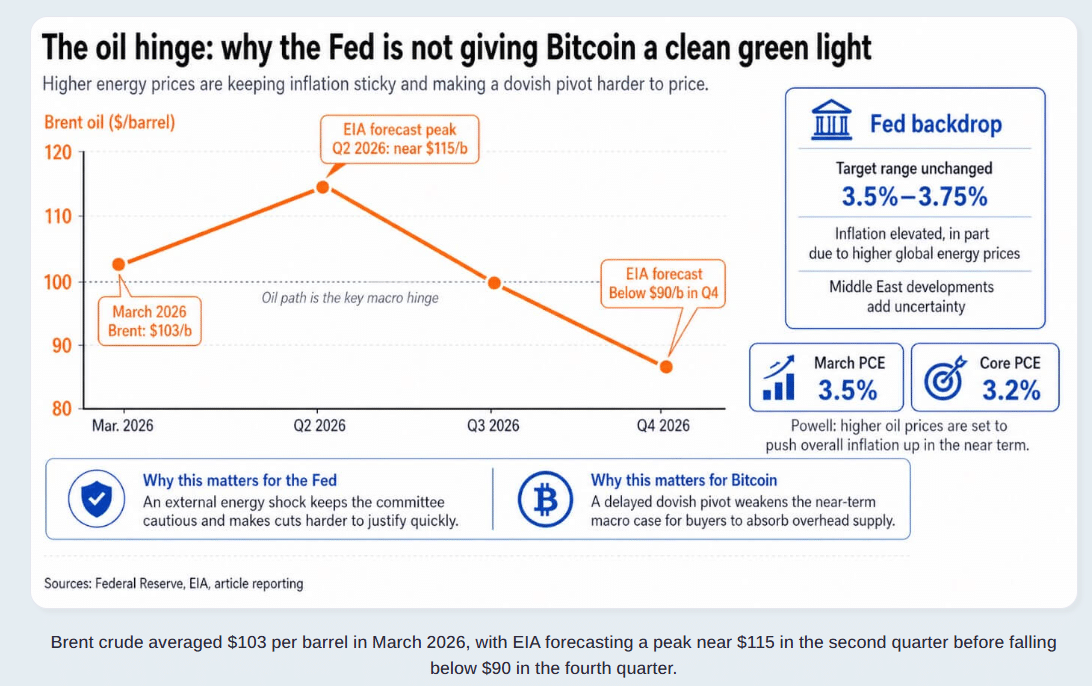
Powell’s Fed Message Did Not Give Crypto a Clean Green Light
The Federal Reserve kept interest rates steady, but the tone around inflation remained cautious. Higher energy prices have complicated the outlook, and that reduces the chance of a quick shift toward easier policy. For crypto, that is important because lower rate expectations often support speculative assets, while sticky inflation keeps investors defensive.
The Bitcoin price did not collapse after the Fed decision, but it also did not receive the clean signal bulls wanted. Powell’s message left traders with a familiar problem: risk assets may rally on hope, but they need stronger proof before breaking resistance with conviction.
On-Chain Signals Show Where Buyers Are Hesitating
On-chain data is giving traders a useful map. The key issue is not only whether BTC can touch $80,000, but whether it can stay above it. If the Bitcoin price breaks through that zone with strong spot demand, the next upside area could sit around $82,000 to $84,000.
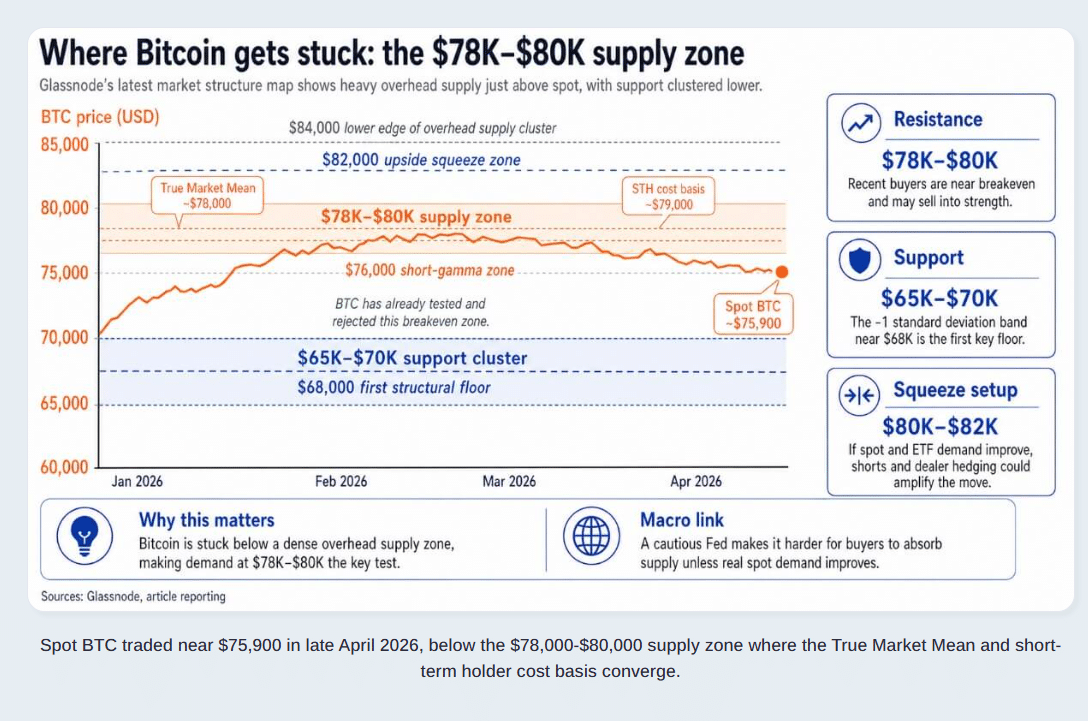
Still, there is a catch. When profit-taking rises near breakeven levels, buyer liquidity has to do more work. Without fresh demand from ETFs, long-term holders, or larger spot buyers, a move into resistance can fade quickly. That is why the recent rejection does not look random. It reflects a market where conviction exists, but not enough of it yet.
ETF Demand and Liquidity Remain the Swing Factors
ETF flows are another key indicator because they show whether institutional demand is strong enough to absorb selling. When ETF inflows are healthy, they can help BTC climb through resistance even when short-term holders sell. When flows weaken, the market becomes more dependent on leveraged traders, and that can make rallies fragile.
The Bitcoin price is also reacting to liquidity conditions. Higher rates tend to pull money toward cash and fixed-income assets, while easier policy usually supports crypto, tech stocks, and other risk assets. That is why the Fed’s cautious stance matters even for investors who mainly follow charts.
What Comes Next for BTC?
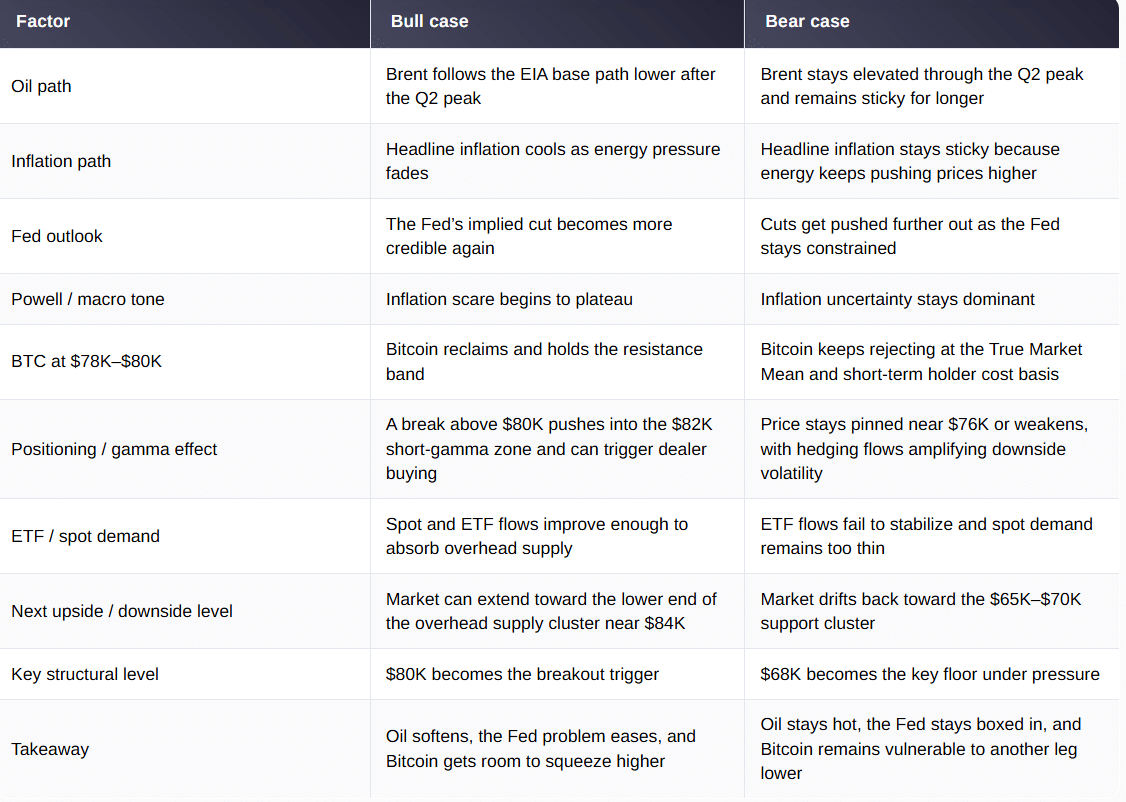
A clean daily close above $80,000 would improve the short-term outlook and may force bearish traders to cover positions. That could add fuel to a move toward $82,000 or higher. But if BTC keeps failing near $78,000 to $80,000, the market may revisit lower support around $70,000, with $68,000 viewed as an important structural level by several analysts.
For now, the Bitcoin price is caught between improving crypto sentiment and a macro backdrop that still feels uncomfortable. It is not a broken market, but it is not a fully confident one either.
Conclusion
The current BTC setup is simple, but not easy. Bulls need a strong break above $80,000, steady ETF demand, and a softer inflation outlook. Bears need repeated rejection at the same resistance zone and weaker liquidity. Until one side wins clearly, the Bitcoin price may continue to chop around a tight range where every Fed comment, oil move, and on-chain signal gets magnified.
Frequently Asked Questions
Why is the Bitcoin price below $80,000?
The Bitcoin price is below $80,000 because resistance is building near the $78,000 to $80,000 area, where many recent buyers are close to breakeven and may sell into rallies.
Can BTC still break above $80,000?
Yes, BTC can break above $80,000 if spot demand improves, ETF inflows strengthen, and macro pressure eases. A clean close above resistance would be more important than a brief intraday spike.
What is the biggest risk for Bitcoin now?
The main risk is sticky inflation keeping the Fed cautious for longer. That can reduce liquidity and make investors less willing to chase crypto rallies.
Glossary of Key Terms
True Market Mean: An on-chain level that estimates the average cost basis of active market participants.
Short-Term Holder Cost Basis: The average purchase price of investors who bought BTC recently.
Resistance: A price area where selling pressure often slows or blocks a rally.
ETF Flows: Money entering or leaving exchange-traded funds that hold Bitcoin.
Liquidity: The amount of available money and market depth supporting buying and selling.
Sources