





This article was first published on The Bit Journal.
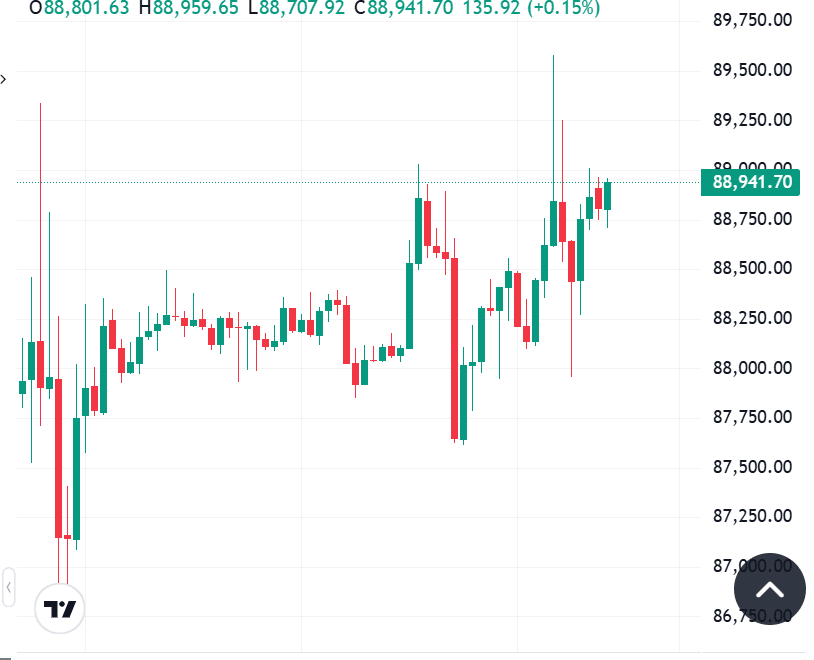
Bitcoin keeps bumping into $90,000, then drifting away, then trying again. It looks like a pause, but it is really a negotiation, with traders testing whether that round number is a ceiling or a new baseline.
A recent market report tied the stalemate to a shift in posture across markets. More capital has rotated into steadier corners like gold and U.S. Treasuries, while appetite for high-volatility trades has cooled. It is the financial version of choosing seatbelts over speed.
Why $90,000 Feels So Heavy
Round levels attract orders because people anchor on them, and that bias shows up most clearly when a market is unsure about what comes next. In Bitcoin, liquidity often stacks around clean numbers, turning them into barriers until enough demand shows up to chew through supply. The same report described Bitcoin as hovering near $90,000 without a decisive move, even as longer-term fundamentals stay constructive.
A separate price note in mid-December described a range market, with Bitcoin trading between roughly $81,000 and $95,000. In that setup, traders sell rallies and buy dips, and breakouts tend to need a fresh wave of liquidity.
The Indicators That Matter During a Sideways Market
Technical traders watch volume and trend lines. When volume fades near resistance, rallies often fail. A close above key moving averages with rising volume can signal follow-through.
On-chain behavior is one of the first places traders look. The reporting behind this $90,000 stalemate said major holders were not buying aggressively at current levels, while retail also looked hesitant, which can leave price glued in place.
Even so, late-November coverage noted that whale cohorts had returned to accumulation as Bitcoin recovered above $90,000, suggesting some large players are still positioning, just patiently.
ETF flows add another layer because they represent steady, rules-based demand. One recent update cited $457.29 million of inflows into U.S.-listed spot Bitcoin ETFs in a single day, a useful reminder that institutional access can keep bids alive even when trading feels sluggish.
Macro Gravity Is Still Real
Bitcoin still reacts to the same macro winds that move other risk assets. In late December, gold hit new records as investors leaned into safe-haven exposure and priced in further rate cuts, which shows where marginal money has been flowing during uncertainty.
What Could Unstick Bitcoin Before 2026
The next clean move likely needs a catalyst that restores risk appetite, such as softer inflation, clearer rate guidance, or a broad rebound in sentiment. Recent commentary framed the current action as consolidation rather than a sharp bearish turn, which keeps the upside case on the table if confidence returns.
If buyers can reclaim and hold $90,000 with volume and continued ETF support, the market can flip from quiet to fast. If not, repeated failures can drain enthusiasm, keeping Bitcoin range-bound into early 2026.
Conclusion
Bitcoin stuck near $90,000 is less about a broken rally and more about timing. The market is balancing patient accumulation, cautious retail, and a macro backdrop that rewards safety. When that balance breaks, price will follow.
Frequently Asked Questions
What does consolidation mean?
It is a period where price trades in a range while the market resets.
Why is $90,000 important?
It is a psychological level where orders cluster, so it often acts like resistance until buyers overwhelm sellers.
Do whales decide the trend?
Large holders influence liquidity, but price still depends on broad demand and macro conditions.
Do ETF inflows guarantee a rally?
No, but inflows can provide steady demand that supports price during cautious periods.
Glossary of Key Terms
Resistance: A price zone where selling pressure often increases.
On-chain data: Blockchain-based metrics used to infer holder behavior and flows.
Whales: Large holders whose trades can affect liquidity and volatility.
Spot Bitcoin ETF: A fund that tracks Bitcoin’s spot price, offering traditional market access.
References