





A Bitcoin whale can stir the entire crypto market with one large transaction, especially when years-old coins suddenly come back to life. That is exactly what happened after an early Bitcoin holder moved a massive stash from a long-inactive wallet. At first glance, the transfer looked like the start of a major selloff. A closer look, however, tells a very different story.
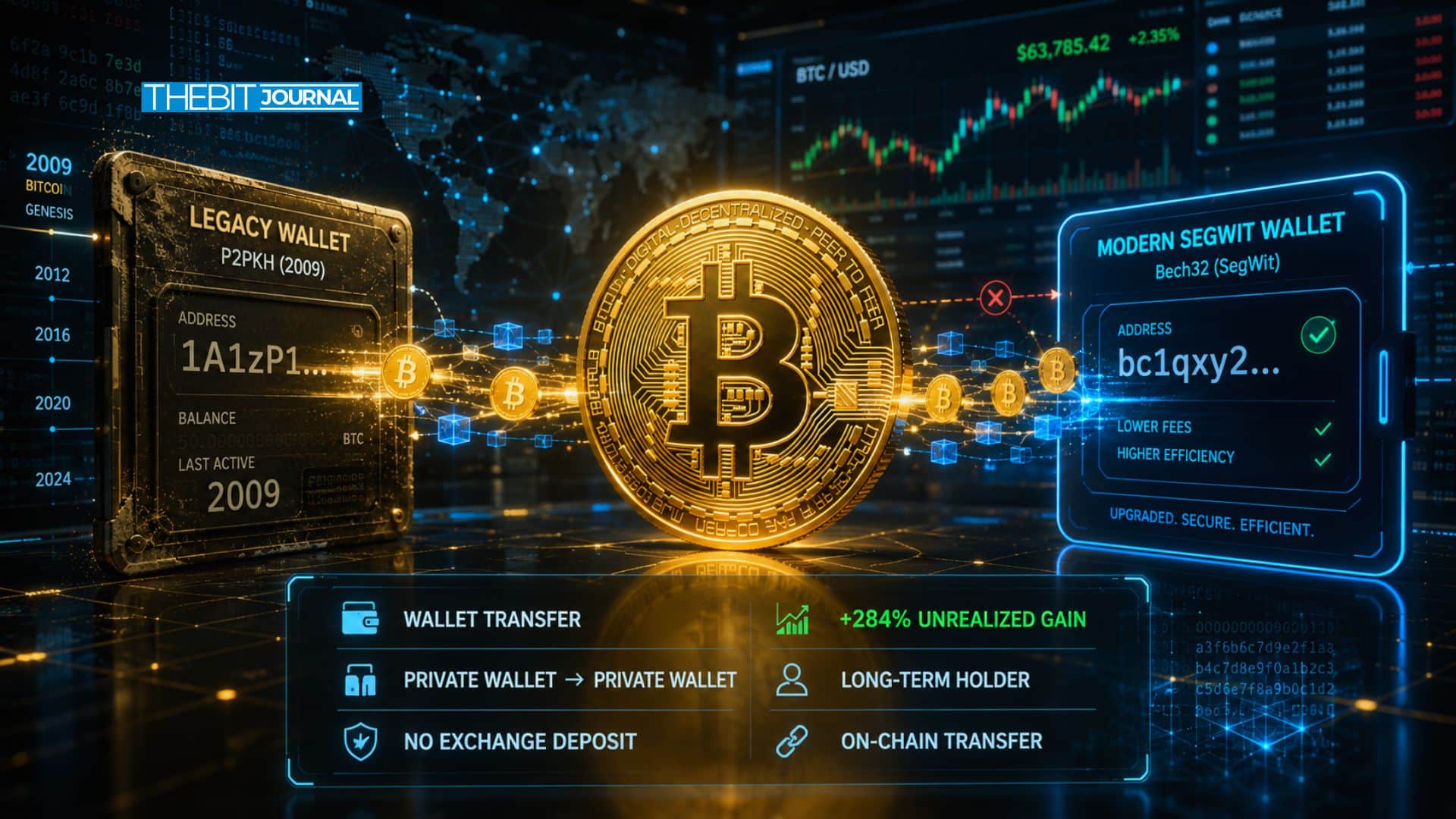
According to the source, the coins moved from a legacy address beginning with “1” to a modern address beginning with “bc1q.” Blockchain data also shows that the funds never reached a crypto exchange, suggesting the transfer was an internal wallet movement rather than a market exit. Glassnode data further separates this holder from another group of long-term investors who recently sold Bitcoin at a loss.
Why This Bitcoin Whale Transfer Matters More Than It Seems
The latest Bitcoin whale transfer started from a legacy “1” address, also known as a Pay-to-Public-Key-Hash (P2PKH) address. Introduced in 2009, this was Bitcoin’s original address format and was widely used by early adopters. When coins move from these old wallets, blockchain analysts pay close attention because they often belong to long-term holders. Because these legacy wallets are often linked to Bitcoin’s earliest years, even routine transfers can trigger market speculation.
The coins arrived in a dormant Bitcoin wallet using a bc1q, or SegWit, address. SegWit reduces transaction size, lowers network fees, and improves efficiency. When this holder originally received the coins, bc1q addresses had little wallet support. Moving the funds today reflects how Bitcoin infrastructure has matured and suggests the owner is adopting newer wallet technology instead of preparing to sell.
A Dormant Bitcoin Wallet Can Move Without Signaling a Sale
A dormant Bitcoin wallet does not automatically mean an investor is cashing out. Large holders often transfer assets between private wallets for operational and security reasons.
Some upgrade custody systems or rotate private keys to improve protection. Others move assets for inheritance planning or institutional storage. Another possibility is an over-the-counter, or OTC, transaction. In an OTC trade, buyers and sellers complete large deals privately without using a public exchange order book. This helps reduce price swings and allows major transactions to take place without affecting the open market.
That behavior supports the view that the owner is reorganizing holdings instead of preparing to sell.
Glassnode Data Reveals Why This Whale Stands Apart
Recent on-chain analysis shows this Bitcoin whale should not be grouped with another cohort of long-term holders. Earlier this week, investors who bought Bitcoin near last year’s highs used the recent market rebound to sell at a loss.
This holder took a different path. Despite sitting on an unrealized gain of roughly 284%, the owner has sold nothing. That strengthens the case that this was simply an internal wallet transfer rather than profit taking. Instead, the transfer remained entirely between privately controlled wallets, leaving no on chain evidence that liquidation has begun.
Conclusion
The biggest question is no longer whether the Bitcoin whale moved coins. The real question is where those coins go next. Blockchain analysts closely monitor exchange deposit addresses because once Bitcoin reaches Coinbase, Binance, or another trading platform, it becomes available for sale and may increase market selling pressure. If those coins eventually arrive at Coinbase, Binance, or another exchange deposit address, that would become the first real on chain evidence that the whale intends to exit the position.
Until coins reach Coinbase, Binance, or another exchange, the transfer remains a wallet movement rather than evidence of market liquidation. For crypto investors, developers, and financial analysts, this event serves as a reminder that context matters more than headlines. A dormant Bitcoin wallet can become active without signaling panic, and careful analysis of blockchain data often tells a far more accurate story than the initial market reaction.
Glossary of Key Terms
Bitcoin Whale: An individual or entity that holds a large amount of Bitcoin.
Dormant Bitcoin Wallet: A wallet that has remained inactive for a long period.
SegWit (bc1q) Address: A modern Bitcoin address that offers lower fees and better efficiency.
P2PKH Address: Bitcoin’s original wallet address format introduced in 2009.
OTC (Over-the-Counter) Trade: A private crypto transaction completed outside public exchanges.
FAQs About Bitcoin Whale
Why did the Bitcoin whale move the coins?
The transfer appears to be a wallet upgrade, not a confirmed sale.
Was the Bitcoin sold?
No. The coins remained in private wallets and were not sent to an exchange.
Why is the bc1q address important?
It reduces transaction fees and improves network efficiency.
What would indicate a possible sale?
A transfer to Coinbase, Binance, or another exchange deposit address.
Sources/References