

This article was first published on The Bit Journal.
The latest round of market turbulence has yielded an unusually strong Bitcoin price resilience as global energy markets carry on experiencing extreme volatility. Prices for oil climbed toward $100 after rising tensions in the Middle East and fresh disruptions around the Strait of Hormuz, a waterway that handles about one-fifth of global oil shipments.
In earlier phases of the market cycle, such an oil shock would typically push risk assets lower, including cryptocurrencies. However; this time around, Bitcoin price resilience has been notable.
Oil Shock and Geopolitical Tensions Fail to Shake Bitcoin
Oil markets have been volatile in March as geopolitical tensions tied to Iran escalated. Attacks on shipping and threats to energy infrastructure raised alarm over potential supply disruptions, lifting crude prices and putting global markets on the defensive.
Iranian officials have also warned that in the event of more serious disruptions, oil prices could rise close to $200 a barrel; adding more uncertainty to global markets.
Market data also indicated that Bitcoin held quite stable during the oil rally, even as equities shook with volatility. Instead of falling sharply; the asset stayed mainly within a defined range between 63,000 and 72,000 dollars during the geopolitical turmoil.
Bitcoin briefly touched around $71,300; before easing to about $69,800 as markets adjusted to the macro shock. Oil benchmarks meanwhile; surged higher. West Texas Intermediate crude increased about 4.8 percent to over $92; and Brent crude climbed more than 5 percent to roughly $97 a barrel during the same period.
This stability indicates that Bitcoin’s market structure is stronger compared to past periods; when macro shocks caussed broad selling across crypto markets.
Why Bitcoin Has Been So Resilient: A Cleaner Market Structure
According to data from CoinShares; leverage ratios in Bitcoin markets have plunged over the last few months. The ratio; which had fluctuated around 33% as far out as October 2025, dropped to about 25% by the early days of March 2026.
This decline suggests speculative excess already has been wrung out; meaning the market is less prone to cascading liquidations when volatility rises.
In a recent analysis, CoinShares said:
“Market structure entering the crisis was already significantly cleaner … With leverage reduced and much of the motivated selling already exhausted, the market was better positioned to absorb new demand.”
The huge distribution phase that occurred over the previous months is another factor backing Bitcoin price resilience. It is estimated that around $30 billion worth of Bitcoin moved from large holders to the wider market in that time.
That distribution left many technical indicators in oversold territory well before the current geopolitical events unfolded, which also decreases the chances of a panic-induced sell-off.
ETF Inflows Signal Institutional Demand Returning
Institutional flows is another reason why Bitcoin price resilience has survived the latest market shock.
US-based spot Bitcoin exchange-traded funds saw the return of net inflows in recent days, after weeks of continued outflows. Digital-asset investment products saw more than $1 billion of inflows in the first days of March after roughly five weeks of outflows nearing around $4 billion, according to data.
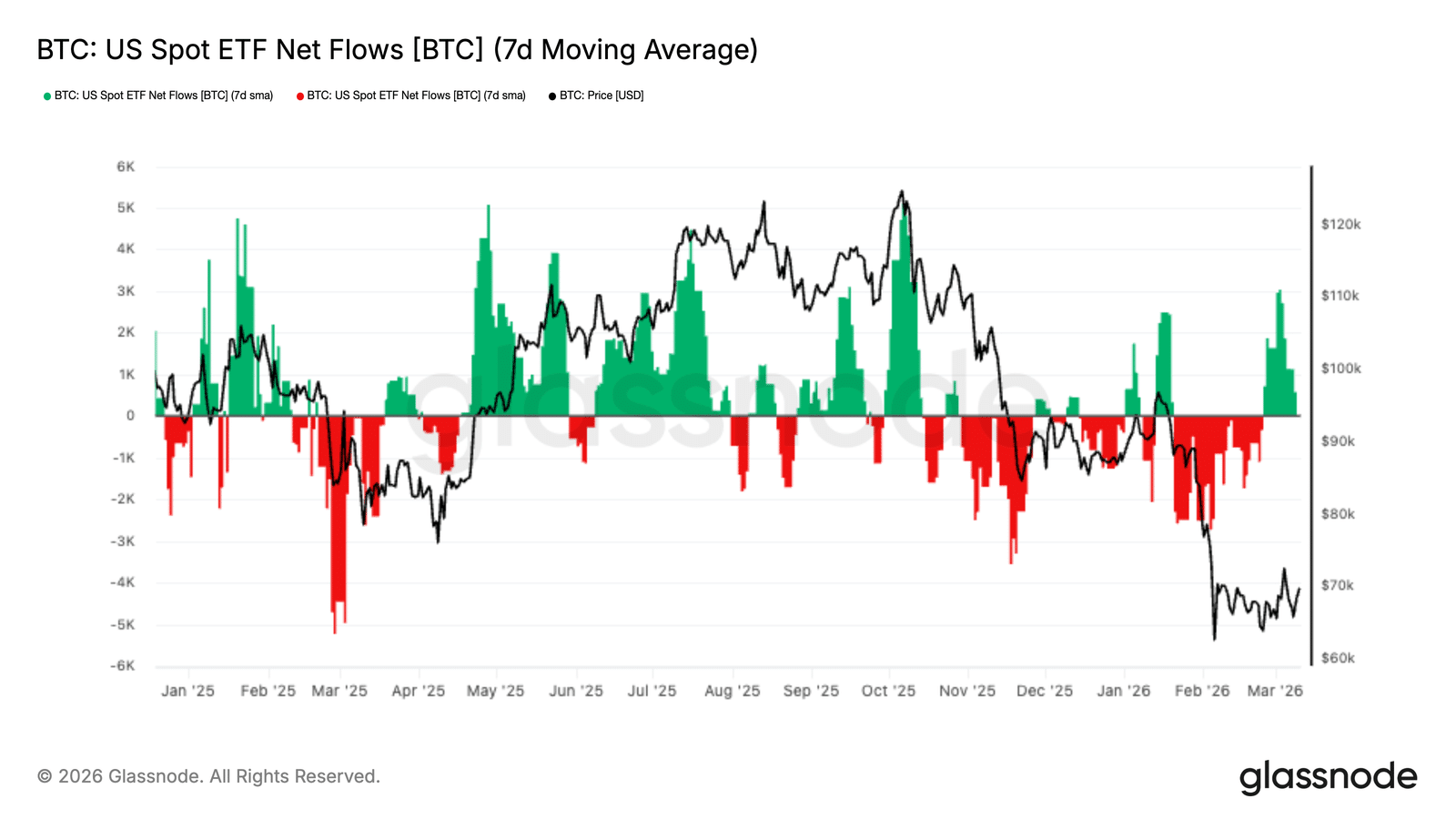
Just this month, a single day alone saw approximately $458 million go into spot Bitcoin ETFs; one of the strongest inflow days in months. These flows suggest that macro uncertainty may present an opportunity for institutions to accumulate Bitcoin rather than exit the market.
Since the start of 2024, when U.S. spot Bitcoin ETFs were approved, demand for ETF products has become one of the principal macro forces controlling the move in crypto. That means huge pools of capital can now flow into Bitcoin through established financial routes.
This structure allows for steady inflows into the ETFs and therefore supports Bitcoin price resilience, even during periods of volatility in financial markets.
On-Chain Indicators Suggest Accumulation Phase
Metrics that record long-run investor returns suggest the market now sits at levels similar to those seen in late 2022; immediately following the collapse of FTX. Bitcoin’s one-year Market Value to Realized Value (MVRV) ratio sank deep into negative territory at that point; showing that many investors were sitting on loss-making coins.
Despite the negative sentiment; Bitcoin rose approximately 67% in the next three months.
The latest figures reveal the same pattern, with long-term returns looking subdued while prices remain stable. This means accumulation may be happening quietly under the surface.
More on-chain signs support that perspective. Major accumulative clusters have developed between $62,800-$72,600, suggesting buyers keep soaking up selling pressure on major exchanges.
In the meantime, Realized Value to Transactions (RVT) ratio is on an uptrend. This metric relies on the ratio of stored value in the Bitcoin network to daily transactional activity.
An increasing RVT ratio usually indicates that coins are either being held; or are not being traded. Collectively, these signs reaffirm the case for continued Bitcoin price resilience in the current market climate.
Derivatives Positioning Points Toward Potential $80K Move
Recent negative funding rates on perpetual futures suggest traders are accumulating short positions. All of this means that a sudden pick up in spot demand can force short sellers to buy back positions, exerting upward pressure on prices.
There is an imbalance in options markets, too. Data from CME Group shows some $660 million in Bitcoin call options are open for March contracts with around $240 million in put options.
That said; derivatives analytics indicate about $2 billion worth of negative gamma exposure is clustered around the $75,000 strike price.
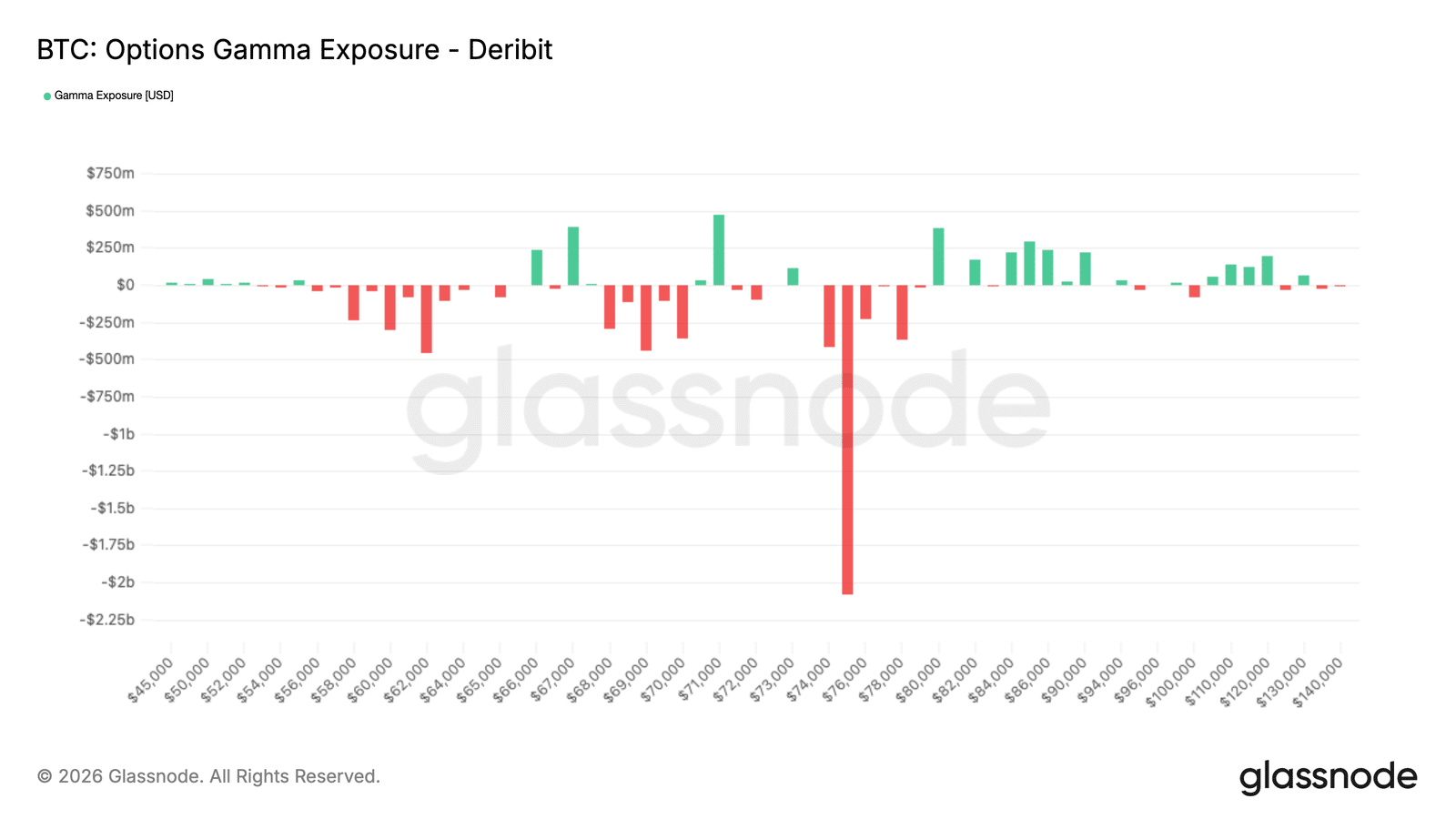
If Bitcoin enters that range, the corresponding hedging by market-making firms could magnify upward price movement.
Such structure could mean that, if spot demand stays firm and Bitcoin price resilience continues, the market could see momentum build toward $80k.
Conclusion
The market is currrently seeing a change in the way Bitcoin responds to macro shocks. Despite a surge in oil prices and heightened geopolitical tensions in the Middle East; Bitcoin price resilience was not altered by these factors.
There are several structural reasons for this stability. Decreased leverage throughout crypto markets, has also eased cascading liquidation risk. ETF inflows indicate that institutional investors are returning, while on-chain metrics paint a picture of accumulation rather than mass distribution.
There is also room for upward pressure in derivatives positioning if short positions start to clear.
Together; these dynamics indicate that Bitcoin’s current trading range around $70,000 could be a consolidation phase rather than an indication of weakness. Should demand continue to build; the next advance could target prices in the $80,000 area.
Glossary
Bitcoin (BTC): The first and most well-known cryptocurrency which was created in 2009 as a decentralized digital currency.
Spot Bitcoin ETF: A fund that owns Bitcoin inside; giving investors retail access to BTC via traditional stock markets.
Leverage Ratio: A measure of how much borrowed capital that traders are using to increase their positions in derivatives markets.
MVRV Ratio: A metric on the blockchain that shows Bitcoin’s market cap versus its realized value, which is used to measure investor profitability.
Gamma Exposure: A derivatives concept explaining how options market makers hedge positions as prices gravitate toward certain strike levels.
Frequently Asked Questions About Bitcoin Price Resilience
What caused Bitcoin’s stability as oil has rallied?
Bitcoin was anchored close to $70,000 because market leverage had already been beaten down, ETF inflows were back and buyers showed up at price dips.
How do Bitcoin ETFs affect the market?
Currently; Spot Bitcoin ETFs allow institutional investors to purchase BTC through more traditional markets. Their inflows can help sustain prices even through macro uncertainty.
To what extent do futures markets influence Bitcoin price movements?
A negative funding rate shows that traders are making short trades on BTC. These short positions could be forced to close if prices move up; injecting further upward momentum.
What has been Bitcoin’s trading range lately?
During the recent geopolitical volatility; Bitcoin for most of it has been trading between roughly $63,000 and $72,000.
What is the big deal about the $80,000 level that traders are talking about?
Options positioning and derivatives selling activity above $75,000; could provide upward pressure on price if Bitcoin breaks through its current range.
References