







According to the latest industry reports, Institutional players added a commanding $33.6 billion in Bitcoin ETFs in Q2, which actually suggests a deeper trust and confidence in the asset class. Investment advisers and hedge funds now hold $26.4 billion in Bitcoin ETFs. Even as retail is still in charge; this is a really noticeable turn for institutions.
Investment Advisers Take the Lead as Bitcoin ETFs Rise
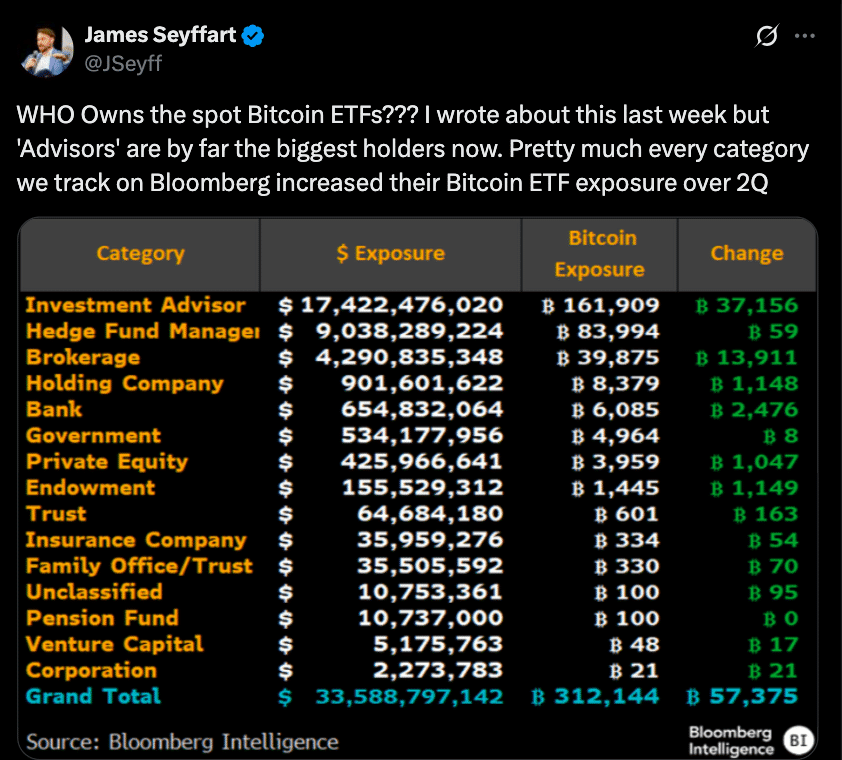
Data from Bloomberg’s James Seyffart shows investment advisers accounted for $17.4 billion of institutional Bitcoin ETFs by June 30, nearly doubling hedge fund exposure of $9 billion.
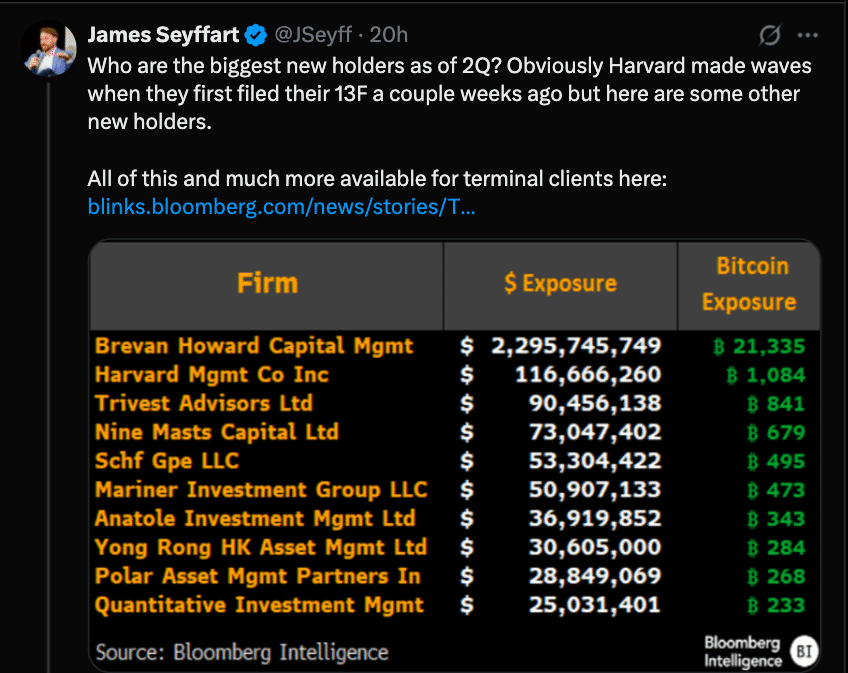
Together, institutional holdings across all categories grew 57,375 BTC in Q2. Brevan Howard increased its position in BlackRock’s iShares Bitcoin Trust (IBIT) by 71%, now holding 37.5 million shares worth $2.3 billion.
Harvard University also got into the Bitcoin ETF game, buying $117 million in IBIT, more than its holdings in Alphabet or Nvidia and one of the top five positions in its equity portfolio. Remarkably, Bitcoin is now bigger than Harvard’s gold ETF position of $102 million.
Also read: Bitcoin ETFs See $1.45B in Outflows as Economic Data Signals Trouble
Expanding Horizons Across Institutions
Not just advisers and academia, but other institutional tiers also increased their investments. Brokerage firms added around $4.3 billion, banks invested approximately $655 million through leveraged inflows. Pension funds held steady at $10.7 million.
Despite all this institutional buying, Seyffart notes this is still only 25% of total Bitcoin ETFs as retail investors account for the other 75%.
According to Seyffart;
“The other 75% are owned by non-filers which is largely going to be retail.”
What This Means and Why Now?
Institutions have been cautious with crypto for a long time, citing volatility and regulatory uncertainty. But with Bitcoin ETFs now regulated, compliant and available, professional portfolio managers are stepping in with conviction.
Yale and Stanford alumni network manager Sophia Lee says this is the moment where crypto gets into traditional allocation frameworks. Institutional capital brings big money, depth and volatility reduction.
The list of players including Brevan Howard, Harvard, brokerages; means Bitcoin ETFs are going mainstream.
Conclusion: From Momentum to Mainstream?
Based on the latest research, Institutional Bitcoin ETFs are gaining ground and adoption. Investors are therefore advised to watch out for SEC filings, fund flows and ETF market share changes.
Sustained institutional demand could push Bitcoin higher. Analysts warn about tax-advantaged structures, shifting portfolio mandates and ETF fee wars.
For in-depth analysis and the latest trends in the crypto space, our team offers expert content regularly.
Also read: Future of Bitcoin ETF Approvals and Their Market Impact
Summary
Institutional Bitcoin ETF holdings reached $33.6 billion in Q2 2025, led by investment advisers with $17.4 billion; nearly double hedge funds’ $9 billion exposure. Brevan Howard became the largest holder of BlackRock’s IBIT with a $2.3 billion position. Harvard’s endowment joined in, buying about $117 million, more than its holdings in Alphabet and gold ETFs.
Glossary
Institutional Bitcoin ETF holdings: Assets held by institutions through spot Bitcoin ETFs.
IBIT: BlackRock’s iShares Bitcoin Trust ETF
13F: Quarterly SEC filing for institutional managers with over $100m AUM
Advisers: Investment professionals managing client portfolios, including Bitcoin
ETF AUM: ETF assets
FAQs for Wall Street’s Bitcoin ETF
Who bought the most institutional ETFs in Q2?
Investment advisers bought the most with $17.4 Billion in Bitcoin ETFs
What did Brevan Howard do?
They increased their IBIT holdings by 71% to $2.3 billion.
Did academia participate?
Yes. Harvard’s endowment bought $117 million in IBIT, more than its investments in Alphabet.
How much of Bitcoin ETF supply is retail?
75% of total ETFs, according to Bloomberg.
Why is this important?
It shows institutional acceptance of Bitcoin as part of mainstream investment strategies, adding credibility and scale.