







Passive exposure might have been the crypto ETF strategies investing when it was first formulated, but the market has matured since then and so must investors. For years; the most common approach was simple for both retail investors and asset managers: buy Bitcoin, hold it, then wait for price appreciation.
This “HODL” model has worked in previous cycles because Bitcoin’s long-term growth beat traditional assets over and over again. So did early crypto ETFs, which allowed investors to benefit from price increases without undergoing active management.
However, that framework is becoming outdated, in the view of Duncan Moir of 21Shares. He argues that crypto remains a developing asset class and that makes it better suited for active strategies rather than passively allocated.
Active Yield Generation vs Passive Holding
Yield-seeking is one of the biggest motivators behind crypto ETF strategies:
Asset managers are designing products to provide income, not just depending on price appreciation. And that includes yield-bearing instruments and staking rewards and structured exposure to other financial assets related to crypto.
An example of this is 21Shares’ introduction of an exchange-traded product tied to the preferred stock from Strategy, called STRC. Offering a dividend of up to 11.5% per annum, paid monthly, the product has already attracted strong demand from several regions.
This shows a clear change in investor expectations. Institutions are craving more than passive exposure. They seek predictable returns, particularly in a market not exactly famous for stability.
Hence, the crypto ETF strategies are changing to seek both capital appreciation and income generation.
Changing Investor Behavior: Highlights of the Demand by Region
According to data, the United States is still the leading market for crypto ETF inflows, with about $638 million so far this year. Germany ranks next with $377 million, and Switzerland has seen roughly $233 million.
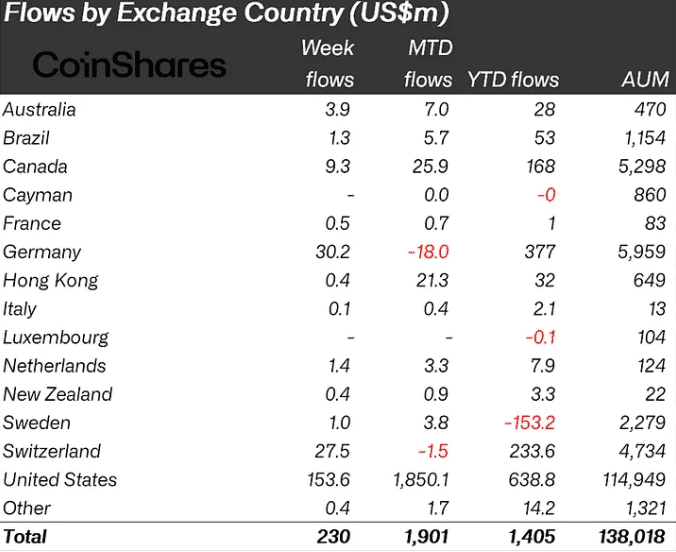
Though in the lead for inflow, much of this is concentrated in Bitcoin and Ethereum within U.S. In contrast, European institutional investors are focused more on newer assets and application-layer exposure outside of Layer-1 networks.
European investors considered more mature in their crypto exposure; are found possessing Bitcoin and Ethereum already. As a result, they are now in search of diversification through sophisticated and active products.
Staking and Structured Products Redefine ETF Utility
Staking is a way for investors to earn rewards by locking assets in support of blockchain networks. Now, this very feature is being integrated into the structure of ETFs to evolve them from passive trackers into instruments generating income.
For example, Grayscale has enabled staking in its Ethereum-based products and BlackRock recently launched a Nasdaq-listed Ethereum fund with staking that recorded roughly $15.5 million worth of trading volume on its debut day.
These innovations are changing the core value proposition of crypto ETFs. They no longer just track prices of the assets, they add extra returns.
Asset managers are also considering thematic strategies. 21Shares has created a Bitcoin and Gold ETP to capture safe haven demand during currency debasement concerns and growing U.S. debt levels.
This clues investors into how crypto ETF strategies are changing from single-asset exposure.

Market Size and the End of Pure Passive Models
Evidence for the retreat from passive investing is also contained in more general industry data.
Globally, actively managed ETFs have $1.8 trillion in assets as of the end of 2025, according to data compiled by Morningstar and Goldman Sachs Asset Management. Now this trend is spreading into crypto.
As of March 2026, total crypto ETF AUM is about $130 billion, having plunged from nearly $240 billion at the peak in 2025. The drop reveals an urgent problem. The past reliance on passive exposure alone is not enough to drive growth in this more competitive and volatile market.
Asset managers have been responding to this by constructing more complex products, designed to provide enhanced risk-adjusted performance.
Conclusion
Passive crypto ETF strategies are clearly breaking away. Though it began as a simple “buy and hold” model, it is now transforming into something more complex in terms of yield, diversification and active management. This change is being driven by the reality of risk because these assets are volatile, and many investors want their money to do better in these conditions.
While passive strategies may have characterized early crypto ETFs, the future is increasingly built on active and income-generating as well as thematic approaches.
Glossary
Crypto ETF strategies : How asset managers structure and manage crypto exchange-traded funds.
Passive investing: A strategy that follows an asset’s price without active decision-making.
Active Management: A strategy in which portfolio allocations are adjusted based on current market conditions.
Staking: The act of locking up crypto in order to earn rewards and assist that token/blockchain in its operations.
ETP: An exchange-traded product meant to provide exposure to assets.
Frequently Asked Questions About Crypto ETF Strategies
What is the reason passive crypto ETF strategy are going out of style.
Because investors now want yield, diversification and active management, not just price tracking.
Why the change in crypto ETF strategies?
Market maturity, income-seeking investor demand and heightened asset manager competition.
How does staking create better crypto ETFs?
This enables funds to earn extra yield on top of price appreciation.
How does crypto ETF growth break down between regions?
Inflows are dominated by the U.S., but Europe shows more appetite for diversified and sophisticated products.
References