







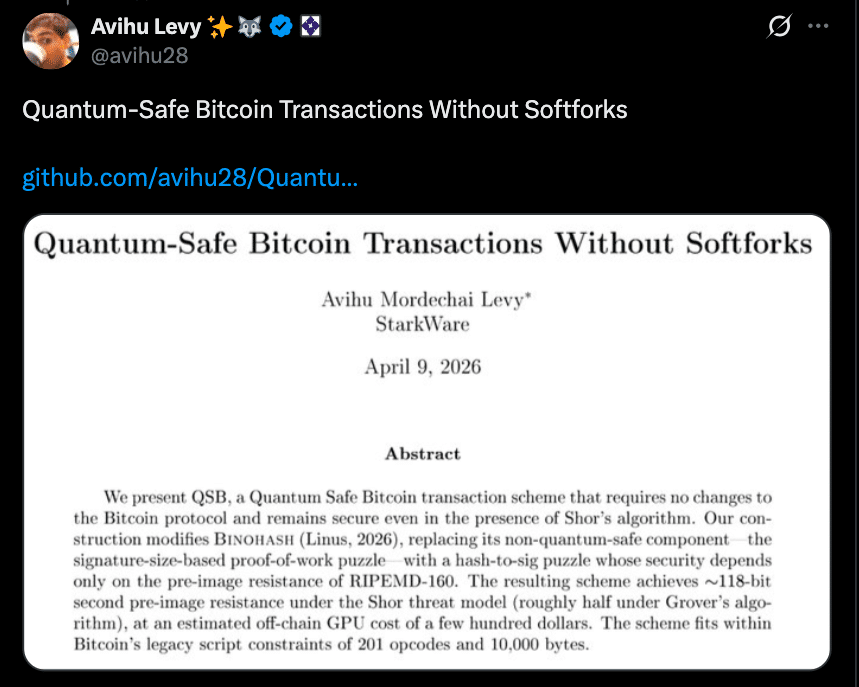
A new proposal in the Bitcoin quantum-safe conversation has opened up the possibility of users protecting their transactions from quantum attacks without modifying the network’s protocol.
StarkWare’s chief product officer Avihu Levy introduced a protocol named Quantum Safe Bitcoin (QSB). The proposal describes a method for attaching a quantum-safe mechanism to transactions within Bitcoin’s existing script rules, not requiring a soft fork or network-wide upgrade.
That alone makes it notable. Changes to Bitcoin are painfully slow, controversial and require a broad consensus. Therefore, such a solution that works within the current system immediately draws attention.
How Bitcoin Quantum-safe Model Operates
The proposal is based on a change from Bitcoin’s current cryptographic approach.
Bitcoin transactions today use elliptic curve digital signatures (ECDSA). These are secure from classical computers, but susceptible to quantum attacks applying Shor’s algorithm that can extract private keys from public keys.
Levy’s approach eliminates that dependency altogether. Rather than utilizing elliptic curve mathematics, QSB uses a hash-based puzzle that is frequently referred to as a “hash-to-signature” operation.
This approach relies on hash preimage resistance, which cannot be fully broken by quantum computers but can only be attacked with slower methods like Grover’s algorithm.
In summary, the security model changes from signatures that quantum devices can break to hash-based work that is still resistant even with quantum advantage. However, this redesign keeps the transaction valid based on Bitcoin’s existing rules and improves resistance to future threats.
The Cost Concern: $75 to $150 a Transaction
The main limitation of the Bitcoin quantum-safe proposal is cost. The generation of a QSB transaction is far larger and thus, involves substantial off-chain computation preferably through GPU. Current estimates for the transaction cost anywhere from $75 to $150.
This is not a minor drawback because it makes the system unworkable for everyday payments. Instead it is positioned as a tool for High-value transfers, Institutional custody movements and Emergency protection scenarios. The computation itself can be done in hours, but the cost barrier is what drives down adoption.
The proposal also creates operational challenges. QSB transactions are not standard; they do not propagate according to Bitcoin’s default network rules. Instead, users would have to pay them directly to miners willing to process them.
There are also holes in compatibility like the system not being Lightning Network capable, full on-chain broadcasting is still a work in progress; the complexity of the transaction is higher compared to normal Bitcoin transfers.
The limitations emphasize that this is not a simple upgrade for casual users.
Community Reaction: Breakthrough or Overstatement?
Reactions from the Bitcoin ecosystem have been mixed. Eli Ben-Sasson called the development a milestone, arguing that it proves Bitcoin can be quantum-safe immediately. But not everyone agrees.
The proposal, however, does not address every vulnerability, particularly those involving older Bitcoin holdings. There are many early wallet types where they expose the public key directly (like P2PK addresses) leading to vulnerabilities later on if quantum attacks become efficient.
This also includes around 1.7 million BTC known to be sitting in older formats, frequently mentioned in ongoing discussions regarding quantum risk.
The disagreement opens up a larger problem that partial solutions don’t remove systemic risk.
Even the researchers who built QSB acknowledge its limitations. The proposal is described as a temporary or last-resort measure, not a long-term solution.
The more durable solution is still protocol-level upgrades, like new address types or signature schemes aimed at post-quantum security.
For instance, one proposal is BIP-360 (BIP for “Bitcoin Improvement Proposal”) which would add quantum-resistant structures like Pay-to-Merkle-Root and which could only be implemented via a soft fork. The challenge is coordination.
Bitcoin doesn’t have a central authority, and upgrades require years of debate and testing. That gradual process is part of why stopgap concepts like QSB are gaining attention.
New research from Google’s quantum division suggests that breaking Bitcoin’s cryptography may require far fewer resources than previously thought, bringing the timeline for real-world attacks much closer.
Developers are already investigating alternatives, such as recovery solutions that enable users to prove wallet ownership without revealing private keys.
Conclusion
The Bitcoin quantum-safe proposal presents that in the short term, the network can adapt to numerous threats, but deep changes are necessary for long-term security. QSB shows that without upgrades, Bitcoin can be made more resilient today but the trade-offs are too great for widespread use
At the same time, it confirms the necessity for protocol-level upgrades, community coordination and migration paths for vulnerable coins. Bitcoin’s greatest strength, which is its resistance to change, is also its biggest obstacle in defending against threats, like quantum computing.
Bitcoin quantum-safe discussions are now starting to generate actual engineering proposals and working models. Levy’s QSB scheme shows that quantum-resistant transactions are possible already today, within Bitcoin’s existing infrastructure but that has come at a price, which is financial, technical and practical.
At $75 to $150 a transaction, with limited compatibility and incomplete coverage of vulnerabilities, the proposal is best viewed as a stopgap measure and not a full solution.
The bigger question remains unresolved. Bitcoin will eventually require a coordinated upgrade to fully mitigate quantum risk.
Glossary
ECDSA: The signature system currently used by Bitcoin.
Shor’s Algorithm: The quantum algorithm that can break elliptic curve cryptography.
Hash Preimage Resistance: Property of hash functions that makes them harder to reverse.
Soft Fork: A Bitcoin upgrade that is backward-compatible.
Quantum Computing: This is an enhanced computing model that has the potential to attack some of the cryptographic systems.
FAQs About Bitcoin Quantum-Safe Proposal
What is the Bitcoin quantum-safe?
It refers to making Bitcoin resistant to attacks from quantum computers that could break current cryptography.
Does this proposal require an upgrade to Bitcoin?
No. It does so without a soft fork and stays within existing rules of Bitcoin.
Why is the solution expensive?
Secure transactions need heavy GPU computation to generate.
Are Those Quantum Computers a Threat to Bitcoin Now?
Not in the immediate term, research suggests that danger may strike sooner than is thought.
What is the long-term solution?
Most experts favor protocol-level upgrades using quantum-resistant cryptography.
References