













Bitcoin and risk markets are currently experiencing a significant downturn, driven by broader economic uncertainties and shifting investor sentiment. The crypto market is under stress as Bitcoin’s worth has dropped to less than $100,000, and altcoins have dropped as well.
According to recent reports, this is a macroeconomic issue, along with AI build-out costs and changing US monetary policy, that are responsible for the recent crypto market decline and a sell-off in the risk markets, including cryptocurrencies, as per the latest reports. As investors become increasingly cautious, these spaces are seeing a surge in volatility, with a notable surge in liquidation.
AI Concerns and Economic Uncertainty Weigh on Risk Markets
Risk markets are one of their worst periods right now, and the crypto industry is having a hard time keeping up with the momentum after the crash that happened in October. As a result of this, Bitcoin’s value went down to $97,193, which is below a very important level of $100k. This has led to a lot of worries and uncertainty about what is going to happen next.
In this risk markets downturn, the Nasdaq Index was not spared, dropping 2.3% after Palantir CEO Alex Karp expressed skepticism about the profitability of AI. This led to the fear of a weaker US economy. Karp stated that not all AI implementations will generate sufficient value to justify costs, leading to a sell-off in tech stocks and cryptocurrencies like Bitcoin.
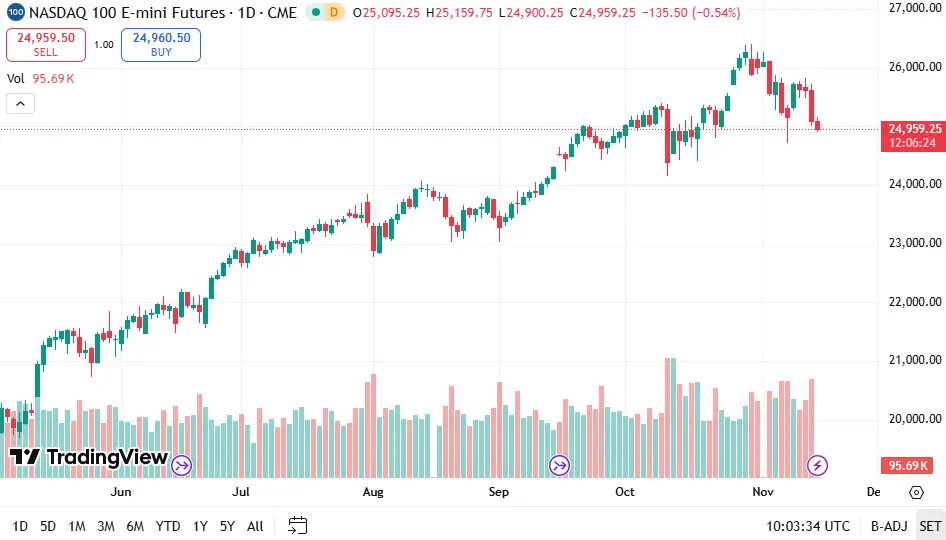
Shares of Palantir (PLTR), Intel (INTC), and CoreWave (CRWV) are down 6% or more today, triggering a risk-off move that’s also impacting Bitcoin. BTC is trading at $97k, down 6.5% after testing the $105,000 level, with $350 million in leveraged bullish positions liquidated, causing it to drop below the key $100,000 psychological support.
Tesla’s stock has fallen by 6.6% amid a broad tech sector sell-off, with shares now down 10% since CEO Elon Musk received his $1 trillion pay package. The decline comes after the company recalled over 10,500 Powerwall 2 energy storage systems due to safety risks, with 22 reported overheating incidents.
Disney’s stock dropped 8% after reporting weaker-than-expected quarterly results, with revenue missing estimates at $22.5 billion. The company’s linear TV business is under pressure, with a 16% decline in revenue and a 21% drop in operating income.
What Led to the Bitcoin Sell-Off?
Interestingly, the recent Bitcoin sell-off appears to have been negatively impacted by a lack of a definite event or insiders selling their holdings. As a matter of fact, several analysts attribute the supply pressure source to the so-called “term of chronic long-term holders” who were specifically active in the period from 2017 to 2022. These investors, in all likelihood, are realizing their gains following the many years of accumulation, since approximately 815,000 BTC have been liquidated in the last 30 days.
The slow liquidation is interpreted as a transfer of conduct under control, thus indicative of a more mature market dynamic. Some of the selling is being taken off the hands of these holders by institutional buyers, who, however, do not seem to be able to lift the overall demand, which remains weak.
A Closer Look at the Shifting Investor Sentiment
There is a significant shift in investor sentiment towards risk markets that is becoming very obvious. Such a change can be seen as the investors look at the risk and the return associated with Bitcoin and other volatile assets in the long run again. As global liquidity is becoming tighter and more capital is going into safe, yield-earning instruments, a large number of investors are choosing stability rather than speculative growth.
Another factor that is influencing sentiment towards risk markets is the increasing emphasis on regulatory clarity and geopolitical developments. The period of waiting and watching is what investors are choosing as a result of uncertainties that surround U.S. policy decisions, global crypto taxation coordination, and stricter compliance rules.
The recent 43-day government shutdown has significantly reduced visibility into the US economic outlook, leaving investors and analysts uncertain about the future. Some estimate the shutdown could slash US GDP growth by 2%, while others believe the impact will be temporary and that most negative effects will reverse once federal spending resumes. RBC analysts are cautioning that interpreting job market data will be challenging, as “furloughed and essential employees would be counted as unemployed.”
Conclusion
Overall, the recent decline to the bottom line reveals risk markets struggling with economic uncertainty, ambiguous regulatory measures, and changing investor priorities. With liquidity becoming scarce and caution being increased, Bitcoin and the wider risk sector may still be under pressure for some time until clearer indications are received from the global markets and policymakers.
Frequently Asked Questions
- Why is Bitcoin not holding at $100,000?
Bitcoin is dropping as a result of macroeconomic uncertainty, the tech-sector losing strength, and investors having less appetite for risk. - Are HODLers mostly responsible for the decrease in BTC volume?
It is a fact that long-term holders have significantly sold their BTC, thus contributing to the market with continuous pressure from the supply side. - Is the market going to bounce back soon?
The comeback is tied to the revival of the economic forecast, investor trust, and the U.S. policy decisions being clear.
Glossary
- Risk-Off Sentiment – A market mood where investors shun riskier assets and seek safer alternatives.
- Liquidation – The closing of trading positions that are leveraged and incurring losses beyond the margin requirements.
- Macroeconomic Factors – Big economic conditions such as inflation, interest rates, and GDP that affect markets.
- Long-Term Holders (LTHs) – The investors who have kept Bitcoin for years and generally sell only during significant market changes.
- Volatility – The occurrence of rapid and unpredictable price changes in financial markets.
- AI Build-Out Costs – The situation of rising expenses that companies face while developing and scaling artificial intelligence technology.