

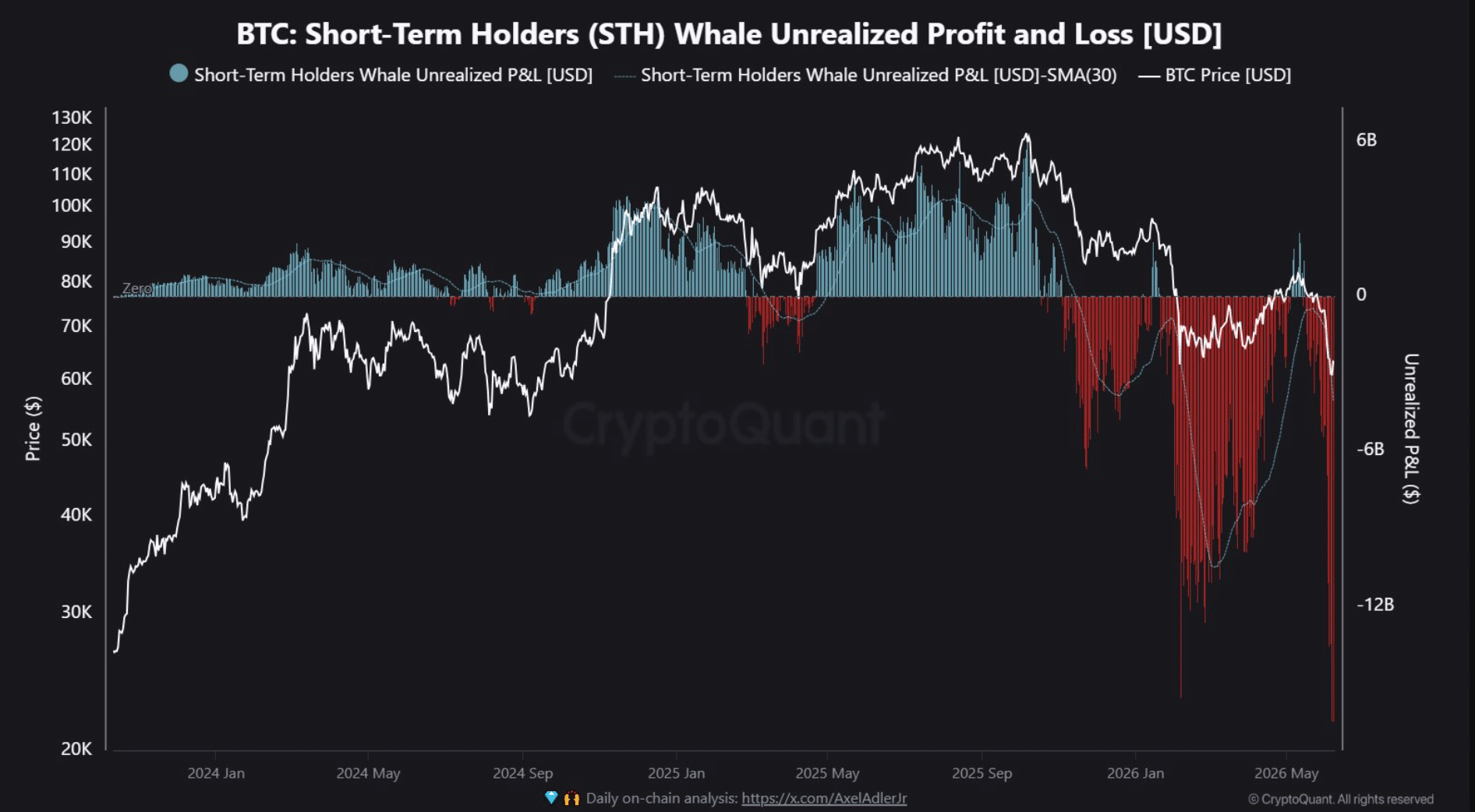
Bitcoin is facing a tense market reset as large short-term holders sit on nearly $16.4 billion in unrealized losses, raising fresh questions about whether the latest pullback is a healthy shakeout or an early warning of deeper pressure. The move matters because big wallets often shape market mood during fragile phases. When they hold firm, confidence can return quickly. When they sell, even a normal correction can start to feel heavier than it really is.
Bitcoin Whales Carry Heavy Paper Losses
Bitcoin whales are now at the center of a wider debate about market strength after BTC slipped from higher levels and moved closer to the $60,000 zone. On-chain data suggests that newer large holders, especially those who bought within recent months, are feeling the squeeze as their average entry prices sit above current market levels.
This is not just a number on a chart. Unrealized losses show how much value investors would lose if they sold at current prices. For smaller traders, that pressure can cause nerves. For large holders, it can create market-moving decisions. A whale selling into weakness may not only lock in losses but also add supply when demand is already thin.
Bitcoin whales often become more important during corrections because their activity gives traders a sense of where conviction stands. If these holders absorb the pain and avoid aggressive selling, the market can slowly rebuild. If they begin reducing exposure, selling pressure may spread into futures, spot markets, and sentiment indicators.
Retail Buyers Step In While Large Wallets Pull Back
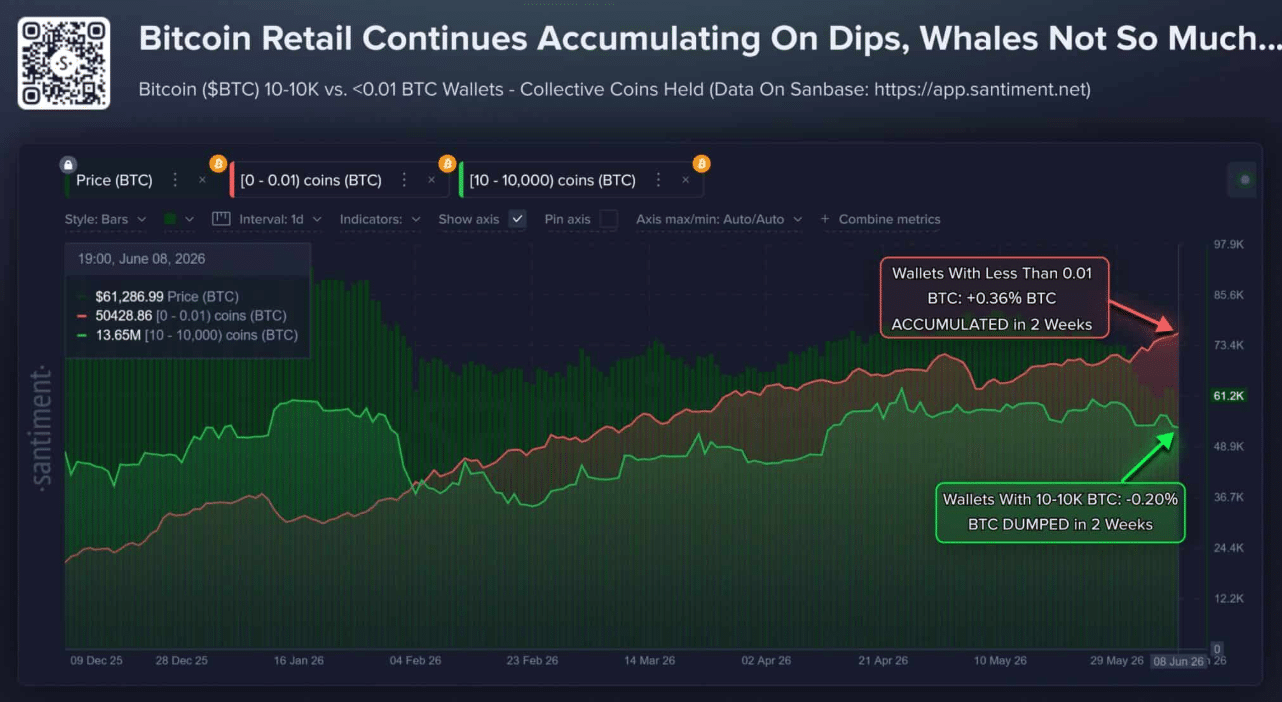
A notable split has appeared between smaller wallets and larger holders. Retail addresses holding less than 0.01 BTC have continued to add coins during the decline, while wallets holding between 10 BTC and 10,000 BTC have trimmed positions. That does not mean small investors are controlling the market, but it does show a change in behavior.
Bitcoin whales reducing exposure while retail buyers accumulate can create an uneven market. Retail buying helps absorb supply, but it may not be enough if large wallets keep selling. This is similar to a stock market pullback where everyday investors buy the dip while institutions wait for stronger confirmation before adding risk again.
The key issue is timing. If retail accumulation continues and whale selling slows, BTC may find a stronger base. If the opposite happens, the market could remain trapped in a weak range, with rallies fading before they gain proper momentum.
What the $16.4B Loss Signal Means for BTC
The $16.4 billion loss figure points to stress among short-term large holders, not necessarily market collapse. Crypto markets often pass through painful transfer phases, where impatient buyers exit and stronger hands absorb coins at lower prices. These phases can look ugly in real time, yet they sometimes prepare the ground for a more stable recovery.
Still, the risk cannot be brushed aside. Bitcoin whales under pressure may react faster than long-term holders because their positions are newer and their conviction may not be as deep. Short-term holders usually have less emotional and financial commitment to a market cycle, which makes their behavior more sensitive to sudden price drops.
Another key indicator is the realized price of short-term holders. When BTC trades below this level, recent buyers are broadly underwater. That condition can create fear, but it can also attract buyers who see discounted pricing. The difference depends on liquidity, macro conditions, and whether leverage is building in the wrong direction.
Discounted Valuation Does Not Mean a Bottom Is In
Some valuation models now suggest Bitcoin is trading below its long-term fair value range. That can make BTC look attractive compared with overheated periods, but discounted does not always mean cheap enough. In past bear market bottoms, valuation indicators often moved into deeper capitulation zones before a durable recovery formed.
Bitcoin whales may therefore remain cautious until stronger signs appear. These signs include lower exchange inflows from large wallets, rising spot demand, calmer funding rates, and a return of steady ETF inflows. Without those signals, BTC may continue to trade like an asset waiting for confirmation rather than one ready to run.
Market structure also matters. If futures traders become too bearish, a short squeeze can push BTC higher quickly. If leverage builds on the long side too early, another flush can follow. This is why traders are watching not only price, but also liquidity zones, open interest, and realized losses.
Conclusion
Bitcoin whales are facing one of the most important pressure tests of the current cycle. The $16.4 billion in unrealized losses shows that newer large holders are no longer sitting comfortably, while smaller wallets are using the decline to build exposure. That contrast gives the market a mixed tone.
Bitcoin whales do not need to buy aggressively for BTC to stabilize, but they do need to stop adding heavy sell pressure. Until that happens, every rebound may face doubts. For now, Bitcoin remains in a fragile zone where patience, liquidity, and whale behavior could decide whether the market forms a base or slides into another round of weakness.
Bitcoin whales will remain the group to watch because their next move may reveal whether this correction is turning into accumulation or distribution.
Frequently Asked Questions
Why are Bitcoin whales important right now?
Bitcoin whales matter because they hold large amounts of BTC, and their buying or selling can influence liquidity, price direction, and market confidence during volatile periods.
Does $16.4B in unrealized losses mean whales have sold?
No. Unrealized losses mean those positions are losing value on paper. The loss becomes real only if holders sell at current prices.
Can retail buyers support Bitcoin during a whale selloff?
Retail demand can help, but large wallet selling often requires stronger spot demand, ETF inflows, or institutional buying to fully absorb the pressure.
Glossary of Key Terms
Unrealized Loss: A paper loss on an asset that has dropped below its purchase price but has not been sold yet.
Whale: A large crypto holder whose transactions can influence market liquidity and sentiment.
Short-Term Holder: An investor who bought BTC recently, often within the past few months, and may react faster to price swings.
Realized Price: The average price at which a group of investors acquired their coins, used to judge whether they are in profit or loss.
Market Liquidity: The ease with which BTC can be bought or sold without causing a sharp price move.
Sources
Disclaimer: This article is for informational purposes only and does not provide financial, investment, or trading advice. Cryptocurrency markets are volatile, and readers should conduct independent research before making any decision.