







Ethereum has climbed back above the $2,000 line just as the latest BlackRock Ethereum buy worth $41.9 million is making rounds. The purchase, made through BlackRock’s spot Ethereum exchange-traded fund, is believed to have given the asset new momentum.
Market data indicated the transaction took place when more general Ethereum ETF flows were mixed, which helped make the scale of the move particularly noticeable.
BlackRock Invests $41.9 Million in Ethereum
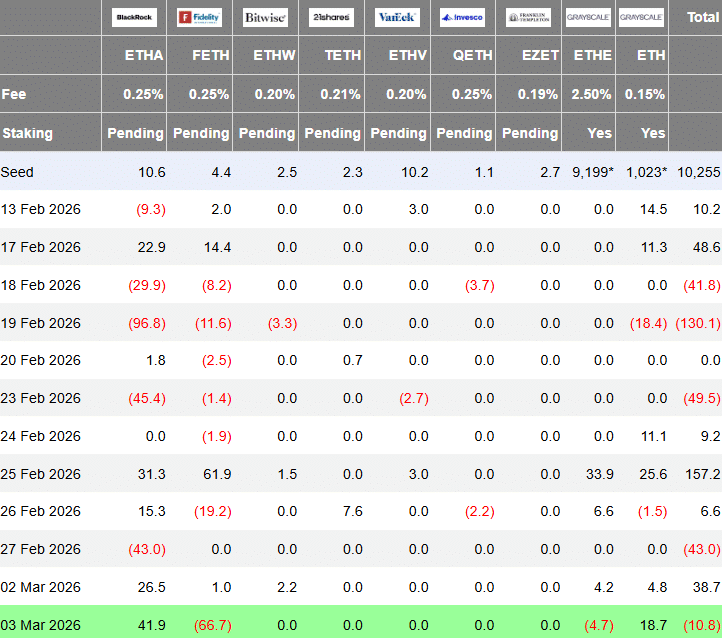
The newest BlackRock Ethereum buy was registered on March 3 and was carried out via the firm’s iShares Ethereum Trust, one of the regulated investment vehicles aimed at providing institutional investors with exposure to Ethereum.
Data released by market trackers show the fund attracted $41.9 million in inflows in that session, building on a series of institutional buys in the first days of March.
The move happened after a $26.5 million inflow the previous day, indicating institutional demand for Ethereum.
Ethereum ETF flows across the overall market were less consistent over the same timeframe. Ethereum ETFs combined, added $38.7 million in inflows on March 2, but there was a net outflow of $10.8 million the next day.
Regardless of that, BlackRock’s fund was still firmly positive. The company’s move to keep adding to its Ethereum holdings stood out because other funds saw outflows over the same time period.
There was considerable action in the broader ETF market during that same week. Cumulative inflows into BlackRock’s Bitcoin and Ethereum products totaled about $654 million over two days, showing the ongoing accumulation of digital assets via regulated vehicles by large asset managers.
Ethereum Network Activity Surges as User Growth Accelerates
As the Blackrock Ethereum buy made headlines, on-chain activity across the Ethereum network has also been growing rapidly.
Ethereum’s daily new active addresses reached around 837,200 according to recent data from Santiment with an increase of approximately 82% in a very short period. Simultaneously, around 284,800 new addresses were being generated daily, a 64% increase.
This type of growth indicates that Ethereum stage remains attractive to users and developers alike; even in the midst of continued market turbulence.
The surge in activity suggests that demand for decentralized applications; decentralized finance protocols and tokenized assets deployed on Ethereum’s infrastructure remains strong. Transaction volumes and smart-contract usage usually increase as more users interact with the network.
Ethereum Tests Resistance as Market Watches the $2,150 Level
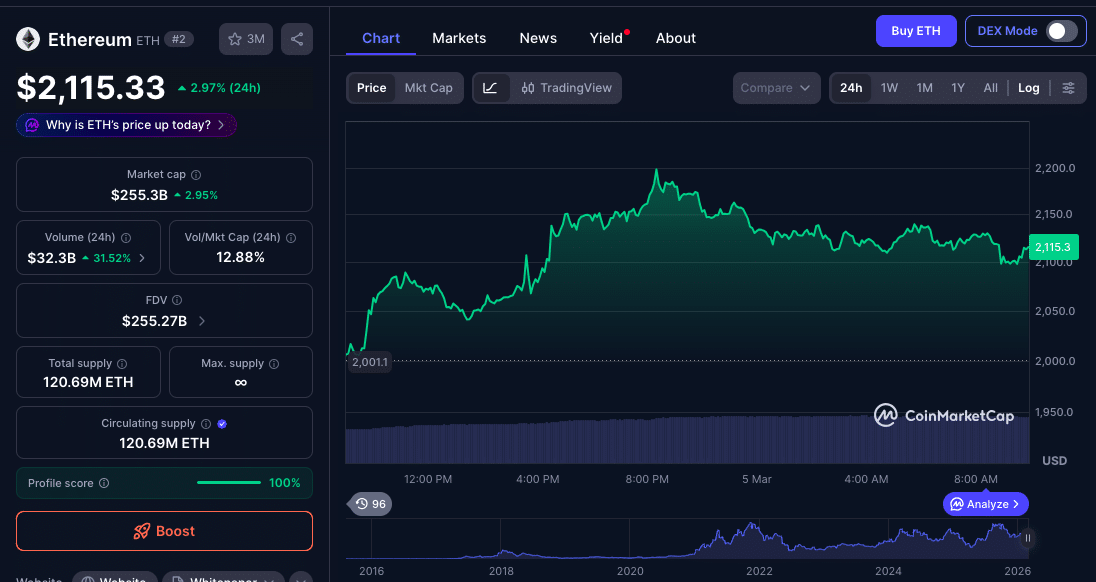
When the latest institutional flows were recorded; Ethereum traded around roughly $2,075 as the asset approached a key technical level of resistance.
Market charts show the asset locking horns with resistance around $2,150; a band that traders are monitoring closely. A push above that price could pave the way toward higher price ranges in the near-term.
Momentum has been seen in the technical indicators. Analysts said Ethereum’s MACD price average had recently undergone a bullish crossover, while the Relative Strength Index (RSI) was gaining ground suggesting buying pressure was building.
Also, chart patterns during the same timeframe revealed that Ethereum was forming an ascending triangle structure, a structure typically seen as one that leads to breakout attempts as momentum builds.
While price direction is not driven solely by technical patterns, the wider context of the market has boosted bullish sentiment around Ethereum. The recent BlackRock Ethereum buy alongside increasing network action and multiple re-tests of $2,000 have set the belief that institutional players are still in the game.
Institutional Capital Continues to Shape Ethereum’s Market
Institutional participation is a main driver of Ethereum’s price structure over the past few years.
Large investment firms are turning to regulated financial products like ETFs to get exposure to digital assets without holding the tokens directly. One such structure is BlackRock’s iShares Ethereum Trust.
Asset managers, hedge funds and investment banks have consistently built out their digital-asset strategies as regulation clears up in parts of the world.
Based on this context, the BlackRock Ethereum buy is taken as yet another sign that institutional investors are still watching Ethereum even despite persistent volatility across the broader crypto market.
Unlike smaller firms, large firms tend to deploy capital for much longer time frames.
Conclusion
Ethereum’s climb above $2,000 has gathered steam due to rising institutional demand and stronger network activity. The recent BlackRock Ethereum buy worth $41.9 million on March 3 injected new momentum into the market.
The deal stressed how major asset managers continue to gain exposure to digital assets via regulated investment products. Joining the previous day’s $26.5 million inflow, the purchase means continued institutional demand for exposure to Ethereum.
Additionally, the Ethereum network itself is growing significantly. Daily active addresses and new wallet creation have surged; indicating growing use across decentralized applications and financial services.
Glossary
Ethereum: A platform for blockchain-based applications; supporting smart contracts and decentralized application development.
Spot ETF: An exchange-traded fund that actually holds an asset like Bitcoin or Ethereum; rather than derivatives.
Daily Active Addresses: A daily count of unique (non-duplicated) blockchain addresses interacting with a network.
MACD (Moving Average Convergence Divergence): A technical indicator used to track changes in the momentum of asset prices.
Relative Strength Index (RSI): The momentum indicator is used to assess if an asset is overbought or oversold.
Frequently Asked Questions About BlackRock Ethereum Buy
What is behind the attention around BlackRock Ethereum buy?
On March 3; the firm saw a $41.9 million inflow into its Ethereum ETF as institutional demand for ETH exposure remains strong.
Were there other Ethereum ETFs inflows during the same time frame?
Yes. Ethereum ETFs saw $38.7 million in inflows on March 2; but the next day there was a $10.8 million net outflow across the sector.
What’s going on with Ethereum’s network activity?
According to recent data, daily active addresses have now reached roughly 837,200 new addresses created are increasing sharply with adoption.
Why is Recognizing Institutional ETF Inflows Important for Ethereum?
ETF inflows means capital entering the market through regulated investment products that large financial institutions use.
References