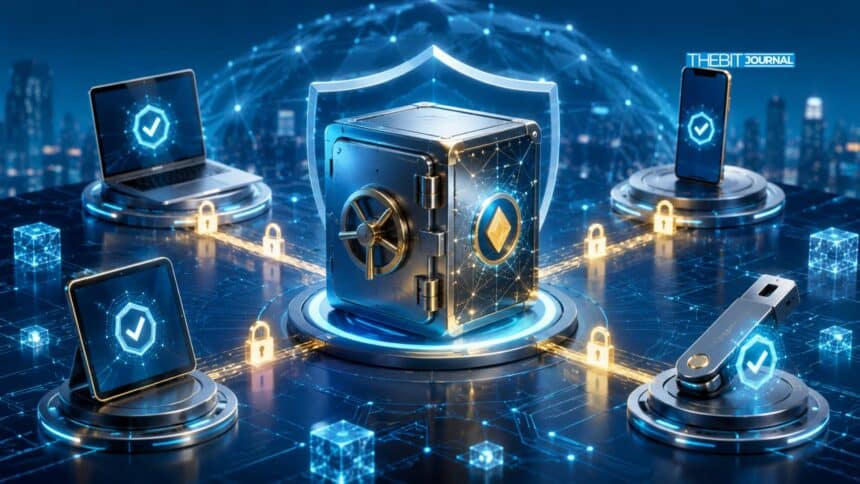

Crypto security has a simple problem hiding under all the complex language: whoever controls the private key controls the funds. That can be useful for fast self-custody, yet it also creates a dangerous weak point. One lost device, one stolen seed phrase, one careless approval, and digital assets can move with no bank desk to call afterward.
Multi-Signature Authentication was designed to reduce that risk by making crypto transactions depend on more than 1 approval before funds can leave a wallet. In plain terms, it turns a single-key door into a shared vault, where access requires a defined number of trusted signers.
Multi-Signature Authentication: A Smarter Security Layer
Multi-Signature Authentication is a crypto security method that requires multiple private keys, or signatures, to approve a transaction. Instead of giving full control to 1 wallet key, it spreads authority across several keys, devices, or people. A common setup is called “2-of-3,” where any 2 signatures out of 3 approved keys are needed before a transaction can be executed.
This is not just a technical upgrade. It is a governance tool, a risk-control system, and, for many organizations, a basic standard for handling treasury assets. Smart contract wallets can require multiple valid signatures before execution, which helps avoid single points of failure and reduces the chance that 1 lost private key leads to a total loss of funds.

Why Single-Signature Wallets Carry Higher Risk
A single-signature wallet is simple as it needs 1 private key to approve transactions. That makes it convenient for daily crypto use, but it also means 1 compromised key can drain the wallet. For a casual user holding a small balance, that may be acceptable. For a protocol treasury, exchange reserve, investment fund, family office, or DAO, it is often too much risk sitting on one point.
The crypto market has already seen how private key failure can become a costly weakness. Security researchers continue to warn that poorly stored or centrally managed keys can create major vulnerabilities, especially when backend systems, bridges, or internal access controls are weak.
Multi-Signature Authentication reduces this pressure by making attackers compromise more than 1 signer or device. It does not make a wallet impossible to attack, but it raises the bar. That matters because crypto theft often works like water finding a crack. The attacker usually looks for the simplest path, and a single key is often that path.
Multi-Signature Wallets Explained: Added Security for Crypto
A multi-signature wallet is a crypto wallet that requires more than 1 private key approval before funds can move. The wallet can be configured in different ways, such as 2-of-3, 3-of-5, or 4-of-7. The first number shows how many signatures are required. The second number shows how many total authorized signers exist.
For example, a company may place 5 executives or security officers as authorized signers and require 3 approvals for withdrawals. If 1 person loses access or leaves the company, the treasury is not frozen. If 1 signer is hacked, the attacker still cannot move funds alone. That is the core value of Multi-Signature Authentication: it adds friction where friction is useful.
In traditional finance, companies use dual approval for payments, board approval for large transfers, and internal controls for treasury movement. Multisig brings a similar idea on-chain, but with cryptographic enforcement rather than paperwork.

How Multi-Signature Authentication Works in Practice
The process begins when a wallet owner or organization creates a multisig wallet and chooses the signing threshold. The wallet then stores a set of authorized public addresses. When someone proposes a transaction, the wallet waits until enough approved signers confirm it. Once the threshold is reached, the transaction can be executed on-chain.
A 2-of-3 setup might include 1 hardware wallet held by the founder, 1 device controlled by the finance lead, and 1 recovery key stored securely offline. A 3-of-5 setup might include different departments, external custody support, and a board representative.
The beauty of Multi-Signature Authentication is that it can match the level of risk. A small team may need speed, while a large treasury may need stricter approval rules. The structure can be adjusted based on asset value, signer availability, compliance needs, and operational urgency.
Why It Matters for Web3 Organizations
Web3 organizations often manage funds in public wallets. That transparency is useful, but it can also attract attention. Attackers can see where large balances sit. They may not know the people behind every wallet, but they can track transaction patterns, governance activity, and treasury movements.
This is where Multi-Signature Authentication becomes more than a wallet feature. It becomes part of institutional discipline. DAOs use it to manage community funds. Protocol teams use it to control upgrades. Startups use it to protect operating capital. Investment groups use it to ensure that no single partner can move assets without oversight.
Modern multisig wallets also support on-chain approvals and auditability, making them useful for organizations that need clearer records of who approved what and when.
Key Security Indicators Crypto Users Should Watch
The first key indicator is the signature threshold as a 2-of-3 wallet is more flexible, while a 4-of-7 wallet is harder to compromise but slower to operate. Neither is automatically better. The right choice depends on the size of funds and the need for speed.
The second indicator is signer independence. If all keys sit on laptops in the same office, the wallet is not as strong as it looks. Strong Multi-Signature Authentication depends on separation across devices, people, locations, and access methods.
The third indicator is transaction clarity. Signers must understand what they are approving. Blind signing can weaken even the best multisig setup. Clear transaction review, hardware wallets, address checks, and simulation tools all matter.
The fourth indicator is recovery planning. A multisig wallet can protect against theft, but poor recovery planning can lock funds forever. Teams should define what happens if a signer loses a device, becomes unavailable, leaves the company, or dies.
The fifth indicator is operational discipline. The wallet is only as safe as the humans around it. Phishing, fake meeting links, malicious browser extensions, social engineering, and rushed approvals still create risk.
Multisig Is Strong, But Not Magic
It would be a mistake to present Multi-Signature Authentication as a perfect shield. It reduces single-key risk, but it cannot fix every security flaw. If signers approve a malicious transaction, the wallet may still execute it. If a team uses weak devices, poor communication, or compromised software, attackers may target the full signing process rather than just 1 key.
A major 2025 crypto breach involving a multisig cold wallet showed that attackers can exploit signing workflows, interfaces, or operational gaps even when funds are not controlled by a simple single-key wallet. The lesson was not that multisig failed as a concept. The lesson was that multisig must be paired with careful transaction verification, secure devices, and strong internal procedures.
Multi-Signature Authentication vs MPC Wallets
Multisig and MPC both aim to reduce single-key risk, but they work differently. Multi-Signature Authentication requires multiple signatures on-chain or through a smart contract structure. MPC, short for multi-party computation, splits key control into separate cryptographic shares, so no single party holds the complete private key.
Multisig is often easier to audit on-chain because approvals can be visible depending on the wallet and chain. MPC can offer a smoother user experience and may hide some complexity from the blockchain itself. For organizations, the choice often depends on transparency, compliance needs, chain support, signer workflow, custody model, and technical comfort.
Many serious crypto operations use a layered approach. They may use multisig for treasury control, cold storage for long-term reserves, and stricter internal approvals for large transfers. Good security is rarely one tool. It is a stack.
Common Use Cases in Crypto
Multi-Signature Authentication is widely used for DAO treasuries, where community funds should not depend on 1 person. It is also common in crypto startups, where founders, finance leads, and security officers may share approval rights.
It is useful for family offices and high-net-worth holders who want protection against theft, coercion, or simple mistakes. It can also help exchanges and custodians separate hot wallet operations from cold storage controls.
Another important use case is protocol administration. Some smart contracts allow upgrades or emergency actions. If 1 private key controls those functions, the protocol carries serious centralization risk. Multisig can place those powers behind multiple approvals.
Best Practices for Safer Multisig Management
The best multisig setup starts with proper planning. The signer group should include trusted people with clear roles, but it should not be so small that 1 absence creates chaos. Hardware wallets should be used where possible, and recovery keys should be stored offline in secure locations.
Teams should avoid placing all signers in the same physical or digital environment. A phishing campaign can spread quickly through one workplace, one chat group, or one shared cloud system. Separation makes attacks harder.
Every large transaction should follow a review process. Signers should verify the recipient address, amount, token, network, contract interaction, and timing. For organizations, approvals should be documented, especially when funds belong to investors, users, or a community treasury.
Security reviews should also happen regularly. Signers change. Devices age. Staff leave. Wallet permissions become outdated. A multisig wallet created 2 years ago may not fit the current risk profile of the organization.
The Future of Wallet Security
Wallet security is moving toward programmable accounts, account abstraction, social recovery, spending limits, session keys, and custom approval rules. ERC-4337, for example, introduced a framework that supports smart account features without requiring a change to Ethereum’s base protocol.
That direction does not make Multi-Signature Authentication obsolete. It makes the idea broader. The future wallet may not look like today’s wallet, but the principle will remain: high-value transactions should not depend on 1 fragile secret.
For mainstream users, multisig may become less visible and easier to use. For institutions, it will likely become part of a wider control system that includes policy engines, compliance checks, hardware security, and real-time monitoring.
Conclusion
Multi-Signature Authentication gives crypto users and organizations a practical way to reduce single-key risk. It spreads control, improves accountability, and makes unauthorized transfers harder to execute. That matters in a market where funds move instantly and mistakes can be permanent.
Still, multisig is not a shortcut around good security habits. It works best when paired with hardware wallets, signer separation, transaction review, recovery planning, and clear governance. For individuals, it can protect long-term holdings. For teams, it can protect treasuries and build trust. For the wider crypto industry, it is one of the clearest signs that self-custody is maturing from a personal tool into a serious financial control system.
Frequently Asked Questions
What is Multi-Signature Authentication in crypto?
Multi-Signature Authentication is a wallet security method that requires more than 1 approved signature before a crypto transaction can be completed. It helps prevent a single stolen or lost private key from giving full control over funds.
Is a multisig wallet safer than a normal wallet?
A multisig wallet is generally safer for larger balances because it removes the single point of failure found in ordinary single-key wallets. However, safety still depends on signer behavior, device security, and careful transaction review.
What does 2-of-3 mean in a multisig wallet?
A 2-of-3 wallet has 3 authorized signers, but only 2 approvals are required to move funds. This provides backup access while preventing 1 signer from acting alone.
Can multisig wallets be hacked?
Yes, multisig wallets can still be attacked if signers are tricked, devices are compromised, or transaction details are not reviewed properly. Multisig reduces risk, but it does not remove the need for strong security practices.
Who should use a multisig wallet?
Multisig wallets are useful for DAOs, crypto companies, investment groups, family offices, founders, and individuals holding meaningful long-term crypto balances.
Glossary of Key Terms
Private Key
A private key is the secret cryptographic credential that gives control over a crypto wallet. If it is exposed, funds can be stolen.
Public Address
A public address is the wallet address used to receive funds. It can be shared, unlike a private key.
Signature
A signature is the cryptographic approval that confirms a transaction was authorized by a valid private key.
Threshold
A threshold is the number of required signatures needed to approve a multisig transaction, such as 2 signatures in a 2-of-3 wallet.
Smart Contract Wallet
A smart contract wallet uses programmable blockchain logic to manage how transactions are approved and executed.
DAO Treasury
A DAO treasury is a pool of funds controlled by a decentralized organization, often managed through shared governance and multisig approvals.
MPC Wallet
An MPC wallet uses cryptographic key shares instead of standard on-chain multisig signatures to reduce single-key exposure.
Cold Wallet
A cold wallet stores keys offline, making it less exposed to online attacks.
Sources
Disclaimer
This article is for informational and educational purposes only and should not be treated as financial, investment, legal, or cybersecurity advice. Crypto users and organizations should consult qualified professionals before choosing custody tools, wallet structures, or treasury policies.