



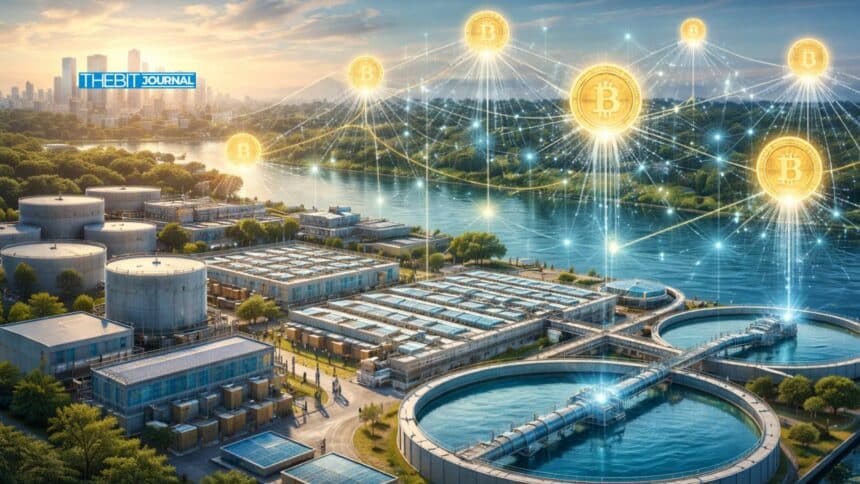

RWA tokenization is moving from concept to real-world use as blockchain infrastructure firm Global Settlement Network (GSN) begins applying this model to government-linked water infrastructure in Indonesia. On Wednesday, the company confirmed the launch of a pilot project in Jakarta focused on tokenizing water treatment facilities.
The initiative is designed as a starting point, with plans to expand across Southeast Asia and gradually scale the project to $200 million in tokenized assets over the next 12 months. The announcement places essential public infrastructure, rather than financial products, at the core of the blockchain initiative.
GSN described the project as a phased rollout that prioritizes funding efficiency and settlement systems, instead of pursuing rapid or broad market expansion.
What does RWA tokenization mean for infrastructure financing?
In practical terms, RWA tokenization means creating blockchain-based records of physical assets to improve access to funding and open new financing options. In this project, the assets are water treatment facilities that operate under government contracts.

The physical infrastructure itself does not change. Only the financing structure is recorded digitally. GSN’s approach connects tokenization with long-term infrastructure requirements rather than short-term or speculative trading by tying blockchain records to essential public utilities.
How is the Jakarta pilot structured?
The initial pilot focuses on eight government-contracted water treatment facilities in Jakarta. GSN said this phase is designed to raise up to $35 million, with the funds planned for facility upgrades and expansion of the local water network.
The pilot is structured as a controlled test. If it performs as expected, it will form the basis for a wider rollout, with the overall program targeting $200 million in tokenized assets across Southeast Asia.
Why is Southeast Asia central to the rollout plan?
The regional focus reflects ongoing structural funding pressures in Southeast Asia. GSN and its partner, Globalasia Infrastructure Fund, pointed to a widening gap in water infrastructure financing across the region.
They noted that more than $4 trillion in long-term investment will be required by 2040, a level that significantly exceeds current spending trends.
In this situation, RWA tokenization is being presented as a supplementary financing approach that could help improve access to capital, especially in markets where large-scale infrastructure projects often face challenges in securing stable and long-term funding.
What role do settlement rails play in the project?
As part of the 12-month phased rollout, GSN and Globalasia Infrastructure Fund plan to test rupiah-stablecoin settlement rails within controlled corridors. The testing will start within domestic markets before moving into additional foreign exchange corridors.
These settlement trials are meant to improve transaction processing as the project grows. The system is designed to work alongside existing financial structures, supporting the infrastructure-focused use of RWA tokenization in this initiative.
What are local stakeholders saying?
Mas Witjaksono, chairman of Indonesia-based Globalasia Infrastructure Fund, said
The project Offers significant opportunities for growth, as Indonesia has numerous major infrastructure developments and natural assets that can be accessed for tokenization.”
He noted that the country’s scale and asset base create room for alternative financing structures. His remarks suggest that RWA tokenization is being viewed locally as a practical way to support existing infrastructure projects. He also indicated that the approach is focused on financing and access to capital, rather than changes to ownership or governance arrangements.
How does this fit into the broader tokenized asset market?
The Jakarta pilot is taking place as tokenized real-world assets continue to increase on-chain. Data from RWA.xyz shows that more than $21 billion in RWAs are currently recorded on-chain, held by 629,528 holders.
Some crypto executives have said that adoption in emerging economies could support further growth in 2026, especially in regions facing challenges with capital formation. In this setting, RWA tokenization linked to infrastructure is increasingly viewed as a practical use case rather than a theoretical concept.
Does regional crypto adoption support this approach?
Southeast Asia continues to record high levels of on-chain activity. Chainalysis identified the Asia-Pacific region as the fastest-growing market for on-chain crypto activity, with a 69% year-over-year increase in value received.

In a follow-up report, Chainalysis ranked Indonesia as the second-largest market globally for on-chain value in the 12 months leading up to June 2025, noting a 103% increase. These factors help explain why infrastructure-linked RWA tokenization is being explored in the region, particularly for projects connected to public-sector requirements.
Conclusion
RWA tokenization applied to water infrastructure in Jakarta represents a careful move toward blockchain projects focused on essential public services. GSN’s phased rollout and testing of settlement systems are designed to ensure the project is implemented gradually and securely.
The initiative’s emphasis on public infrastructure funding positions it as a financing model rather than a market-focused experiment. If the project achieves its $200 million target across Southeast Asia, it could provide a practical framework for addressing long-term infrastructure financing gaps using tokenized structures.
Glossary
Settlement Rails: Blockchain tools that securely move money and record transactions.
Water Gap: The $4 trillion funding shortfall for Southeast Asia’s water projects.
Jakarta Pilot: GSN’s first project tokenizing eight government water facilities.
GSN: The blockchain company behind the Jakarta RWA pilot.
RWA Tokenization: Turning real-world assets into blockchain-based investments.
Frequently Asked Questions About RWA Tokenization
What is the GSN Jakarta pilot about?
The GSN Jakarta pilot is a project to use RWA tokenization for water treatment facilities in Jakarta.
How many facilities are included in the Jakarta pilot?
The pilot includes eight government-contracted water treatment facilities in Jakarta.
How much money is the pilot aiming to raise?
The pilot aims to raise up to $35 million for facility upgrades and network expansion.
What are settlement rails in this project?
Settlement rails are digital payment systems that help process transactions safely using blockchain.
Who is partnering with GSN for this pilot?
GSN is working with the Globalasia Infrastructure Fund to run the pilot and test funding systems.
Sources