

This article was first published on The Bit Journal.
A new crypto supply imbalance has suddenly emerged between Bitcoin (BTC) and Ethereum (ETH) .
This imbalance, as measured by exchange reserves, institutional flows, and wallet behavior, is driving market liquidity and sentiment. Latest data reveals Bitcoin and Ethereum reserves have hit a multi-year low, with institutional demand and exchange staking creating a liquidity crisis.
As both assets grapple with this structural change, onlookers in the markets are watching to see how this apparent imbalance could impact volatility, price action, and the broader crypto ecosystem over the coming months.
Bitcoin Liquidity and Supply Dynamics
As of December 2025, there is a notably reduced Bitcoin supply on centralized exchanges and over-the-counter (OTC) desks.
On-chain analytics sources suggest that exchange liquidity is dwindling, with reserves approaching record lows relative to their historical averages.
Recent market reports have cited CryptoQuant statistics indicating billions of dollars worth of outflows from Bitcoin ETFs in Q4, with exchange balances are substantially lower than earlier this year.
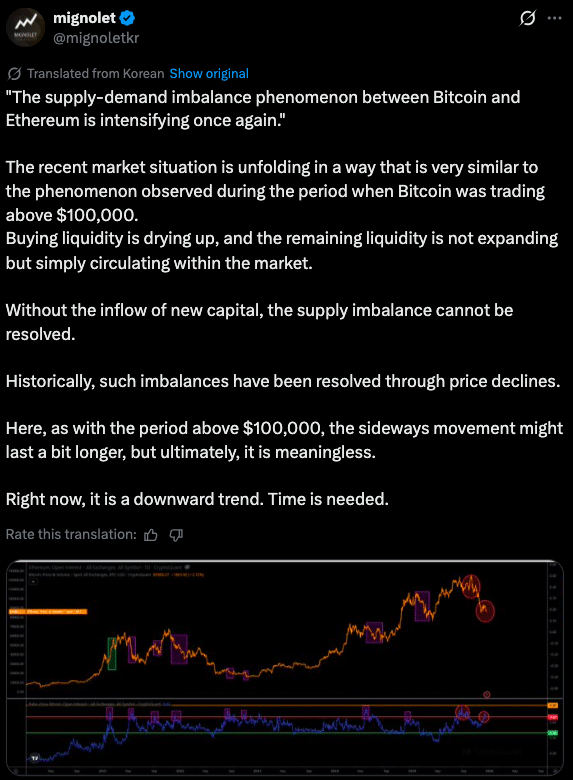
The decrease in potential BTC supply is also taking place as long-term holders are either keeping or adding to their holdings, further reducing the number of coins available for active commerce and trading.
Although scarcity is frequently seen as a long-term bullish sign, it can also augment short-term volatility by increasing the price impact of large trades on shallow order books.
Outflows from the ETF of more than $350 million in a single session were an indication of investor caution, even though price action has been fairly resilient. This contrast is a what investors are struggling with in the face of supply constraints, but also continued positioning by large holders.
Ethereum’s Evolving Supply Scope
Ethereum’s supply layout also indicates friction among traders and institutions adjusting their exposure. According to on-chain data, only a small percentage of the total ETH supply remains on exchanges, under 9% recently reported, with a vast amount moving toward staking, institutional wallets, and Defi use-cases.
Increased staking and institutional involvement are two factors behind the decline in the liquid ETH supply. These dynamics can be traced in the behavior of ETF purchasers who are not only gobbling up ETH through their inflows into institutional vehicles and staking but effectively withdrawing tokens from active trading pools as a result.
The market condition is not only causing a decline in market liquidity but also adding pressure from the supply side compared to demand.
Some market watchers, meanwhile, have argued that while Ethereum’s supply-side pressures can help create a narrative of structural scarcity, they also expose markets to more violent swings as transactional demand waxes and wanes.
Interweaving staking, ETF flows and DeFi engagements has produced a supply picture with many faces that are very distinct from Bitcoin’s.
Inflows and ETF Supply Impact
These institutional investment products have transformed how the supply of both Bitcoin and Ethereum is distributed.
Spot ETFs have taken up a lot of recently minted supply in 2025, with one recent outlook suggesting that U.S.-listed crypto ETFs may purchase over 100% of newly issued supply next year, which could mean that the demand from these products may overwhelm annual issuance for some leading digital assets.
This institutional hunger has a few consequences. ETP flows can help mitigate sell-side pressure for Bitcoin, also helping to take available coins off the market and hold onto them in the long term.
For Ethereum, ETF and staking integration are also effectively pulling the floating supply off exchanges to a large extent, increasing scarcity in the process. These changes in supply distribution have subtle implications.
On one hand they are signaling strong institutional demand while at the same time they continue to drive available tradable supply lower.

On-Chain Supply Signals And Market Implications
On-chain metrics shed further light in on this crypto supply imbalance. On Bitcoin, data from blockchain analytics firms and exchanges alleges that vast amounts of BTC have moved out from long-dormant wallets since mid-October 2025. Approximately 62,000 BTC which at today’s prices is about $7 billion.
For Ethereum, meanwhile, on-chain exchange reserves are at multi-year lows as DeFi staking and institutional stacks gulp substantial amounts of ETH.
This pattern of diverging supply behavior across leading assets sheds light on how varying levers, such as staking for ETH, off-exchange accumulation for BTC, feed into wider supply dynamics in more nuanced fashions.
Conclusion
The crypto supply imbalance between Bitcoin and Ethereum has become increasingly obvious and intensified in late 2025 due to shrinking exchange reserves combined with more institutional inflows and dwindling liquidity pools.
Bitcoin’s low on-exchange liquidity, coupled with changing wallet ownership patterns, has abated tradeable supply, while Ethereum, moving to stake and ETF holdings, has tightened its available float at an even greater pace.
These changing supply dynamics have been m noticeable in market volatility and structural liquidity challenges.
Glossary
Crypto supply imbalance: The point where the amount of available tradable supplies of digital assets such as Bitcoin and Ethereum on exchanges are sharply disconnected from demand or accumulation patterns.
Exchange reserves: The quantity of a cryptocurrency that sits on centralized exchanges, treated as a proxy for market liquidity.
ETF (Exchange-Traded Fund): A financial product that tracks an asset and holds the asset on behalf of investors, with an effect on supply in traded markets.
Staking: The act of locking up ETH in a protocol to help secure the network, earning rewards and removing liquid supply.
On-chain data: Information sourced directly from blockchain transactions, to study supply, transfers and wallet behavior.
Frequently Asked Questions About Crypto Supply Imbalance
What is causing the crypto supply imbalance between BTC and ETH?
Recent on-chain data indicates a decrease in trading reserves for both assets, with ETH in particular moving into staking and institutional hands, which has served to reduce liquid supply as demand remains robust.
What does this supply imbalance reflect on price action?
As tradable supply falls, markets can be more sensitive to trades, and experience larger price swings with even relatively low volumes.
Are institutional flows influencing the imbalance?
Yes, spot ETFs and institutional demand are soaking up new supply while also removing exchange liquidity across Bitcoin and Ethereum.
Is the current imbalance unique to 2025?
There have been dynamics in supply that have evolved over time, but this low of a ratio of exchange reserves to institutional capital allocation in 2025 is certainly starker than previous cycles.
References
EGW
Cryptopolitan
The Economic Times
AMBCrypto