






Bloomberg senior ETF analyst Eric Balchunas stunned markets this week by raising his odds for a Solana ETF approval to “100 percent.” That bold call came after issuers amended their filings again, signaling that the U.S. Securities and Exchange Commission (SEC) could greenlight Solana’s long-awaited product sooner than expected.
This is more than just analyst optimism. It reflects a deeper regulatory reset now reshaping the ETF landscape. The SEC’s move to adopt generic listing standards has essentially stripped away the procedural barriers that once slowed altcoin ETFs.
Instead of juggling complicated dual-filing processes, issuers now need only to satisfy updated S-1 requirements, a change that could cut months off review timelines.
A New Path for Crypto ETFs
Until recently, ETFs tracking crypto assets faced a gauntlet of filings. Exchanges had to request rule changes under the 19b-4 process, while issuers separately filed S-1s for product registration. This two-track system often dragged on for most of a year. With the new standards, much of the 19b-4 burden is gone, replaced with a faster, more predictable route.
Balchunas explained on X: “The universal listing standards have rendered the 19b-4 form meaningless. Now, only the S-1 matters, and the Solana ETF could be approved at any time.” His comment hit home for traders watching the Solana market, where volumes have already spiked on speculation.
The change isn’t just bureaucratic. It shows that the SEC is slowly learning from the rollout of Bitcoin and Ethereum ETFs, smoothing the runway for other projects like Solana.
Market Signals and Investor Mood
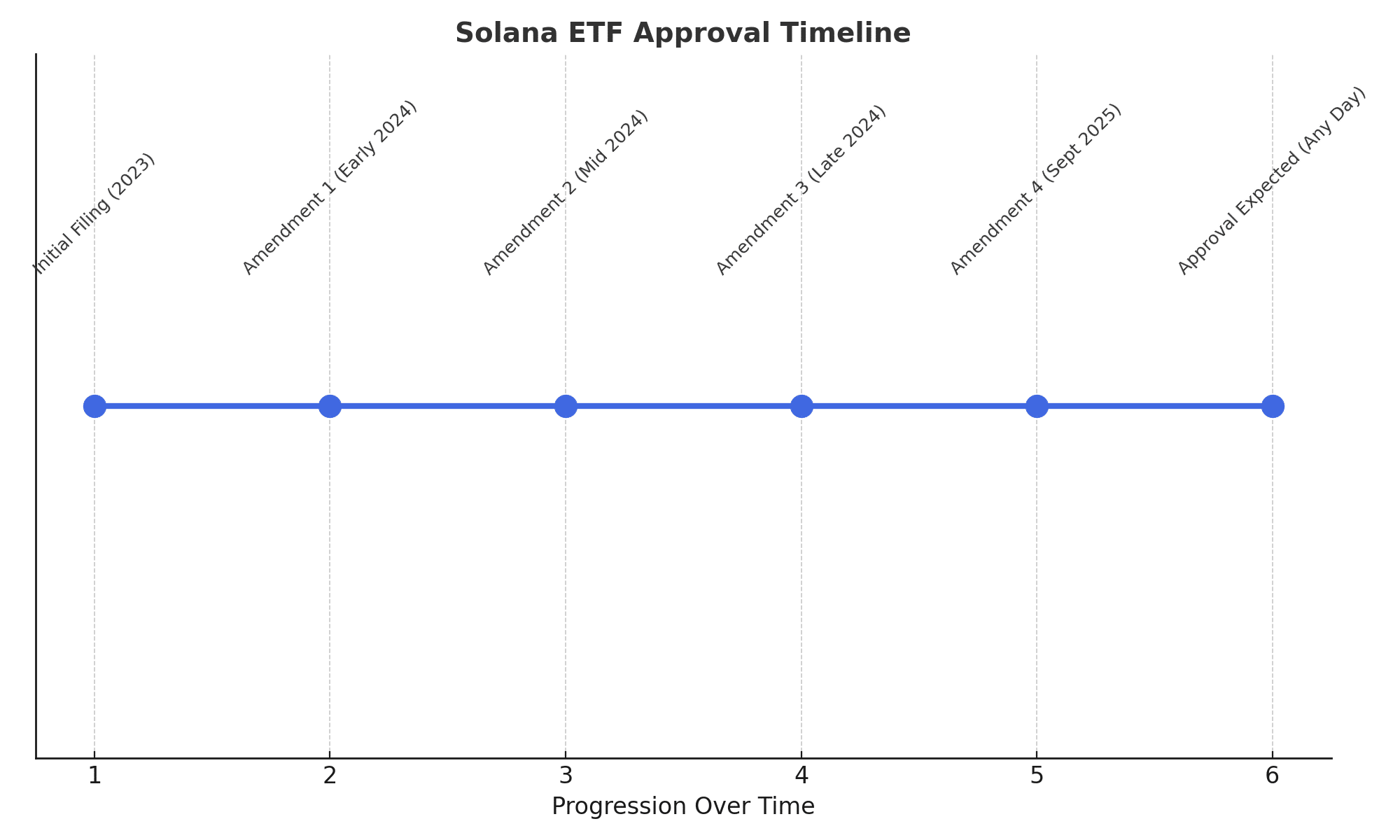
The buzz around the Solana ETF is part of a larger shift in sentiment. Issuers have already filed multiple amendments, an unusual but telling sign. Analysts see this as housekeeping — ensuring the documents align with the SEC’s expectations before the final nod.
Investors are treating it as a near-done deal. Open interest on derivatives platforms linked to Solana has climbed, and liquidity pools have grown as traders brace for what could be one of the biggest ETF launches since Ethereum.
If approved, a Solana ETF would not only legitimize the asset but also extend Solana’s reach into pension funds, endowments, and everyday brokerage accounts.
Still, caution lingers. A single delay in corporate finance review could nudge the timeline back. The SEC remains unpredictable, and even seasoned analysts admit that sudden political or market events can alter the mood.
Ripple Effect Beyond Solana
The excitement is not confined to one project. A Solana ETF approval would almost certainly influence other altcoin filings, including those tied to XRP, Cardano, and Litecoin. The SEC’s willingness to let Solana pass through the regulatory gate could set a precedent for broader diversification in the crypto ETF market.
As Balchunas noted: “Once Solana is through, the dominoes fall quickly. Investors are going to demand broader exposure, and issuers will race to meet that demand.” Such remarks underscore how one approval could shift the balance of capital allocation across the digital asset sector.
Summing Up
For now, the spotlight rests firmly on the Solana ETF. Its fate will signal not just the SEC’s comfort with altcoins but also the maturity of crypto’s integration into Wall Street. Approval would represent more than a checkbox; it would show regulators are ready to embrace a new tier of digital assets beyond Bitcoin and Ethereum.
Markets know the stakes. Should the Solana ETF launch in the coming weeks, it may redefine how institutions engage with blockchain projects. And as history has shown, once the door is open, it rarely closes again.
FAQs
Q1: What is a Solana ETF?
It is an exchange-traded fund that tracks the price of Solana (SOL), letting investors gain exposure through traditional brokerage accounts.
Q2: Why did analysts raise approval odds to 100%?
Regulatory reforms eliminated the old 19b-4 hurdles, leaving only S-1 filings. This accelerates the approval timeline and boosts confidence.
Q3: How soon could the Solana ETF be approved?
Analysts suggest approval could come “any day,” though internal SEC reviews may still add short delays.
Q4: How would this affect Solana’s price?
While no one can predict with certainty, ETF approvals historically bring increased liquidity and institutional inflows, often lifting prices.
Glossary
ETF (Exchange-Traded Fund): A financial product that tracks assets like stocks or crypto and trades on regulated exchanges.
S-1 Filing: A registration statement issuers file with the SEC to launch a new product.
19b-4 Filing: A form exchanges once used to request rule changes, now mostly redundant under generic listing standards.
Liquidity Pool: A collection of funds locked in smart contracts to support trading on decentralized platforms.
Generic Listing Standards: New SEC rules allowing certain ETFs to list automatically if they meet eligibility criteria.