













Former Binance CEO Changpeng “CZ” Zhao has reignited speculation around Binance Coin (BNB) after hinting at efforts to integrate the token into traditional banking systems.
A successful move would not only redefine the role of BNB beyond crypto-native utilities but also make it a serious competitor in the bigger TradFi sphere, which further impacts bullish BNB price prediction models.
Bank Integration Could Reshape BNB Price Prediction

Zhao proposed that banks would use BNB in many different ways: as a settlement option, to drive tokenised securities, as a client staking, or rails to central bank digital currencies (CBDCs).
The proposal reinforces the BNB narrative beyond being a utility token within the Binance ecosystem, and rather makes it infrastructure with the capacity to have real-world application, and redefine institutional BNB price prediction expectations. To be so integrated, however, institutions would simply need clear guarantees, namely, regulatory clarity, reliability, and stable value.
Banks need to adopt BNB. 👀
As a small community member, I am happy to help any bank integrate. https://t.co/BQUiBaOX75
— CZ 🔶 BNB (@cz_binance) September 13, 2025
Ethereum And Solana Maintain TradFi Edge
Skeptics point out that Ethereum and Solana have a stronger presence there, citing that they have a more entrenched presence with Wall Street in terms of ETFs and being held as corporate treasury assets, an aspect taken into consideration in any BNB price prediction than competitors.
This will never happen. They will adopt Solana, hence the SOL ETFs this month.
— SnacksFighter (@SnacksFighter) September 13, 2025
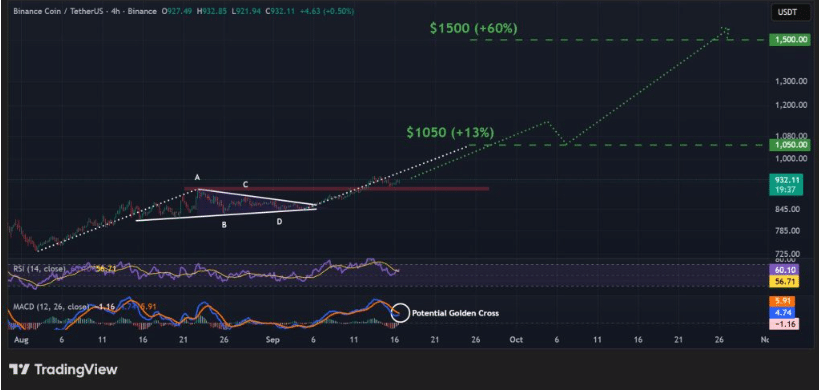
As the discussion of TradFi adoption persists, technical analysts are indicating a bullish outlook of BNB. The token has just probed in the support of around $905, which was previously the resistance point at the peak of a bullish pennant. The flip into support indicates validation of a consistent breakout and continuation of the August rally that is currently defining the short-term BNB price prediction in traders.
Also read: Solana vs BNB: U.S. Institutions Clash With Asian Capital in Market Battle
RSI Rebound Highlights Growing Buyer Strength
The momentum indicators are fueling up the perspective. The Relative Strength Index (RSI) has sharply recovered at the neutral 50 level to almost 60 which has been suggesting that buyer control is gaining strength. In the meantime, the MACD is on the verge of a golden cross on the 4-hour chart a formation commonly followed by the initial phases of a new uptrend.
Analysts believe that the technical framework can drive BNB to the all-time height of $1,050. More than that, macro catalysts might also be involved: anticipated U.S. interest rate reductions, starting as early as tomorrow, can trigger additional inflows into risk assets in another driver that is frequently considered in medium-term BNB price prediction exercises.
$12 trillion BlackRock expects the Federal Reserve to cut interest rates tomorrow. pic.twitter.com/YlVJgnBASA
— Bitcoin Junkies (@BitcoinJunkies) September 16, 2025
Also read: BNB Price Prediction as Bulls Face $662 Showdown: Is a Surge to $700 Next?
BNB Absent from ETFs and Treasuries
Should the rate reductions persist to a point of 75 basis points by the year-end BNB may very well extend its open by up to 60% with the next level targeting $1,500. More aggressive forecasts point to a trajectory of hitting $3,000 in case institutional adoption comes to fruition of banking integration pitch at CZ.
In the meantime, BNB is not a part of the primary TradFi content because it has no exposure to ETFs or corporate treasury purchases. However, the proposal of Zhao can be a precursor to change. Once banks switch to the BNB, the utility of the token and its future BNB price prediction might spread much further than its crypto-native background.
Conclusion
Based on the latest research, BNB’s trajectory hinges on both technical momentum and institutional adoption potential. While skeptics highlight Ethereum and Solana’s head start in TradFi, CZ’s banking integration proposal could reshape the narrative. If realized, it may propel BNB toward unprecedented price milestones and broader financial relevance.
Stay up to date with expert analysis and price predictions by visiting our crypto news platform.
Follow us on Twitter and LinkedIn, and join our Telegram channel to be instantly informed about breaking news!
Summary
Ex-Binance CEO Changpeng Zhao’s proposal to integrate BNB into banking systems has sparked renewed optimism for the token’s future. As critics point to Ethereum and Solana having greater TradFi, analysts point to BNB having better technicals, with a bullish price ceiling at $905 and the momentum to continue its rise. The targets are projected at $1,050 and $1,500 during the times of U.S. rate cuts, and the uptake of the institutions might result in BNB reaching as high as $3,000 and extending its application beyond the crypto-native use cases.
Glossary of Key Terms
Changpeng Zhao (CZ): Ex-CEO of Binance, influential crypto leader.
BNB (Binance Coin): Binance’s native token with multiple utility uses.
TradFi: Traditional finance systems like banks and treasuries.
Tokenised Securities: Real-world assets represented as blockchain tokens.
CBDCs: Central bank–issued digital currencies.
RSI: Indicator measuring market momentum and strength.
MACD: Tool tracking trend shifts in momentum.
Resistance/Support: Price levels where movement stalls or rebounds.
ETFs: Funds tracking assets, tradable on exchanges.
Basis Points (bps): 0.01% unit for interest rate changes.
FAQs on BNB Price Prediction
1. What is CZ’s proposal for BNB?
He suggested integrating BNB into banks for settlements, tokenised securities, staking, and CBDCs.
2. How does BNB compare to Ethereum and Solana?
Ethereum and Solana lead in TradFi with ETFs and treasuries, while BNB lags behind.
3. What are the BNB price predictions?
Targets are $1,050 and $1,500, with $3,000 possible if adoption grows.
4. Which indicators support BNB’s bullish outlook?
RSI is rebounding, and MACD nears a golden cross, both pointing to upside momentum.