


This article was first published on The Bit Journal.
Cardano price faced renewed pressure after a major derivatives milestone failed to spark confidence. Markets expected institutional access to lift sentiment, yet the early reaction exposed fragile demand beneath rising visibility across the crypto sector.
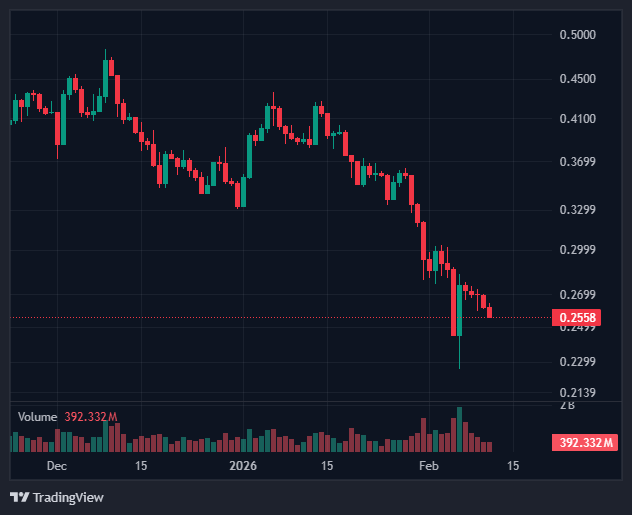
According to the source, CME Cardano futures launched on February 9, 2026, alongside contracts for other leading altcoins. The event expanded regulated exposure to derivatives trading, a step often viewed as bullish for long-term maturity. Still, the Cardano price hovered near $0.27 and quickly slipped almost three percent, signaling hesitation rather than strength.
Immediate Decline Reshapes Early Sentiment
Trading data showed the Cardano price falling from about $0.2720 to nearly $0.2608 during the rollout window. Such movement suggested traders used the news as an exit opportunity rather than a fresh entry point. Institutional infrastructure improved, but conviction failed to follow.
Updated market figures available here confirmed weak spot demand during the decline. Without steady buying pressure, visibility alone rarely sustains momentum. This imbalance defined the first reaction to CME Cardano futures and shaped short-term expectations.
BitMEX Surge Exposes Leverage Driven Behavior
Short-term speculation accelerated rapidly after the announcement. BitMEX ADA futures volume jumped more than 48,770 percent within hours. Despite this surge in leveraged activity, the Cardano price continued drifting lower instead of rallying.
Financial research on derivatives volatility shows leverage can amplify fear as quickly as optimism, as discussed here. The same pattern appeared following CME Cardano futures, where speculative positioning outweighed genuine accumulation and deepened downside pressure.
Falling Open Interest Confirms Bearish Control
Derivatives exposure provided further clarity. Open Interest declined from roughly $490 million to about $425 million while the Cardano price weakened. Falling price paired with falling exposure typically signals liquidation or retreat rather than new bullish positioning.
This behavior showed bulls failed to defend resistance levels. Sellers gained control even as CME Cardano futures increased institutional legitimacy. Market structure therefore contradicted the optimism usually tied to regulated listings in digital asset markets.
Whale Accumulation Diverges From Retail Caution
On-chain trends revealed large holders accumulated hundreds of millions of ADA from late 2025 into early 2026. This buying occurred while the Cardano price continued sliding, suggesting calculated patience from long-term investors rather than panic selling.
Retail sentiment, however, remained fragile. The contrast between whale confidence and public hesitation often appears during late-stage downtrends. Whether this divergence signals quiet accumulation or prolonged weakness remains uncertain after CME Cardano futures failed to trigger recovery.
Technical Signals Hint at Fragile Stabilization
Chart structure placed the Cardano price inside a major support band between $0.22 and $0.27. Momentum indicators suggested selling pressure was slowing. Relative Strength Index readings hovered near 32.59, close to oversold territory, while MACD trended toward a potential bullish crossover.
These signals implied stabilization rather than a confirmed reversal. Sustainable upside requires stronger demand and rising exposure. Until that shift appears, CME Cardano futures may influence volatility more than long-term direction.
Conclusion
The recent decline in Cardano price following the launch of CME Cardano futures highlights a simple market truth. Infrastructure can expand access, but confidence ultimately drives direction. Whale accumulation and technical support offer cautious optimism, yet bearish leverage trends remain dominant.
Future movement in Cardano price will depend on sustained spot demand and renewed participation across investor groups. Without that conviction, visibility alone cannot deliver recovery or restore long-term bullish momentum.
This article is for informational purposes only and does not constitute financial advice. Readers should conduct their own research before making investment decisions.
Glossary of Key Terms
Open Interest: Total active futures contracts reflecting trader exposure levels.
Support Zone: Price range where buying pressure historically slows and declines.
Relative Strength Index: Momentum indicator showing oversold or overbought conditions.
MACD: Trend indicator signaling shifts between bullish and bearish momentum.
FAQs About Cardano Price
Why did Cardano price fall after CME futures launched?
Leverage surged while real buying demand stayed weak, pushing price lower.
Do CME Cardano futures support long-term adoption?
They improve regulated access, but recovery still requires steady capital inflows.
Are whales signaling confidence in ADA?
Large-scale accumulation suggests patience from long-term investors.
What confirms a true Cardano price recovery?
Rising spot demand, increasing Open Interest, and stronger overall market sentiment.
Sources and References